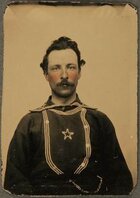
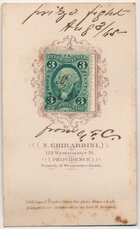
No, it's a tintype. It's very hard to date tintypes, other than the cheap images from the 1890's on. I generally do not buy them, but I needed a few examples for a interactive 19th century photo display I'm doing at a card show this summer. I thought this one would be a good conversation piece. As you say, CDVs are not terribly hard to date. 'No border' CDVs hung around a bit longer than 1862, but the later ones are easy to distinguish from the really old ones. I like that distinction you make between 'two thin lines' and 'one thin, one thicker...' I have attached an image of one of my favorite CDVs of the latter type - it is dated to 1865 on the back, has a revenue stamp and some boxing info. I guess it could be considered a very early boxing card, if you assume that the image is of the guy involved in the boxing match described on the back.
As far as Civil War photos go, I am only collecting ambrotypes. The Civil War was an amazing time for photography, as ambrotypes were fading out and cdv's and tintypes had just begun. Daguerreotypes are not nearly as common as the other three, but when you find them they are spectacular. In reading Civil War letters, you'll frequently hear references to "likeness", "image" or "ambrotype" - all meaning "photograph" - but not so many references to the actual word "photograph".
I only collect ambrotypes for one reason: I generally can't afford CW images that show weapons, so with my limited knowledge, non-weapon non-id'd soldier images in tintype or cdv format are usually a crapshoot as to whether or not they depict a CW soldier. On the other hand, if you find an ambrotype showing a soldier, it's almost always Civil War - you don't have to worry about figuring out if the uniform or weapons were from Indian Wars, etc. Daguerreotypes are a whole different ballgame - you have to figure out if the uniform is PRE-Civil War!






 Forum Host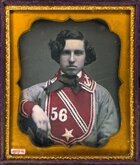


 Bringing the