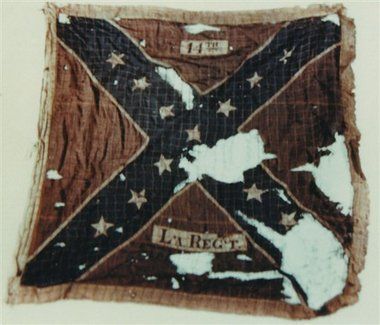
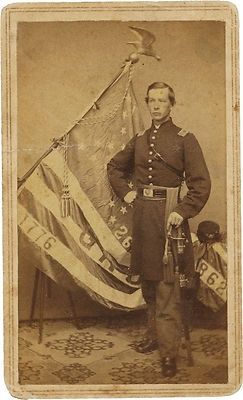
Battle Flags And Those Intrepid Men Who Bore Them

JPK Huson 1863

Brev. Brig. Gen'l
Joined
Feb 14, 2012
Location
Central Pennsylvania
" Color Guard ' , gee whiz, something in high school, marching onto the field at half-time, twirling a flag, always female, wearing what, short-shorts and glitter? I never knew or though much about them. " Color Guard ". Everyone knew what ' Color Guard ' meant, kids at school who practiced with the band, photo n the yearbook. I don't think I knew any in our high school- but it was a big school. I never knew what it meant- did they know?
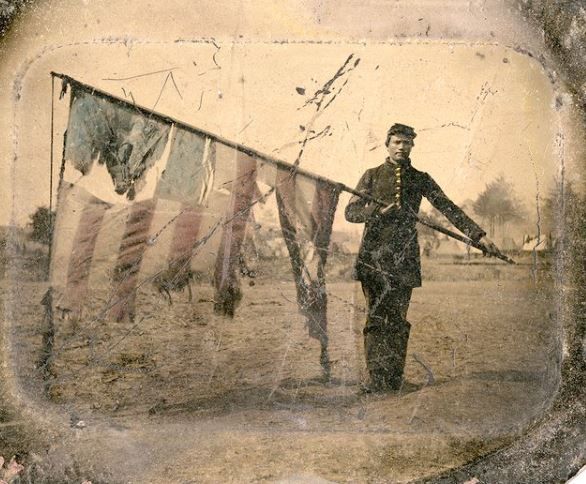
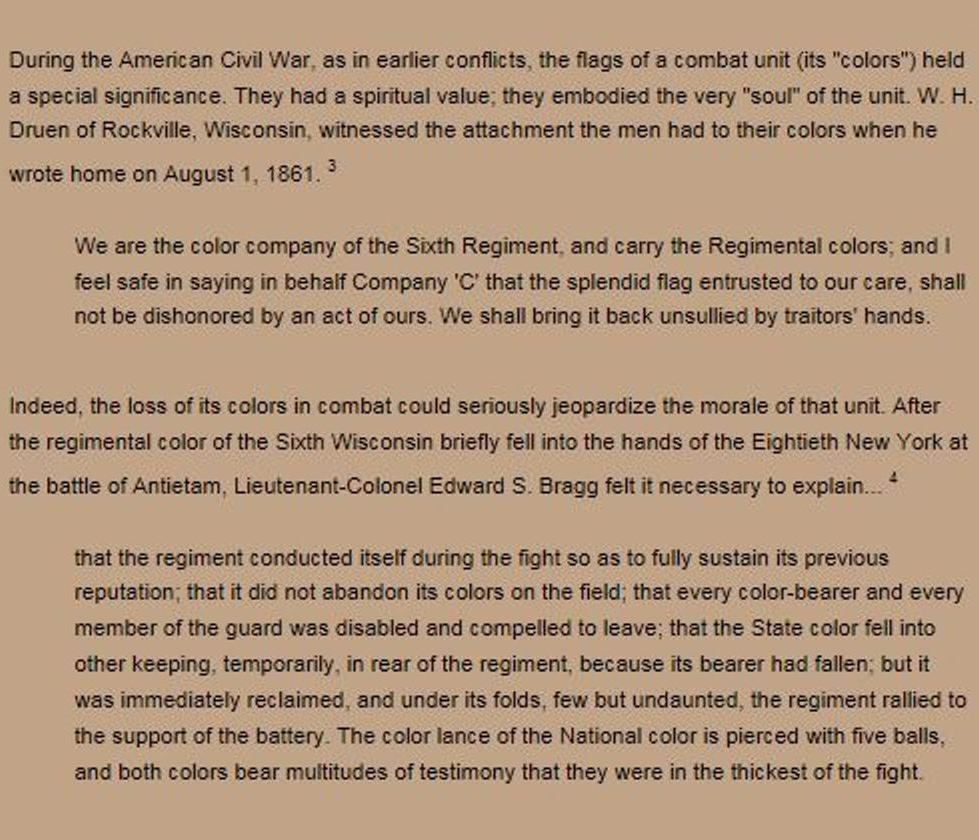
cb1.JPG


bf1.JPG


cb4.jpg

cb5.JPG


bf2.JPG

http://www.wisconsinbattleflags.com/background/

cb9.jpg

cb10.JPG


As an example of how hazardous was the career of the color bearer found a PA site listing all PA regiments and their flag bearers. It's awfully good albeit found it not fully accurate. While working on this thread had occasion to write and request a name be added. A battle report listed a color bearer not included in this master list.

http://www.pacivilwarflags.org/home/colorBearers.cfm

Decided to use the 11th PA Infantry as an example, or their color bearers. Copy/pasted the list, divided the dates to match battles and found a description of the 11th's actions in that battle. It illustrates how hazardous a duty these men undertook. There are more horrific examples spanning the war- it would be doing honor to the men to bring them here.


11th Infantry PA Volunteers


Sgt. Charles H. Foulke, Co. A 11/20/61-8/11/62

Sgt. Robert H.

Knox, Co. C severely wounded 8/30/62 Second Manassas

Sgt. Samuel S. Bierer, Co. C wounded 8/30/62

Lieut. Absalom Schall, Co. C wounded 8/30/62

Sgt. Samuel S. Bierer, Co. C took flag 8/30/62

** Missing, Sgt, Fightner, captured with the colors


While the engagement was in progress at Thoroughfare Gap, General King's division of M'Dowell's Corps was fighting Jackson at Groveton. Early on themorning of the 29th, Rickett's division took up the march for Bristoe station,arriving in the afternoon upon the field where Hooker, the day previous, haddefeated the enemy, and where the dead lay scattered over the ground as theyfell. Continuing the march, it passed Manassas Junction, and arriving on thefirst Bull Run battle-field, late at night, took position in line early on the following morning. At noon the brigade, with Captain Thompson's Pennsylvania battery, was sent to the right with orders from M'Dowell to pursue the enemy; but, soon encountering him firmly posted, the brigade was withdrawnand being temporarily attached to. General Tower's (2d) Brigade, was sent tothe left. With the Twelfth Massachusetts on the right, the Thirteenth on theleft, and the Eleventh Pennsylvania in centre, the brigade advanced to the attack.

The action soon became very warm, the Union lines being thrown into considerable confusion, and, in about an hour, all the troops of M'Dowell's Corps engaged at this point, were in retreat, In the heat of the action, Colonel Fletcher Webster, of the Twelfth Massachusetts, was killed, leaving Colonel Coulter in command of the brigade. General Tower, being soon after severely wounded, the command devolved on Colonel Coulter, who held his position until overpowered by the masses of the enemy hurled upon him when he was forced to yield; reinforcements arriving from Sigel's Corps, he renewed the engagement, but the weight and impetuosity of the enemy's attack was so overwhelming, that they soon melted before it.


Retiring to. the neighborhood of Cub Run, the fragments of these shattered brigades bivouacked for the night. On this hotly contested field, the Eleventh Regiment lost fifty-two killed, sixty-seven wounded, and seventy-five-taken prisoners; of the latter the greater portion were wounded. Lieutenant Colonel Thomas S. Martin was killed early in the action, and Major Henry A. Frink, after having his horse shot underhim, was severely wounded, and fell into the enemy's hands. Colonel Coulter's horse was also struck by a musket ball in the neck. Several color-bearers were shot down, but the State flag was saved. Sergeant Fightner, bearing the flag presented to the Regiment while in the three months' service by the Union ladies of Martinsburg, was wounded and fell with that flag. into the hands of the enemy.


Pvt. Daniel Mathews, Co. C wounded 9/17/62 Battle of Antietam

Pvt. William Welty, Co. C killed 9/17/62

Cpl. Frederick Welty, Co. C severely wounded 9/17/62

Lieut. Edward H. Gay, Co. F, twice wounded 9/17/ 62

Sgt. Henry Bitner, Co. E took flag 9/17/62

As soon as the two armies began to confront each other, Hooker was ordered to move on our extreme right, and flank and attack the enemy's left. The division broke camp at three o'clock on the afternoon of the 16th, crossedAntietam creek, moved towards Sharpsburg, and at dusk took position undera heavy artillery fire. During the night the men remained under arms, theEleventh resting in a corn field, the fire of the enemy's artillery being kept upthrough the early part, and a brisk musketry fire nearly the entire night.At daylight on the 17th, the brigade moved forward in line, with two companies of each Regiment deployed as skirmishers, Companies E and K skirmishingin front of the Eleventh. The enemy were soon encountered in a commandingposition, well covered. General Hartsuff, who had gone forward to examine theground, was severely wounded and taken from the field, early in the engagement. Upon his fall, the command of the brigade devolved upon Colonel Coulter, and that of the Eleventh Regiment upon Captain Cook, of Company F.

Moving steadily forward, the left was made to connect with Seymour's brigadeof the Pennsylvania Reserves, when the engagement became general. Theenemy were driven back, contesting every inch of ground with great firmness,until re-inforceed, when our line was compelled to retire, losing a part of theground already gained. A position was finally taken, and held by the brigade,until re-inforced by a part of General Sumner's Corps, when the enemy wereagain compelled to give way. At nine o'clock in the morning, the brigade wasrelieved, and retiring a short distance re-formed, and received a fresh supplyof ammunition.3 Going into action at about five o'clock in the morning, and retiring at nine, it was, during two hours of that time, subjected to a mostgalling and destructive fire.


Cpl. John V. Kuhns, Co. C thrice wounded 12/13/62 Battle of Fredericksburg

Pvt. Cyrus W. Chambers, Co. C killed 12/13/62

Cpl. John W. Thomas, Co. C severely wounded 12/13/62

Capt. Benjamin F. Haines, Co. B took flag 12/13/62


Cpl. John H. McKalip, Co. C wounded 7/1/63 Gettyburg

Pvt. Michael Kepler, Co. C 7/1/63-4/64

Cpl. Jacob J. Lehman, Co. D 4/64-killed 5/8/64

*Lieut. Samuel McCutchen, Co. F took flag 5/8/64

[unidentified] wounded 5/12/64

Cpl. William Mathews, Co. C 5/12/64-12/3/64

Sgt. Albert Carter, Co. A 12/3/64-5/28/65

Sgt. J.C. Scheurman, Co. A 5/28/65-7/1/65

*Sgt. John P. Shaeffer, Co. B 1/17-29/62, Martinsburg flag

Sgt. William Feightner, Co. I 1/29/62-wounded & captured 8/30/62, with Martinsburg flag

Cpl. Henry B. Temple, Co. K designating flag 7/8/62-?

Pvt. William H. West, Co.K designating flag bearer 8/30/62

cb6.jpg

cb7.JPG


cb8.jpg


cb11.jpg


cb12.jpg

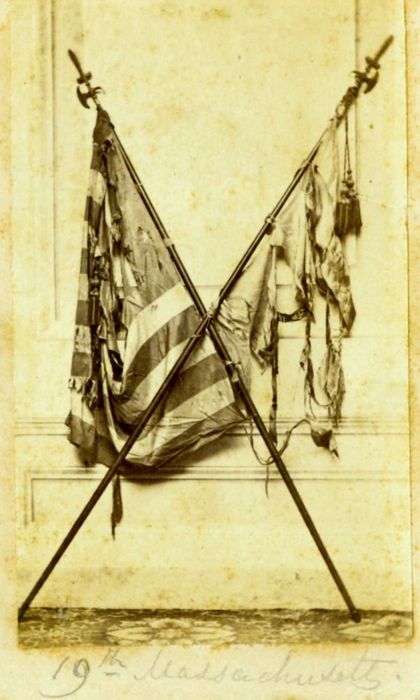
19th Massachusetts


cb13.jpg

cb14.JPG
 

Attachments

  • cb3.JPG
    cb3.JPG
    20.2 KB · Views: 241
Most of us can not fathom today the lengths soldiers would go to in honoring and protecting their regimental colors. It was expected by every man in the regiment that the soldiers carrying the colors would die if necessary to prevent their capture if they were in a tight spot. And this was expected by the Ladies back home as well. They often times made or presented colors to the early regiments and expected the men to take care of them. An example of this is the messages found written in pen on a couple of the stars by the ladies who made the 37th Iowa Volunteer Infantry's flag.

37th Iowa Flag 1_edited.jpg


37th Iowa Flag 2_edited.jpg
 
This is interesting….I've got one….but I guess it depends on what is defined as a 'color bearer'. During the battle of 'White Oak Swamp' (or 'Glendale', or 'Frasers farm', or 'Charles City Cross Roads', or '1st Cold Harbor'…..it gets silly sometimes doesn't it?….) 6/30/1862.

The initial color bearer of the 7th Pa. reserves was mortally wounded (Pvt. Adam Wray, Co. F)….and the flag was picked up and carried from the Field by Capt. Robert Henderson (who subsequently was awarded the Medal of Honor for this action, and promoted on the field to Lt. Col. by General Truman Seymour)….Capt. Henderson was also seriously wounded while doing this.

but….does he count as a 'color bearer' for this action?
 
I wouldn't call it crazy or a suicide mission to be a color bearer in a major battle back then, but its certainly not far off that. I know it was necessary to have the colors and was a morale booster. very tough duty indeed. I wonder what the color bearer casualties percentage would be compared to the regular infantry soldier of the civil war.
 
I watched an old documentary about Gettysburg a couple of weeks ago, in which one yankee unit's loss of color bearers was very well documented. I can't remember the specific figure now, but in one charge they might have lost five or more color bearers to serious wounds or outright death. It might have even been as high as seven or eight men. Regardless of the number, it was pretty appalling.
 
The following is a summary of the Color Bearers for the 5th Alabama Infantry Regiment. They served in the Army of Northern Virginia throughout the war. After the Battle of 2nd Cold Harbor, June 30, 1864, they went to the Shenandoah Valley with General Early. By December 1864, they were in the trenches at Petersburg and would ultimately surrender at Appomattox Court House. Of these 15 men, 7 were killed carrying the Colors into battle. (2 men were transferred before seeing battle - so 7 out of 13 men that saw battle were killed, 1 was permanently disabled.)

5th Alabama Infantry Regiment Color Bearers

Horace B. Chilton of Old Company G- New Company F, was appointed Color Corporal on May 20, 1861. He was promoted to Color Sergeant after the Battle of Seven Pines on May 31, 1862. He was killed at the Battle of Gaines' Mill (1st Cold Harbor) on June 27, 1862, while carrying the flag into battle.

Henry Clay Force of Old Company H, was appointed Color Sergeant on June 15, 1861. He served until April 24, 1862, at which time the regiment was reorganized and he was discharged.

A. A. Alston of Old Company A- New Company I, was appointed Regimental Color Corporal on June 15, 1861. He was discharged from the regiment on August 22, 1862, because he had been appointed Lieutenant of Artillery by President Jefferson Davis.

Augustus H. Moore of Old Company I- New Co. D. Dr. Augustus H. Moore was the son of Dr. John H. Moore. He was listed as Color-Corporal in July 1861. He was appointed Color Sergeant after the reorganization of the regiment in April of 1862. Augustus Moore was killed at Seven Pines on May 31, 1862. The following appeared in the Richmond Daily Dispatch on June 5, 1862: "The colors were borne by Color-Sergt. A. H. Moore, who fell dead, shot in the breast and all dabbled in his life's blood."[2] He was subsequently interred in Hollywood Cemetery, Richmond, Virginia. His obituary notice which appeared in "The Beacon" (an Alabama newspaper), read as follows: "Tears will flow that this brave young hero of but 26 years, whose heart was full of benevolence and affection, is another martyr to this unholy war; yet though the genius of sorrow broods over his grave, the pen of the historian will weave a laurel wreath for his brow, for from the tombs of such martyrs a nation will be generated. There is memory of his noble soul which will drive the blood in boiling currents through the veins of his surviving companions, encouraging them not to falter - not to fear! – And the flag which was bathed in the blood of this gallant soldier, will be a symbol of new life, which must fan the flame of war, until that flag will cease to be a figure of speech, but an empowered and recognized reality."

William L. Kennedy of Old Company I- New Company D was appointed Color Corporal in August 1861. He was appointed Color Sergeant after the Battle of Gaines Mill (1st Cold Harbor) on June 27, 1862. He was wounded and disabled by a falling tree at the Battle of Malvern Hill on July 1, 1862.[3] He appears on the Regimental Return for the month of October 1862, listed as "Wounded furloughed Greensboro". He was wounded and captured at the Third Battle of Winchester, Virginia, on September 19, 1864, and was sent to Harpers Ferry arriving on September 26, 1864. He was forwarded to Point Lookout, Maryland. He was exchanged on October 30, 1864. On November 15, 1864, he was received at Venus Point, Savannah River, from John E. Mulford, Lt. Col. & Asst. Agt. For Exchange, along with 3022 other paroled Confederate Prisoners of War. He subsequently returned to the regiment and was captured at Amelia Court House on April 5, 1865.

Henry Clay Estell of Old Company E- New Company B, was appointed Color Corporal on August 1, 1861. He was wounded at the Battle of Seven Pines on May 31, 1862.[4] He was wounded again during the Seven Days Battles (At Gaines' Mill or Malvern Hill.) By May of 1862, he had been promoted to Color Sergeant. He was killed at the Battle of Chancellorsville on May 3, 1863, when the regiment and the 26th Alabama Infantry Regiment, were charging Fairview hill which had 26 pieces of artillery planted upon it behind breastworks, and supported by three lines of infantry.[5]

Archibald L. R. Thompson was enlisted at Montgomery, Alabama, on May 16, 1861, as a Private in Company E of the 6th Alabama Infantry Regiment. He was an original member of the Hayneville Guard. Transferred to Company K of the 5th Alabama Infantry Regiment on April 27, 1862.[6] By early 1863, he was the Color Sergeant of the regiment. He was wounded at the Battle of Chancellorsville on May 3, 1863, while charging the enemy on Fairview. He appears on a Hospital Muster Roll of sick and wounded in General Hospital No. 12, at Richmond, Virginia, on May 18, 1863. The hospital report states that he was "wounded by grape shot through the fleshy part of the back. Admitted May 8. Wounds healthy & Gen health good. Transferred to Ala Hospital (Chimborazo Hospital No. 4, Richmond, Virginia) May 26." His age was 23 years and by occupation a farmer. He was then transferred to C. S. A. General Hospital, Danville, Virginia, on June 10, 1863. He returned to duty on September 29, 1863. He appears on the Company Muster Rolls for the period December 31, 1863, to April 1, 1864, listed as "Present". He was wounded again near the North Anna River on May 25, 1864, receiving a gunshot wound through the left thigh. He appears on a Receipt Roll for clothing issued to soldiers in Jackson Hospital at Richmond, Virginia, on June 18, 1864. He appears on the Company Muster Rolls for September and October 1864 listed as "Absent – Hosp. Lynchburg Va." He was subsequently furloughed home for 30 days. On April 3, 1865, he was captured at Appomattox. He arrived at City Point, Virginia, on April 13, 1865. His name appears as signature to an Oath of Allegiance to the United States, subscribed and sworn to at Point Lookout, Maryland, on June 21, 1865. He was described as having a dark complexion, dark brown hair, hazel eyes, and being 5'8 ¾" tall. His place of residence is listed as Lowndes County, Alabama. His name appears on the Camp Lomax 151 UCV Monument in Montgomery, Alabama.[7]

Andrew J. Melton of New Company E, was Color Corporal by June 1862. He was killed at the Battle of Malvern Hill on July 1, 1862. "Andrew Melton was in front with our battle flag, cheering the men, when a ball passed through his forehead, and he fell dead, with the shout on his lips, "5th Alabama rally to your colors!" A braver soldier never bled. Andrew was a Color Corporal, and took the flag when its bearer, Color Sergeant William Kennedy, of Greensboro, was disabled by a falling tree, earlier in the afternoon. Near him fell the Color Sergeant of the 3rd Alabama, shot dead,"[8]

Obediah Johns of New Company A was born in Harris, Georgia in about 1841. He was enlisted on March 1, 1862, at Clayton, Alabama, by Lieutenant George E. Macon. He was appointed Color Corporal in 1862. He was wounded and taken prisoner at the Battle of South Mountain on September 14, 1862. His name appears on a Parole of Prisoners of War on October 3, 1862, at which time he was sent to Fort McHenry, Maryland. On October 25, 1862, he was delivered to Aiken's Landing. He appears on a Register of General Hospital No. 9, Richmond, Virginia, on October 29, 1862, and was subsequently transferred to General Hospital 25, where he was admitted that same day. November 7, 1862, he received a forty day furlough. Finally, on April 20, 1863, he was discharged. His wounds had "impaired the usefulness of both arms". At the time of discharge, he is described as being twenty-one years of age, five feet, eight inches tall, with a fair complexion, grey eyes, dark hair, and by occupation a farmer.

Joshua T. Smith of New Company G was appointed Color Corporal in 1862. He was the Color Bearer for the regiment during the Battle of Sharpsburg on September 17, 1862. He was cited for gallantry in battle in General D. H. Hill's report of the Maryland Campaign. He was one of the Color Bearers killed at the Battle of Chancellorsville on May 3, 1863.

George W. Nutting of New Company D, was one of the Color Bearers at the Battle of Chancellorsville. He was wounded in the arm and taken prisoner at that battle on May 3, 1863, when the regiment and the 26th Alabama Infantry Regiment, were charging Fairview hill which had 26 pieces of artillery planted upon it behind breastworks, and supported by three lines of infantry. He was paroled two weeks later only to be killed carrying the Colors during a charge at the Battle of Gettysburg on July 1, 1863.

Oscar Alfonza Williams of New Company K had been appointed a Color Bearer in 1863. He was present at the Battle of 1st Cold Harbor, June 27, 1862, and Malvern Hill, July 1, 1862, where he was wounded in the head. He was a Color Bearer at the Battle of Gettysburg. He was wounded three times in 1864, the last time he was wounded in the knee and disabled at the Battle of Winchester on September 19, 1864.[10] He died in November 1911 and was interred in Mountain Creek, Alabama.[11]

Basil M. Hanks of New Company H, was appointed Color Sergeant a few weeks after the Battle of Gettysburg. was wounded at the Battle of Cool Springs on July 18, 1864. He was promoted to Ensign of the Regiment on October 27, 1864. He served as such until the surrender at Appomattox Court House on April 9, 1865.

George Washington Hannah of New Company B, was appointed Color Corporal some time after the Battle of Gettysburg. He was mortally wounded at the Battle of 3rd Winchester on September 19, 1864, and died on September 26, 1864. He was interred in Stonewall Cemetery, Winchester, Virginia.

John Calvin McDiarmid of New Company D, was born on October 30, 1836. He became a doctor. He was appointed Color Corporal sometime after the Battle of Gettysburg. He was wounded at the Battle of Cedar Creek, October 19, 1864. On February 16, 1865, he was detailed to some road work near Petersburg, Virginia.[13] He died on October 23, 1900. He was buried at Hatchett Creek, Clay County, Alabama.[14]


[2]Richmond Daily Dispatch – June 5, 1862

[3] "The Beacon", August 8, 1862, Letter of J. J. Hutchinson dated July 14, 1862


[5] Clarke County Journal- May 21, 1863. http://ftp.rootsweb.com/pub/usgenweb/al/clarke/military/ghillgurd.txt

Submitted by Jackie Feldman [email protected]

[6]Civil War Journal of William Streety Rinaldi – Edited by James D. Allen, Missouri City, Texas. [email protected]

[7]http//groups.msn.com/autaugaatwar/membernamessz.msnw

[8] "The Beacon", August 8, 1862, Letter of J. J. Hutchinson dated July 14, 1862

[10]Alabama Confederate Pension Application.

[11]Montgomery Advertiser, November 8, 1911


[13]Diary of Samuel Pickens
 
Last edited:
In the Union army, an infantry color guard normally consisted of a sergeant and three corporals. If the regiment had both national and regimental colors, there would be two sergeants and six corporals. When on duty, they were supposed to have bayonets fixed at all times (except for the man actually carrying the flag, of course). In some regiments, the colormen were armed with short, 3-band Enfields, mounted with long saber-bayonets (they apparently took some ribbing about this). In camp, with the colors at the commander's tent, one of the color guard, bayonet fixed, was supposed to be on guard at all times. In battle, the entire color guard was supposed to defend the colors first and foremost.

jno
 
The following recollection of color guards at Pickett's Mill is by CSA Private William Oliphants, 6th Texas Infantry:

"There occurred at the Battle of Pickett's Mill an incident which impressed me greatly. In the last charge an Indiana regiment came up in front of my regiment in splendid style. Although we poured into them a deadly fire they closed the gaps in their line and pressed steadily forward, until they were almost upon us, but they could not stand our terrible fire. When but a few feet from the points of our bayonets they seemed to wither away, and those not killed or wounded were forced to fall back. The color bearer of the regiment fell with his flag, instantly another seized the flag and held it aloft only to fall dead, again and again it was raised only to fall again, until six brave men yielded up their lives in trying to keep it flying. The sixth man fell with the flag in front of our company and only about 12 feet from us. There it lay, a prize within our grasp. I could have reached it with a single bound but thought as it was already ours I would wait until their line had been fully driven back before picking it up. When that Indiana regiment broke and fell back, leaving the flag on the ground at our feet one of the Federals turned and seeing it was being left behind threw down his gun, came back and picked it up. He straightened himself to his full height, gritted his teeth and flapped his flag in our faces. Instantly a half-dozen rifles were leveled on him and in another moment he too would have fallen pierced with bullets, but just then one of the boys cried out, 'don't shoot him, he's too brave.' We lowered our rifles and gave him a cheer as he carried his flag safely away."
 
These are excellent replies, thanks very much! Wish I knew enough to comment a lot without looking up more information; no need at CWT. Both Blue and Gray these men - unbelievable stories. I've found myself sometimes skimming because it's such horrific reading. How they found the ' stuff ' you just cannot imagine.

All the Gettysburg histories, Sears, all of them faithfully have their Pickett's charge accounts. If anyone has the regiments who made it within musketry range ( not that most were not decimated ) with such horrific losses in Color Bearers, those would be great here.

Not to single out any actions through those years. The Battle of Fairfield not many miles away ; Company H, my grgrgrandfather Trooper George Knarr's company. Have always wondered if he witnessed Platt's rescue. Yes, soldiers taking up their regimental flags were Color Bearers. Instant targets, deliberate ones for the good of their fellow soldiers. North and South how many times was this repeated between 1861 and 1865?

Eyewitness Account of 6th U.S. Cavalry Flag Rescue

George C. Platt called to his commander to rescue the flag, and charged the mass of Confederates who had partly succeeded in taking it. He was followed by James McDowell and half a dozen others. McDowell was cut down and fell in the road and the man who cut him down, lowering his sword to a front cut rushed at Platt. Platt went for him with a carte point and dumped him in the road beside McDowell. Platt then rushed into the melee, seized the flag, and got away with it. Our men in the meantime having opened fire on the Confederates and thrown them into confusion. In the encounter the flag was broken from the top of the staff and was taken off by Platt, and he has it now as a memento of July 3, 1863. Of the squad that followed Platt in rescuing the colors, all went down killed or wounded and he himself was badly cut.

Companion Platt was also wounded at Williamsburg and Malvern Hill. He was born in Ireland February 17, 1842 and enlisted in H-troop 6th U.S. Cavalry August 5, 1861. He served until nearly the close of the war and participated in nearly fifty battles and skirmishes. Companion Platt is married and has quite a large family of children. His medal will be inherited by his daughter Mrs. Lydia Griffin.


*** There were many Color Bearers deserving this distinction, seems to me. Platt and others maybe held it for all of them.

Medal of Honor Citation
RANK AND ORGANIZATION: Private, Troop "H", 6th United States Cavalry.
PLACE AND DATE: Fairfield, Pennsylvania, 3 July 1863.
ENTERED SERVICE AT: 6 Aug 1861, Philadelphia, Pennsylvania.
BIRTH: 17 Feb 1842, Londonderry, Ireland.
DATE OF ISSUE: 12 July 1895.
CITATION: Seized the regimental flag upon the death of the standard bearer in a hand-to-hand fight and prevented it from falling into the hands of the enemy.

 
The 25th Mass. went in to the battle of Cold Harbor on June 3, 1864, with a total of 313 officers and men. The next morning, they had less than 100 men present and fit for duty. It was the one, depleted regiment facing six rebel regiments, with artillery support. The charge they made that day was beyond hopeless. Confederate Col. P. D. Bowles described the brief fight as he witnessed it:

"On looking over the works I discovered what I supposed to be one regiment, with a single flag, and an officer in front with sword raised high in the air, calling on his men to charge. I ordered my command to place their guns on the works and wait for orders. When the advancing line reached within seventy yards I ordered my line to fire, when the whole of the Federal regiment fell to the ground save one man.

"The heroic regiment that made this gallant charge was the Twenty-fifth Massachusetts, which was the only regiment that obeyed orders to advance. This we learned from the twenty odd officers and men who fell down among the dead and wounded at the first fire. The balance of the brigade had refused to go forward, and not since the charge of the three hundred at Balaklava has a more heroic act been performed." (Phil. Weekly Times, 3
1 Jan. 1885)

C. Waldo Denny, in Wearing the Blue in the 25th Mass. Vols. described the fate of the Regimental (state) colors, and of its color guard:

"Sergeant Ball, Company F, of Fitchburg, carried the State colors, a blue silk flag with the State arms on one side. It was presented by ladies in Worcester. While carrying this color, the Sergeant fell wounded and Corporal John E. Lewis of Company K, who was one of the color guard, caught the flag as it fell with the Sergeant. The lines were broken — the flying iron crushed bones like glass, and men and officers seemed to be staggered, when the Corporal, bearing the colors aloft, ran ahead, shouting, "Come on, boys!" He was followed by many of the regiment who were upon that part of the line. A number fell, killed or wounded, and Johnny Lewis stood alone far ahead of his comrades. His daring left him without support. In such a storm of bullets no man could live. Men saw him stagger. He took the staff from the socket and planted it in the ground, as if determined that if he fell, the colors of the Twenty-fifth should not fall with him. Tis but for a moment. He reeled to and fro as if tenacious of life; he looked toward the enemy; he looked up, as if imploring God to receive his spirit, and, clutching the colors in his dying throe, fell to the earth enshrouded in the flag he loved and died to save! Upon that banner his manly form reposed sweet in death, while its silken folds were stained with his gallant blood. The flag was considerably in advance of our line, but the brave man to save it was found in David Casey of Company C, who rushed forward, and seizing the standard from the grasp of his dead comrade of Company K, bore it safely to the line still held by the regiment and brigade. There were no funeral honors for Johnny Lewis or his comrade brave men who fell that day!" Sgt David P. Casey was awarded a Medal of Honor for rescuing the flag. The medal is still in the possession of his descendants in Northbridge, Mass.

Another view of the incident from the Confederate side, this time by Col. William Oates of the 15th Alabama, describes Casey as calmly taking up the state flag, looking around, and finding that he was far in advance of his comrades, alone, with shot and shell flying around him. With the Confederates withholding fire, calling out to him to take cover (they didn't want to kill so brave a man), he rolled the color around its staff, put it over his shoulder, and walked back to the Federal lines. This last account may have been a bit of exaggeration on Oates' part -- a good story pleasing to both sides. But, it's a wonderful touch.
 
Last edited:
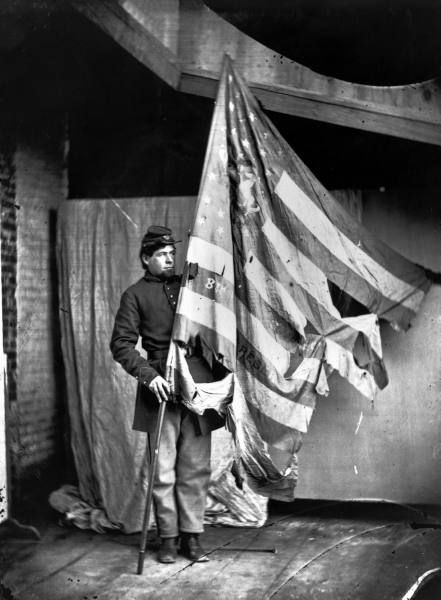
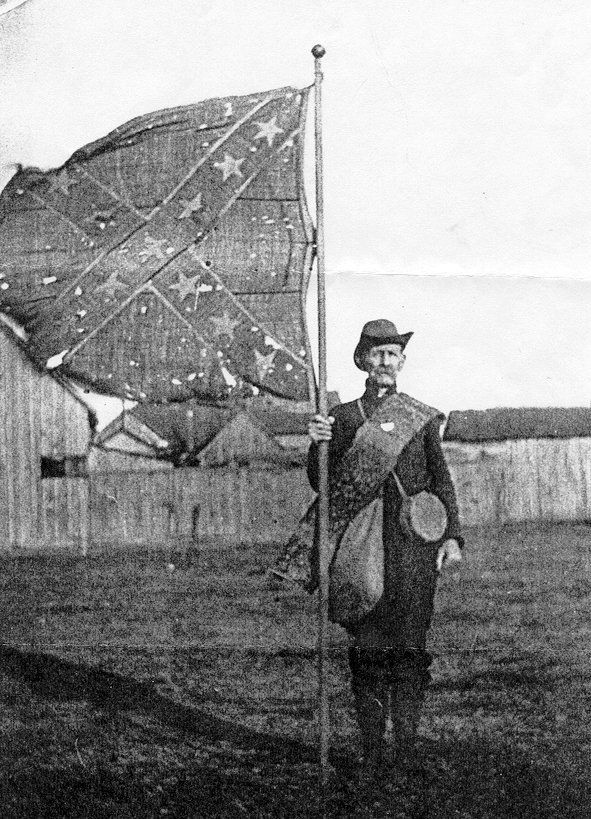
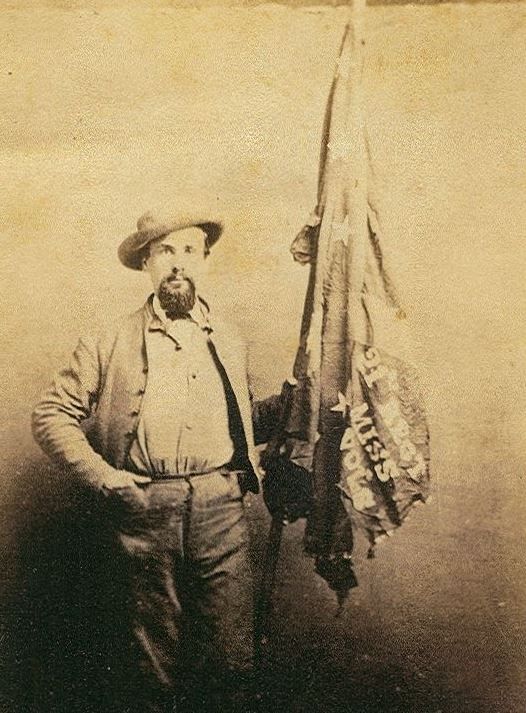
The last photo in the OP is a post-war image of Pvt. Charles P. Matthews holding the colors of the 9th Texas Infantry, taken in the 1920s. He smuggled it out of the surrender at Meridian, MS and brought it back home with him. The 9th Texas mainly served in Ector's Texas Brigade in the Army of Tennessee throughout the war. The flag, however, was a square Richmond Depot 4th Bunting Issue (uncommon in the AoT), the 9th Texas' Col. William Hugh Young bringing a batch back to the brigade following a trip to Richmond in early 1864. It was used from the beginning of the Atlanta Campaign until their surrender at Meridian in May 1865. It was carried throughout many battles, including Kennesaw Mountain, Allatoona Pass, Nashville, and the Siege of Spanish Fort in the Mobile Campaign.

There's more info and photos here: https://davidrreynolds.org/flag_of_the_9th_texas_infantry.php

cb13-jpg.jpg
 
I remember watching something online about a particular battle where a lone Yankee color bearer came marching up to the Confederate line, noticed he was all alone, did an about face and marched back to his lines. Maybe he wasn't a color bearer . . . does anyone else recall that?
 
I remember watching something online about a particular battle where a lone Yankee color bearer came marching up to the Confederate line, noticed he was all alone, did an about face and marched back to his lines. Maybe he wasn't a color bearer . . . does anyone else recall that?
There was a similar incident at First Bull Run, where the Confederates cheered a brave lone color bearer, and held their fire when he finally turned back.
 

Learn About Us
About CivilWarTalk
Contact the Webmaster
Meet the Staff
Link to CivilWarTalk
Join Our Community
Register
Browse Forums
View Today's Discussions
Search the Forum
Get Help
FAQ
Student Guide
Forum Rules & Etiquette
Copyright / DMCA

     Contact Us CivilwarTalk on Facebook CivilWarTalk on YouTube CivilWarTalk on Twitter RSS Feed

Bringing the American Civil War and More to Life.
© 1999 - , CIVILWARTALK, LLC - Site Version 10.0

SlaveryTalk.com - SecessionTalk.com - CivilWarTalk.com - ReconstructionTalk.com
Back
Top