
- Joined
- Sep 10, 2013
- Location
- Mustered Out
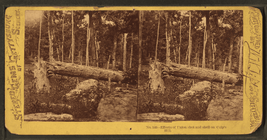
Pictured above is a William H. Tipton view of a tree that was battle damaged during the Battle of Gettysburg and apparently succumbed to its injuries some time later. This view was most likely taken in the 1870s-1880s or even 1890s era. We know this because William Tipton did not really start photographing the battlefield on his own until the latter part of the 19th century. Mr. Tipton was a 12 year old apprentice to the Tyson Brothers at the time of the battle according to William Frassanito's Book Gettysburg: A Journey In Time. The Tyson Brothers who actually lived/worked in Gettysburg were a photographic company that had one of the biggest events in military history literally land in their front yard. Despite their obvious advantage of being able to photograph the event and surroundings their work fell short on many levels. Primarily the Tyson Brothers concentrated on photographing buildings and the effects of the battle on the surrounding nature. Sometime in the 1870s William H. Tipton purchased the photographic studio from his former employers and continued the work. His work captures the effect of the changing face of the battlefield 20 to 40 years after the battle.
Needless to say many of us are fascinated by the idea of today visiting the Gettysburg battlefield or any battlefield really and contemplating the possibility that one of the trees standing before us may have "witnessed" the battle. And soon there after thinking that quite likely these witness trees may have a piece of that history locked within their rings in the form of a minnie ball, canister ball or shell fragment. The possibility of a piece of the Civil War moment could even have been pulled into the tree's center when the roots continued to grow through the ground and pulled other items to it. These aren't random possibilities but realities that we had confirmed when sadly these witness trees have succumbed to time or man's need to cut them down.
My point with this post is to show the effect of the battle years after it ended maybe even decades later that the trees were still dying or their life spans were cut short by the battle. Which points out why there is a limited amount of witness trees that were truly there during the battle. As a point of interest some friends and I tried an experiment to see how many minnie balls it took to cut a modern 4" x 4" in half shooting it with our Springfields and Enfield rifled muskets. Now granted we were trying to hit the wood and at approximately the same place. Despite that I was surprised that it took only three to four direct hits to sever the wood.


 Bringing the