Barataria

That plan is quite interesting, Neil. It certainly differs in some regards from both the Lithograph and the model. I think, as Mark said, we have several very different interpretations going on here!
 
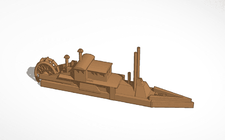
Ok. Here's something I put together yesterday, based upon the lithograph and the model shared by Neil, along with the various sets of measurements. I've since put a roof on that forward pilot house structure, and thickened a couple of pieces, but the general concept is there.

I don't know if the rear "door sized" openings depicted in the lithograph and the paper model were intended to be doors, or whether they actually represent the open passageway between the casemate and the wheel in the rear. So, I compromised. The fore passage is open; the aft passage is represented more along the lines of a doorway sized opening, rather than a true "completely open tunnel," in 3d terms.

Nevermind the extra ridges here and there, incidentally. A product of the 3d sculpting process: they'd be invisible if there was a skin attached, and they won't come out in an actual 3D print. More artifacts of the basic software I'm still using.
 

Attachments

  • barataria.png
    barataria.png
    28.1 KB · Views: 209
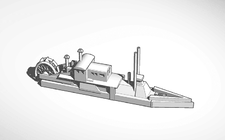
Here's the slightly improved version. As we have no idea what the ship was painted in, the white and brown shades were merely chosen to make the model easier to look at. When printed, of course, they could be printed in any color, and even in multiple colors if someone was really anxious to do so (though that costs a fair penny, and in my opinion, doesn't get a very durable model in the end as a result.) Most people who print these would, of course, prime and paint them.
 

Attachments

  • barataria.png
    barataria.png
    26.1 KB · Views: 219
:: pondering :: I'm wondering what the original, civilian appearance of the vessel was. Way's Packet Directory gives only the information cited earlier in the thread, so that's not much help. ORN II:1 has no useful data on configuration. Silverstone notes an entry in the Lytle list (Andy?).
 
When I first saw the lithograph my impression was that she was stationary ,maybe stuck on a snag ,part of the fallen tree by her bow, or in the shallows, there is no sign of movement in the water at all, maybe they are throwing the foiward gun overboard to lighten the bow.
 
Just out of curiosity, why would anyone, Confederate or Union name a ship for a pirate lair? Is there any rhyme or reason for the naming of such vessels, like battleships being named after states, cruisers after cities, that sort of thing?
 
In this case, it was the original/civilian name for the boat, which was kept by the Confederates when they made it a gunboat; and when the U.S. Navy captures a vessel, the name is often (though not always) kept.

(There had been a general principle that ships of the line were named for states, frigates were named for rivers, and sloops and smaller vessels named for important men or battles, but with the onslaught of new ship types around that time period the system was breaking down. Not to mention that this "system" was inconsistently applied anyway... basically, ships were named at the pleasure of the Secretary of the Navy.)
 
When I first saw the lithograph my impression was that she was stationary ,maybe stuck on a snag ,part of the fallen tree by her bow, or in the shallows, there is no sign of movement in the water at all, maybe they are throwing the foiward gun overboard to lighten the bow.

It looked to me as if she'd hit something hard and her forward gun was dismounted, thrown over the gunwales. Could be completely wrong in this regard!

Just out of curiosity, why would anyone, Confederate or Union name a ship for a pirate lair? Is there any rhyme or reason for the naming of such vessels, like battleships being named after states, cruisers after cities, that sort of thing?

I may be able to shed some light on this. "Barataria" is the fictional region of Spain from which Don Quixote was said to have come. The region in Louisiana was named for the fictional location during one of the periods in which Spain controlled the colony of Louisiana. Barataria was not just a pirate lair: it's most famous because Laffite used it as such, but he was relatively late on the scene. After the ship was taken into US Army service, she kept the name, but apparently, when the Navy took her into service, the name was spelled in the original Spanish form "Barrataria," which is why she appears under both names.

This misnomer is not unheard of. USS St. Louis was really only St. Louis until she was taken into USN service, at which point she was rechristened "Baron De Kalb," but the name "St. Louis" continued to be applied to her. USS "Pittsburg" was really commissioned with that name, and it was never corrected, nor was the spelling of USS "Camanche". One of my favorite excamples (primarily because she's such an interesting little ship) is the vessel we often erroneously call "Naugatuck." This was a name she bore as a civilian ship before she was purchased and extensively converted for use as a test bed for proposed features of Steven's Battery. When she was taken into USRCS service, the vessel was properly known as "EA Stevens," but when the Revenue Cutter Service attached her to the Navy, the Navy entered her into the logbooks as "Naugatuck." Even though she continued to officially carry the name "EA Stevens," she is often referred to "Naugatuck" in official correspondence, and appears so in many discussions, sources, etc. to this day.
 
Last edited:
I don't know if the rear "door sized" openings depicted in the lithograph and the paper model were intended to be doors, or whether they actually represent the open passageway between the casemate and the wheel in the rear.
You can see in the lithograph there is a sliding door on rollers (or what looks like rollers) it is partially opened,i.e., rolled forward, and the howitzer is visible.
 
Been awhile but I got my model completed. Finding information about this ship is a pain. Thank you all for your posts!

View attachment 410799

View attachment 410800

View attachment 410801

View attachment 410802
Nice model. Her plating was 1.25 inch left over material originally intended to be part of a three-layer laminated ironing on the CSS Mississippi. The information is from a letter written by Gen. Butler in an effort to get the former owner of the vessel paid. This is the reason that her conversion seemed so cheap. There were apparently two invoices for labor and material used for the conversion. One for $800 and one for $1500. The latter was the amount put out by the Navy. The previous by the US Army when they used her as a work boat at New Orleans under the nickname "Bull Terrier".
 
Seeking more information on CSS/USS Barataria... Maybe even some better images than the single, Harpers lithograph I've discovered with a Web search.

She is described as an "ironclad gunboat," but Mark's site and other references say she was only semi-protected, along the lines of a tinclad or perhaps a city class. She was captured at New Orleans and used by the Army until 1863,when she was transferred to the Navy. In July of '63, she apparently hits a snag, and her crew, unable to free her, burns her to prevent her falling back into Rebel hands. During her service, she supposedly mounted two twenty four pound howitzers.

Edit: Oops! Too much information on the brain lately. She was scuttled in April of 63, not July.
Before the outbreak of hostilities and before she was sold to the Confederacy, the Barataria was owned by Robert Ruffin Barrow, an exceptionally wealthy plantation owner from Terrebonne Parish. Interestingly, Barrow was married to Volumnia Washington Hunley, the sister of Horace Lawson Hunley, better known as H.L. Hunley. Barrow was known to invest in off-the-wall naval projects and very likely helped fund the creation of a submarine with Hunley known to New Orleans residents as "The Turtule" which looks like a a very squat version of Jules Verne's Nautilous. The Turtle was sunk at the mouth of Bayou St. John in Lake Pontchartrain but is now on display at the State Museum in Baton Rouge. Hunley died in 1864 piloting the CSS Hunley when it went down in Charleston Harbor along with the USS Housatonic, which it had just torpedoed.
 

Learn About Us
About CivilWarTalk
Contact the Webmaster
Meet the Staff
Link to CivilWarTalk
Join Our Community
Register
Browse Forums
View Today's Discussions
Search the Forum
Get Help
FAQ
Student Guide
Forum Rules & Etiquette
Copyright / DMCA

     Contact Us CivilwarTalk on Facebook CivilWarTalk on YouTube CivilWarTalk on Twitter RSS Feed

Bringing the American Civil War and More to Life.
© 1999 - , CIVILWARTALK, LLC - Site Version 10.0

SlaveryTalk.com - SecessionTalk.com - CivilWarTalk.com - ReconstructionTalk.com
Back
Top