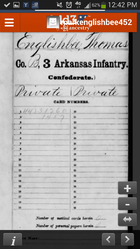
My 2nd great grand uncle Thomas Englishbee, unlisted at Berlin Arkansas in the 3rd Arkansas infantry Regiment, co.B "Berlin Beauregard's" 16th March 1862. He died July 19, 1862 at Petersburg VA, from Typhoid fever. He was no more than 8 years old, because at the time of the 1860 census for the township of Extra, in Ashley county Arkansas his age at last birthday was 6 years. What kind of action would he have been involved in? Are There any records detailing such? His Father Daniel Englishbee, had unlisted at Hamburg Arkansas in 1861 into the Louisiana Partisan Rangers, and served through the end of the war, according to the application for Civil war veterans widows pention aapplication, filed after Daniel's death in 1896
I would be
suspicious of his age in 1860. That he wasn't actually 16 as opposed to 6. They did make mistakes in the census. I've found several over the years.
Third Arkansas regiment of infantry
The Third Arkansas regiment of infantry was organized
at Lynchburg, Va., in June, 1861. When Dr. W. H. Tebbs
and Van H. Manning, a lawyer at Hamburg, Ashley
county, early in 1861 organized two companies and
marched them to Vicksburg, and from there tendered
their services to the Confederate States at Montgomery,
Ala., the secretary of war refused to accept them. Their
officers then went to Montgomery, and by persistent en-
treaty succeeded at length in securing their admission
into the army "for the war. " Captain Manning was an
impetuous Southerner, as was Dr. Tebbs, and they had no
idea of being refused, but insisted until they obtained
marching orders for their little battalion. Manning
knew Hon. Albert Rust, then a member of Congress from
his district, obtained the assistance of his influence, and
as Rust decided to enter the service, Manning urged him
to return to his home at Champagnolle, raise eight more
companies and follow on to some rendezvous, where they
together could organize a regiment for the service "dur-
ing the war. " Rust did so and joined Manning at Lynch-
burg, where the regiment was organized, really the
"First" regiment from Arkansas, as regular troops of the
Confederacy, enlisted for the war. Upon the organization
the officers chosen were, Col. Albert Rust, Lieut.-
Col. Seth M. Barton, Maj. Van H. Manning, Adjt.
Henry A. Butler, Surgeon Joseph Brown, of Union
county. Company A, Capt. W. H. Tebbs, of Ashley
county; Company B, Captain Capers, of Ashley county;
Company C, Capt. T. M. Whittington, of Drew county;
Company D, Captain Douglas, of Desha county; Com-
pany E, Capt. R. S. Taylor, of Desha county; Company
F, Captain Thrasher, of Hot Spring county ; Company G,
Captain Ruddy, of Union county; Company H, Captain
Reed, of Desha county; Company I, Capt. J. H. Alex-
ander, of Dallas county; Company K, Capt. Wilson
Wilkins, of Ashley county. Colonels Rust and Barton
being promoted to brigadier-generals, Major Manning
became colonel, Capt. R. S. Taylor became lieutenant-col-
onel, and Capt. W. Wilkins major, subsequently succeeded
by Major Smith. The regiment was ordered to the
mountains of West Virginia, where it performed arduous
and discouraging service in the campaign on the Gauley
and Cheat rivers. It was followed by hard marching under
Stonewall Jackson, whom Colonel Rust described as an
impracticable old schoolmaster, who said grace before he
ate and prayed before going to bed. The regiment was
engaged in the battles of Greenbrier and Allegheny.
Under Stonewall Jackson at Winchester, in January,
1862, it marched to Bath and Romney, returned to Win-
chester, and was ordered thence to Fredericksburg, and
assigned to the brigade of Gen. T. H. Holmes. It was
engaged in the battle of White Oak Swamp, June 3, 1862;
in J. G. Walker's brigade, July 1, 1862, participated
in the battle of Malvern Hill, and was at Sharpsburg
September 17, 1862, where Colonel Manning was seriously
wounded. At Fredericksburg it was assigned to Hood's
Texas brigade, commanded by General Robertson, and
was recruited by consolidating with it Bronaugh's battal-
ion of five Arkansas companies. It was not engaged at
the battle of Chancellorsville, as it was with Longstreet at
that time at Suffolk. It participated in the battle of Gettys-
burg, in Longstreet's corps, and fought at Chickamauga,
September 19 and zo, 1863, where the gallant Major
Reedy was mortally wounded. From there it went with
Longstreet to Knoxville, and under General Gregg, of
Texas, was in the battle of the Wilderness, May 6, 1864;
marching at double-quick several miles that morning to
save the Confederate line. In the engagement that day, its
colonel, Manning, was shot through the thigh, and being
captured was detained a prisoner of war until three months
after the surrender of Lee. Judge Joe Alexander, as a
private, lost an arm in that battle. The regiment, which
was one of the largest in the army by the accession of
Bronaugh's battalion, having on its roster about 1,500
men, was in the bloody battle of Cold Harbor, June r,
1864, where Texas and Arkansas soldiers exemplified a
valor which was never surpassed. It was at Deep Run,
August 6, 1864; at Petersburg during the siege by Grant;
at High Bridge and Farmville in 1865 ; was in the retreat
with Lee, and surrendered at Appomattox, where it
stacked only 300 guns out of the 1,500 it carried ten
months before. One of its noted achievements was the
repulse of a Maine regiment at Spottsylvania, after the
latter had repulsed the Fourth and Fifth Texas, which
were smaller regiments. Colonel Manning, after being
discharged from prison, settled in Mississippi, married,
and upon the overthrow of the carpet-bag government in
that State was elected representative in Congress.
Source: Confederate Military History, vol. XIV, p. 296


 Forum Host




 Bringing the