Ancestor Help

Chattahooch33

Sergeant Major
Annual Winner
Joined
Oct 4, 2013
Location
Cobb's Legion Country - Bowdon, Ga.
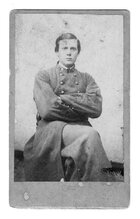
Felix Bryan Parks is a cousin of mine.

Records show he was in the 5th North Carolina Senior Reserves and possibly Colonel of company A out of Wilkes County.

Fold3 has very little on him but I am kinda new to the Fold3 site.

Here is a picture of him:
parks.jpg
 
Fragmentary records from the last months of the war are common. Parks shows up as being age 47 in 1864, so yes, I think the 5th North Carolina Senior Reserves was an old-men-and-boys, home guard sort of unit. My g-g-grandfather was nominally too young for military service, and his father too old, but together they joined a similar regiment in Florida near the end of the war.

The two cards in his CSR give no indication of his rank, or that he was an officer. Since he lived until 1895, "Colonel" may be a courtesy title that reflected his status in the community, rather than an actual military rank held during the war. That happened a lot.
 
Last edited:
Ancestory.com has quite a bit on him - family members, census records, slave registers, photo of him with 2nd wife Frances Louise Hampton Parks, etc.
 
Felix Bryan Parks is a cousin of mine.

Records show he was in the 5th North Carolina Senior Reserves and possibly Colonel of company A out of Wilkes County.

Fold3 has very little on him but I am kinda new to the Fold3 site.

Here is a picture of him:
View attachment 23447

Have paternal roots in Wilkes County :

North Carolina Infantry
74th Infantry
(5th Senior Reserves)
The following was submitted by: Charles Whyte Ellington
The following was taken from:

A Guide to Military Organizations and Installations
North Carolina 1861-1865 (Manarin)
On February 17, 1864, an act to organize "Reserves" was adopted
by the Confederate Congress. A large number of men in the Home
Guard were enrolled in the Confederate service. This reduced the
Home Guard to such an extent that when mobilized they were
consolidated into temporary regiments and were divided into first,
second and third class,, Each class was to serve successive tours of
duty of about, thirty days each. When each class, was mobilized it
was organized into three regiments, thus making nine regiments of
Home Guards.

The law passed by the Confederate Congress on February 17, 1864,
placed in the "Reserves" those men between the ages of 17 and 18
and between 45 and 50. The younger age group was called out in
April and May 1864, and by the end of June eight battalions of
Junior Reserves were organized. As these battalions were
organized into regiments they were given line-numbers. The First
and Sixth Battalions, with two other companies added, were
organized into the First Regiment of Reserves (Seventieth North
Carolina Regiment).

The Second and Fifth Battalions, with two additional companies,
were organized into the Second Regiment of Reserves (Seventy-
First North Carolina Regiment). The Fourth, Seventh, and Eighth
Battalions were organized into the Third Regiment of Reserves
(Seventy-Second North Carolina Regiment).

The words "Junior" and Senior" were not officially used and the
first three "Reserve" regiments were designated First, Second, and
Third Regiment, or Seventieth, Seventy-First, and Seventy-Second
North Carolina. When the men between 45 and 50 were mobilized,
they were organized into regiments designated as the Fourth, Fifth,
Sixth, Seventh, and Eighth Regiments of Reserves, or Seventy-
Third, Seventy-Fourth, Seventy-Sixth, Seventy-Seventh, and
Seventy-Eighth North Carolina. The Seventy-Fifth was the Seventh
Cavalry.

Up to this time the only large group of men that had escaped
military service were the detailed men. These men were under
Confederate jurisdiction and could not be recruited into any State
organization. In November 1864, the Confederate authorities
directed that the detailed men in North Carolina be organized into
regiments and battalions. Three regiments were organized and
designated the First, Second, and Third Regiments Detailed Men.
Their line-numbers were Eighty-First, Eighty-Second, and Eighty-
Third North Carolina Regiments.

The scarcity of information on State organizations, such as Militia and
Home Guards, is because many of the records were poorly kept, and
these that survived were not turned over to the Federal Government
in quantity.

Most of the companies, enthused with a patriotic
spirit, adopted a nick-name, which usually included the name of their
town or county. These, however, were supplanted as the war
progressed by the use of the commanding officer's name when
referring to the unit. The method of numerically designating
battalions and regiments was established by the State and
Confederate authorities; however, the men in the ranks would
generally refer to their company, battalion, or regiment by their
commanding officer's name.

Consequently, units in the Southern army were more commonly
known by their commanding officer rather than their numerical
designation. It should be noted that often after a commanding
officer was killed or otherwise unable to retain command, the
unit would still be called his company, battalion, or regiment,
even though he no longer commanded it.
...................................................................

One of my relatives by marriage, Thomas Earp was in this unit.
 
The Fifth North Carolina Senior Reserve seems also have been known as the Seventy-fourth Infantry. This is extracted from Histories of the Several Regiments and Battalions from North Carolina, in the Great War 1861-'65 (1901), vol. 4:

Tbe Fourth, Fifth, Sixth, Seventh and Eighth Regiments of Reserves (Seventy-third, Seventy-fourth, Seventy-sixth, Seventy-seventh and Seventy-eighth North Carolina) being composed of men at that time between 45 and 50 years of age, those few still living are over 81 years of age. Hence it has been impossible to get their histories written by participants as has been rigidly required of other commands. We have to rely for our scanty data upon the order books and letter books of General T. H. Holmes, who was in charge of the organization of the Reserves in this State, which books have been fortunately preserved by Colonel John W. Hinsdale, his Adjutant-General, and upon such references as are found in
the "Official Records of the Union and Confederate armies."

***

A brigade was formed in November, 1864, of the Fourth, Fifth and Sixth Regiments of Reserves (Seventy-third, Seventy-fourth and Seventy-sixth North Carolina) all of which were on the same service, guarding prisoners at Salisbury, bridges on railroads and arresting deserters. This brigade was placed under command of Colonel Jno. F. Hoke with headquarters at Salisbury. The services performed were useful and indispensable and relieved other troops for service in the field. On some occasions there were fights with deserters who were armed and when banded together made themselves a terror to certain neighborhoods. The only time these three regiments seemed to have come in contact with the enemy was when Stoneman made his raid to Salisbury to release the prisoners at that point.

Upon Johnston's surrender, some few of the regiment were paroled, but the majority doubtless went home without ceremony.

***

Sevenry-fourth Infantry

The history of this regiment is substantially told in what has been said of the Seventy-third. It was organized 3 December,
1864, by the election of

David J. Corpening, Colonel.
George C. Stowe, Lieutenant-Colonel.
Joseph K. Burke, Major.

All these were doubtless officers who had seen previous service and had been retired or had resigned on account of wounds. The only company officer whose name is accessible (till we get copies of the captured rolls filed at Washington) is Captain Nicholson, of Company A. The companies composing the regiment either separately or organized as battalions, had been in service several months. Except detachments guarding prisoners and on local service against deserters, the regiment was at Salisbury guarding prisoners till March, 1865, when being no longer needed for that service, they were sent to the Sixth Congressional District to arrest deserters and patrol and protect the country districts with regimental headquarters at Greensboro.

Upon Johnston's surrender some of them were paroled, but the bulk of them probably returned quietly to their homes.​
 
3rd Regiment N.C. Junior Reserves
Field and Staff
Colonels.
Wetmore Hinsdale, John

Born in Buffalo, New York, February 4, 1843. Previously served as Assistant Adjutant General (Captain) to Lt. Gen. Theophilus H. Holmes (his uncle), commanding N.C. Reserves. Elected colonel of this regiment on January 3, 1865, election confirmed by appointment February 7, 1865. Assigned to duty with this regiment February 14, 1865. Reported present through February 28, 1865. Paroled at Salisbury on May, 24, 1865.

Source: North Carolina Troops 1861-1865, A Roster Junior Reserves, p. 319.
Hilderman0011.jpg
 

Attachments

  • Hilderman0011.jpg
    Hilderman0011.jpg
    90.5 KB · Views: 262

Learn About Us
About CivilWarTalk
Contact the Webmaster
Meet the Staff
Link to CivilWarTalk
Join Our Community
Register
Browse Forums
View Today's Discussions
Search the Forum
Get Help
FAQ
Student Guide
Forum Rules & Etiquette
Copyright / DMCA

     Contact Us CivilwarTalk on Facebook CivilWarTalk on YouTube CivilWarTalk on Twitter RSS Feed

Bringing the American Civil War and More to Life.
© 1999 - , CIVILWARTALK, LLC - Site Version 10.0

SlaveryTalk.com - SecessionTalk.com - CivilWarTalk.com - ReconstructionTalk.com
Back
Top