
- Joined
- Oct 17, 2012
- Location
- Middle Tennessee
America's Quartermaster
By MARK GREENBAUM

Disunion follows the Civil War as it unfolded.
Tags:
Civil War (US) (1861-65)
In July 1862, George B. McClellan's Peninsula Campaign ended and Union forces slowly began their trek back from Virginia's backwaters, stunned by their losses. But if it was a failure on the battlefield, as a logistical operation, it was a stunning success, one of the great organizational feats of human history, all thanks to one man: Quartermaster General Montgomery C. Meigs.
The huge operation involved the movement of over 100,000 uniformed troops from Washington by over 400 ships; 600,000 complete rations to start with and 2.5 million more following the army's arrival; a daily flow of three pounds of provisions per soldier per day, and 25 pounds per horse per day – over 500 tons in all each day that had to be brought down to carry out McClellan's bold operation. The machinery to make this all happen essentially had to be built from scratch. Stepping into a hierarchy bereft of even a semblance of organization or preparedness, Meigs fashioned a brutally efficient military structure that rooted out rampant graft and fed, clothed and housed an army of then-unimagined size – and would continue to do so for the duration of the war. Perhaps the Union would have won anyway, but it is hard to imagine victory without Meigs's war machine.
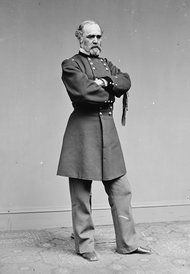 Library of Congress Quartermaster General Montgomery C. Meigs
It's impossible to overstate the logistical challenges facing the Union Army at the start of the Civil War. The expansion of the Army from around 16,000 men in 1860 to half a million just two years later created a nightmare of supply, which was both nonexistent and uncontemplated before cessation. The new army would need uniforms – many, given the rigors of marching – as well as food, blankets for the cold, good tents to withstand the elements, hospitals at the front and horses and mules as well as the provender to keep them functional. Above all, it required transportation via railroad and wagon not just to move soldiers to the front, but a constant, daily supply of all these imperatives together, something made especially difficult by shifting supply lines, rebel cavalry and movement into enemy territory where the Union did not enjoy convenient interior lines.
For the rest: http://opinionator.blogs.nytimes.com/2013/04/12/americas-quartermaster/
By MARK GREENBAUM
Disunion follows the Civil War as it unfolded.
Tags:
Civil War (US) (1861-65)
In July 1862, George B. McClellan's Peninsula Campaign ended and Union forces slowly began their trek back from Virginia's backwaters, stunned by their losses. But if it was a failure on the battlefield, as a logistical operation, it was a stunning success, one of the great organizational feats of human history, all thanks to one man: Quartermaster General Montgomery C. Meigs.
The huge operation involved the movement of over 100,000 uniformed troops from Washington by over 400 ships; 600,000 complete rations to start with and 2.5 million more following the army's arrival; a daily flow of three pounds of provisions per soldier per day, and 25 pounds per horse per day – over 500 tons in all each day that had to be brought down to carry out McClellan's bold operation. The machinery to make this all happen essentially had to be built from scratch. Stepping into a hierarchy bereft of even a semblance of organization or preparedness, Meigs fashioned a brutally efficient military structure that rooted out rampant graft and fed, clothed and housed an army of then-unimagined size – and would continue to do so for the duration of the war. Perhaps the Union would have won anyway, but it is hard to imagine victory without Meigs's war machine.
It's impossible to overstate the logistical challenges facing the Union Army at the start of the Civil War. The expansion of the Army from around 16,000 men in 1860 to half a million just two years later created a nightmare of supply, which was both nonexistent and uncontemplated before cessation. The new army would need uniforms – many, given the rigors of marching – as well as food, blankets for the cold, good tents to withstand the elements, hospitals at the front and horses and mules as well as the provender to keep them functional. Above all, it required transportation via railroad and wagon not just to move soldiers to the front, but a constant, daily supply of all these imperatives together, something made especially difficult by shifting supply lines, rebel cavalry and movement into enemy territory where the Union did not enjoy convenient interior lines.
For the rest: http://opinionator.blogs.nytimes.com/2013/04/12/americas-quartermaster/

 Bringing the