Aeppelküchle

major bill

Brev. Brig. Gen'l
Forum Host
Joined
Aug 25, 2012
GERM GER.jpg
Today I read and article about Johann Georg Kohl toured America in 1855. He visited a Swabian Settlement no to far from where I live. It appears that people from Swabia and Würtemberg stating coming to the area in 1837 and had started a very successful farming community near Ann Arbor Michigan. This settlment was considered the most prosperous German settlement in Michigan.

While there Kohl shared Aeppelküchle with the locals and claimed not only was their bread better than American bread but even better to bread in Germany. He calls American bread insults-to-bread bread. Herr Kohl says Aeppelküchle was what it was called in the Swabian dialect however, I can not find Aeppelküchle on line. Kohl seems to indicate it was a Swabian style apple tart. So what does a Aeppelküchle taste like?

Young men from this area joined Michigan regiments during the Civil War. There were enough settlers from Swabia and Würtemberg that the Washtenaw county atlas used a bilingual map key.

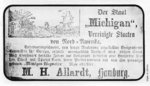
This is what help bring them to my home state.
 
Last edited by a moderator:
I did find Apfelkucken on line which is described as German cake. So perhaps I should have tried a different spelling before posting. Well if Herr Kohl would have traveled a bit further north my ancestor I am named after would have served him Applejack, and it seems likely Herr Kohl would have been in no condition to write about his visit. The alcoholic content of Applejack is dependent on how cold it gets in the winter. My family would have not wasted good apples making apple cake.
 
Modern Europeans don't like American bread because Americans like a light, white bread without much flavor, and even our (store bought) grain breads tend in that direction. From what you say, I wonder if this difference has been the case further back than I realized!

I did find Apfelkucken on line which is described as German cake.

That was my first thought. Technically, Apfelkucken just means apple cake, but the older recipes I have seen are a sweet yeast dough in a big flat pan with apples and sugar and cinnamon and whatnot over them -- a lot of them include sour cream in either the bread or the topping. I like it, but I'm more likely to make an apple cobbler or a slump...
 

The state "Michigan", United States of America
The signatory, governmentally employed Commissioner of Emigration for Europe, freely gives information about the aforementioned state. On request he`ll send, postage free, a pamphlet about the state with a special map, as well as a free example of the "Michigan Guidebook" that he publishes. Adress:
M.H. [Maximilian Heinrich] Allardt, Hamburg
 
Last edited:
Now to the apples. Apfelkuchen is apple pie, in theory. NOW Aeppelküchle can simply mean the same in dialect BUT küchle (or küchlein) also is a minimisation which could also mean in regards to the size. AND instead of apple pie it could be used for a form of apple pastry or for apple pancakes. So ... as sure as eggs is eggs, as you might say. :wink:
 
Last edited:
The state "Michigan", United States of America
The signatory, governmentally employed Commissioner of Emigration for Europe, freely gives information about the aforementioned state. On request he`ll send, postage free, a pamphlet about the state with a special map, as well as a free example of the "Michigan Guidebook" that he publishes. Adress:
M.H. [Maximilian Heinrich] Allardt, Hamburg

Thank you for translating this. My German language class in the Army after I arrived in Germany lasted one day. I did not learn much German in a day.
 
Apple pie, apple cake, apple tarts were all a great misuse of Michigan apples in 1860. You use special apples from special apple trees to make special hard cider. When the temperature gets to well bellow zero (15 to 20 below zero is ideal), you drill a very small hole in the bottom of the frozen hard cider barrel and let the applejack dip into a jug. Every thing in the barrel is frozen except the alcohol. If you are lucky and it get to 25 below zero you get really good applejack.
 
Ja. Nein. Danke. Bier (just like beer). What else to learn on a first day in garrison? :sneaky:

I was only in Germany for 8 months and did not go off base that much. I usually volunteered to work both Saturdays and Sundays. I did not take any leave time off. The Army sent me there to work and I felt obligated to work.
 
When I was growing up in Lansing Michigan we only had two kinds of Germans groups in my area.

1. The Germans in Frankenmuth (and Saginaw area), Lutherans from Franconia.
2. The Germans in the Westphalia (Portland area) were Catholics from Wimbach, Meerhof, and Hesse.

The two areas were different and when I moved in to the Portland area when I was 18, locals asked me was a German or a Protestant. I was more use to the German Lutherans in my area and did not really understand what they were asking me.
 
I'm living in Baden-Württemberg but since I only moved here and my family leaves in the east, I couldn't pull out a recipe from grandma on Äppelküchle (or as @major bill spelled it Aeppelküchle) and needed to google it. This came up:
Apfelküchle
The Apfelküchle is a traditional German pastry, consisting of sliced apples dipped in batter and fried to a golden brown color. It is popular in Baden-Württemberg, a federal state in South-Germany. The Apfelküchle has spread throughout Europe and the USA. It is similar to an apple fritter but is made more like a pancake and can be prepared in numerous different fashions. While it is traditionally eaten as a complete meal, because of its sweet taste, it has become popular to eat Apfelküchle as a dessert as well.
Like @GELongstreet said: küchle here can refer to the size (it's smaller than a typical Apfelkuchen (= apple pie)) and to the local variation of spelling for Kuchen (= cake).

I remember seeing Apfelküchle at least once at a restaurant which serves typical Swabian dishes. There it was served as dessert together with cinnamon and sugar as well as vanilla sauce, all of which in Swabia traditionally belongs to Apfelküchle and other desserts.
 
Modern Europeans don't like American bread because Americans like a light, white bread without much flavor, and even our (store bought) grain breads tend in that direction. From what you say, I wonder if this difference has been the case further back than I realized!


That was my first thought. Technically, Apfelkucken just means apple cake, but the older recipes I have seen are a sweet yeast dough in a big flat pan with apples and sugar and cinnamon and whatnot over them -- a lot of them include sour cream in either the bread or the topping. I like it, but I'm more likely to make an apple cobbler or a slump...
My wife bakes fresh bread fo us all the time as we hardly ever buy store bought bread.
 
Apple pie, apple cake, apple tarts were all a great misuse of Michigan apples in 1860. You use special apples from special apple trees to make special hard cider. When the temperature gets to well bellow zero (15 to 20 below zero is ideal), you drill a very small hole in the bottom of the frozen hard cider barrel and let the applejack dip into a jug. Every thing in the barrel is frozen except the alcohol. If you are lucky and it get to 25 below zero you get really good applejack.
Nothing better then homemade.
 
I'm living in Baden-Württemberg but since I only moved here and my family leaves in the east, I couldn't pull out a recipe from grandma on Äppelküchle (or as @major bill spelled it Aeppelküchle) and needed to google it. This came up:
Apfelküchle

Like @GELongstreet said: küchle here can refer to the size (it's smaller than a typical Apfelkuchen (= apple pie)) and to the local variation of spelling for Kuchen (= cake).

I remember seeing Apfelküchle at least once at a restaurant which serves typical Swabian dishes. There it was served as dessert together with cinnamon and sugar as well as vanilla sauce, all of which in Swabia traditionally belongs to Apfelküchle and other desserts.

Sound good. I lived in Munich for 6 months but did drive through the Swabia area. I don't think I stopped to eat.
 
Apple pie, apple cake, apple tarts were all a great misuse of Michigan apples in 1860. You use special apples from special apple trees to make special hard cider. When the temperature gets to well bellow zero (15 to 20 below zero is ideal), you drill a very small hole in the bottom of the frozen hard cider barrel and let the applejack dip into a jug. Every thing in the barrel is frozen except the alcohol. If you are lucky and it get to 25 below zero you get really good applejack.
Reminds me that one year, my Mom and I left wine in a box upNorth over the winter..we figured, why not? It won't freeze...well, what we wound up with was Ice Wine, which was about twice the alcohol content we thought we were having. I'll just say, "ouch"..
 
My uncle used my great great grandfathers applejack mixture. I have fell victim to this applejack more than once when I visited my uncle.
 
I was stationed in Germany for six years and had apfelkuchen many times. It was much more cake than pie. Very dense, like a pound cake, with sliced apples, cinnamon and nutmeg(?) I think. Really good stuff!
Ice wine on the other hand is wine made from VERY late grapes. Late to the point of beginning to wrinkle. This is done to maximize the sugar content and sweetness. During fermentation, more sugar equals more alcohol! Eiswein is generally a "dessert" wine. Too sweet for me...but maybe I should have had a glass with my apfelkuchen.
Darn it.
 
I'm living in Baden-Württemberg but since I only moved here and my family leaves in the east, I couldn't pull out a recipe from grandma on Äppelküchle (or as @major bill spelled it Aeppelküchle) and needed to google it. This came up:
Apfelküchle

Like @GELongstreet said: küchle here can refer to the size (it's smaller than a typical Apfelkuchen (= apple pie)) and to the local variation of spelling for Kuchen (= cake).

I remember seeing Apfelküchle at least once at a restaurant which serves typical Swabian dishes. There it was served as dessert together with cinnamon and sugar as well as vanilla sauce, all of which in Swabia traditionally belongs to Apfelküchle and other desserts.

I was born in Baden-Württemberg but moved up north to Lower Saxony, but I think you found the right thing. This is what they look like:

https://en.wikipedia.org/w/index.php?title=Apfelk%C3%BCchle&oldid=852080851
Article is in English
 
Last edited by a moderator:

Learn About Us
About CivilWarTalk
Contact the Webmaster
Meet the Staff
Link to CivilWarTalk
Join Our Community
Register
Browse Forums
View Today's Discussions
Search the Forum
Get Help
FAQ
Student Guide
Forum Rules & Etiquette
Copyright / DMCA

     Contact Us CivilwarTalk on Facebook CivilWarTalk on YouTube CivilWarTalk on Twitter RSS Feed

Bringing the American Civil War and More to Life.
© 1999 - , CIVILWARTALK, LLC - Site Version 10.0

SlaveryTalk.com - SecessionTalk.com - CivilWarTalk.com - ReconstructionTalk.com
Back
Top