Absent Without Leave

Lee mervin

Cadet
Joined
Jul 1, 2019
Hi,
I would be very grateful if anyone could help me interpret some service records belonging to my Great Grandfather's brother William Wedgwood, originally from Staffordshire England, who emigrated to New York in the mid 1840s.
After being invalided out of the 40th New York Infantry regiment in June 1862 due to chronic rheumatism, he reenlisted with The 133rd New York Infantry Regiment in September 1862.
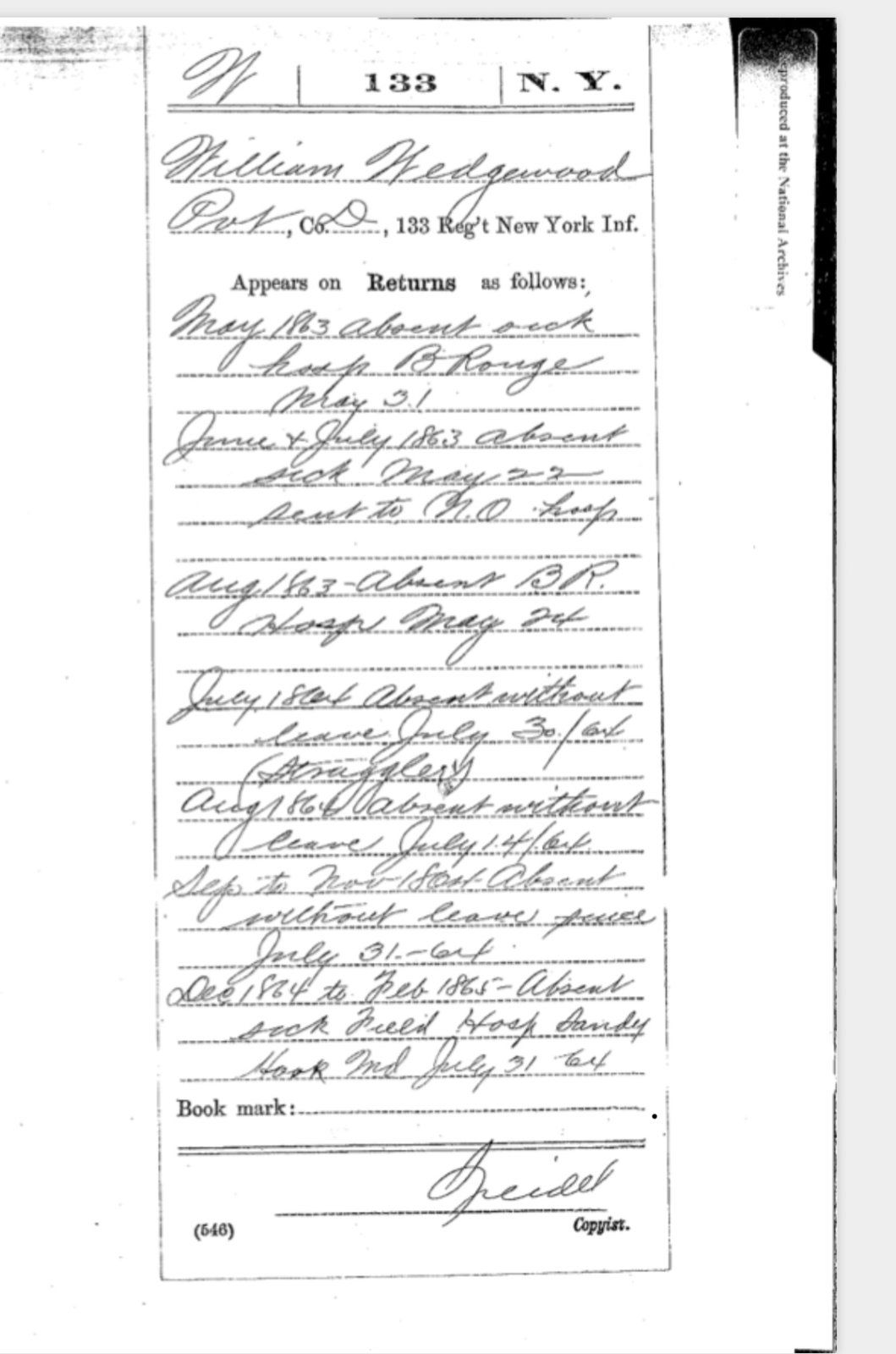
The particular document I would like some help on seems to be records of his whereabouts at the time roll calls were taken. (See attached).From July to November 1864 he is described as being Absent Without Leave - finally turning up in a Field Hospital in Sandy Hook in December 1864.
He doesn't seem to have been disciplined for his absence and was mustered out in June 1865.
Was it common for soldiers to be lost track of for so long? And does anyone know what the reference to Stragglers in the entry for July 1864 might mean?
Many Thanks
67D307F7-EE9E-4742-8D43-1AA3F1FDD0BB.jpeg
 
Hi, Lee,

I'm less familiar with Union records, but I have several Confederate ancestors who have AWOL pop up with some regularity on their service records and seemingly without penalty. I've even seen the notation, "Absent without leave, expected to return." But I had another ancestor from the same family in a different Confederate regiment who received a courtmartial over it.

I suspect how well one knew the company officer might make a difference in whether they were willing to give you the benefit of the doubt or if, indeed, they may have been notified of the absence beforehand.

We've also chatted on here before about people being mistakenly counted as absent because their officers hadn't realized that they were captured or wounded. Based on your ancestor's previous health issues and finally turning up in a hospital, I wonder if they lost track of him while he was sick?

Hope this helps! Interested to see what folks with more experience with Union records think. :smile:
 
Seeing AWOL was extremely common. Basically, it means the soldier is not where he's supposed to be. Sometimes the soldier may be sick and left behind at a place or at a hospital, but if the captain of the company didn't know he would be listed as AWOL. If they had no good reason for not being with the regiment, they may face a court-martial where at least he could explain where and why he wasn't with his unit.
 
Hi, Lee,

I'm less familiar with Union records, but I have several Confederate ancestors who have AWOL pop up with some regularity on their service records and seemingly without penalty. I've even seen the notation, "Absent without leave, expected to return." But I had another ancestor from the same family in a different Confederate regiment who received a courtmartial over it.

I suspect how well one knew the company officer might make a difference in whether they were willing to give you the benefit of the doubt or if, indeed, they may have been notified of the absence beforehand.

We've also chatted on here before about people being mistakenly counted as absent because their officers hadn't realized that they were captured or wounded. Based on your ancestor's previous health issues and finally turning up in a hospital, I wonder if they lost track of him while he was sick?

Hope this helps! Interested to see what folks with more experience with Union records think. :smile:
Many Thanks Zella
 
The particular document I would like some help on seems to be records of his whereabouts at the time roll calls were taken. (See attached).From July to November 1864 he is described as being Absent Without Leave - finally turning up in a Field Hospital in Sandy Hook in December 1864.
He doesn't seem to have been disciplined for his absence and was mustered out in June 1865.
Was it common for soldiers to be lost track of for so long? And does anyone know what the reference to Stragglers in the entry for July 1864 might mean?

The 133rd NY was part of the Union force that took part in The Battle of Cool Spring, also known as Castleman's Ferry, Island Ford, Parker's Ford, and Snicker's Ferry. The battle was fought July 17–18, 1864, as part of the Valley Campaign of 1864. It was a Confederate victory. For whatever reason, William became separated from the regiment, and finally located in the hospital. He was awol but returned, howbeit late. Hence the term, "stragglers" He wasn't there to answer roll following the battle, and several months after.
 
Last edited:
1. The AWOL notes start in July 1864.
2. The AWOL notes continue until the end of the November 1864 pay period.
3. He is recorded as being at Sandy Hook Hospital MD December 1864 to February 1865 and note the very last line on the card - last three words July 31st 1864.
4. He was a patient at Sandy Hook MD Field Hospital from July 31st 1864 until February 1865. Somehow, word of this didn't get back to his Regiment until December 1864. Ergo, no derogatory action by the Army for said time period.
5. If he successfully applied for and received a pension, this is double-proof of the Army's right hand not knowing what the left hand was doing.
 
You're very welcome! Glad to help. :smile:

Another thing I forgot to mention is the muster rolls, in which it was decided who was present and who was absent, are kind of weird by modern standards. They would be taken one day of the month, but the notations for that day would stand for the whole month.
Thanks - thats v helpful :smile:
 
1. The AWOL notes start in July 1864.
2. The AWOL notes continue until the end of the November 1864 pay period.
3. He is recorded as being at Sandy Hook Hospital MD December 1864 to February 1865 and note the very last line on the card - last three words July 31st 1864.
4. He was a patient at Sandy Hook MD Field Hospital from July 31st 1864 until February 1865. Somehow, word of this didn't get back to his Regiment until December 1864. Ergo, no derogatory action by the Army for said time period.
5. If he successfully applied for and received a pension, this is double-proof of the Army's right hand not knowing what the left hand was doing.
Many Thanks - that explains it perfectly
 
The 133rd NY was part of the Union force that took part in The Battle of Cool Spring, also known as Castleman's Ferry, Island Ford, Parker's Ford, and Snicker's Ferry. The battle was fought July 17–18, 1864, as part of the Valley Campaign of 1864. It was a Confederate victory. For whatever reason, William became separated from the regiment, and finally located in the hospital. He was awol but returned, howbeit late. Hence the term, "stragglers" He wasn't there to answer roll following the battle, and several months after.
Many thanks - that makes a lot of sense
 

Learn About Us
About CivilWarTalk
Contact the Webmaster
Meet the Staff
Link to CivilWarTalk
Join Our Community
Register
Browse Forums
View Today's Discussions
Search the Forum
Get Help
FAQ
Student Guide
Forum Rules & Etiquette
Copyright / DMCA

     Contact Us CivilwarTalk on Facebook CivilWarTalk on YouTube CivilWarTalk on Twitter RSS Feed

Bringing the American Civil War and More to Life.
© 1999 - , CIVILWARTALK, LLC - Site Version 10.0

SlaveryTalk.com - SecessionTalk.com - CivilWarTalk.com - ReconstructionTalk.com
Back
Top