
 Forum Host
- Joined
- Aug 27, 2011
- Location
- Central Massachusetts
The story of Mexique, the old mule who was "retired from active service, on full pay and allowances," by order of the Secretary of War, on the advice of Gen. Sherman himself, appeared in Harper's Young People, vol. 5, May 27, 1884.
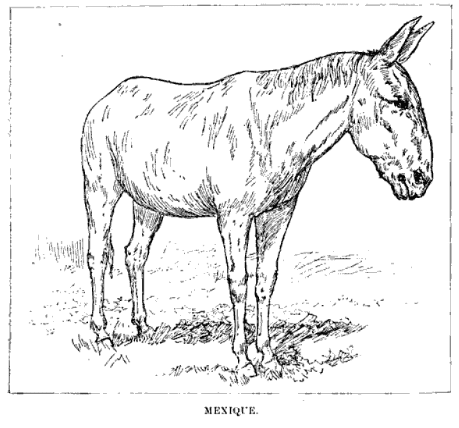
The story of Mexique has been told a number of times, in greater or lesser detail, and some slight variation as to his exact record. Perhaps the most "authoritative" appeared in Adrian Rexford's 1888 sketch of "The Army Mule" (American Magazine vol. 7, no. 4), a full transcription of which article I have just put online -- linked in my signature below.
A Very Fortunate Mule, by Gustave Kobbe
THERE appeared not long ago in a Western journal an engraving of a mule seated in a cushioned arm-chair, with his feet on the table, reading a paper, and waited on by a soldier. This picture was a humorous representation of the good fortune which has lately befallen an army mule. Mexique by name. This mule has served his country faithfully for a large number of years, and been rewarded like a soldier who has done his duty well, with a pension not in dollars and cents, but in hay and oats.
Like every patriot who has been through the wars. Mexique has an interesting history. The incidents of his long and useful career were duly related in a document which accompanied the application for his pension. For, according to regulations, the career of an army horse or mule is always duly recorded, there being special books furnished and kept for that purpose.
Mexique, who is now a white mule, was purchased during the Mexican war by the Quartermaster's Department in Mexico. Our army transport has always been done by mules. The army mule, therefore, is a peculiarly American animal, in addition to being a peculiar animal on his own account. He is usually on intimate terms with the soldiers, does a good deal as he pleases, and is the only living thing in the army that ever dares to treat an officer with disrespect. But properly treated by his driver, he will idolize him, and obey the slightest hint of command. When, however, driven by a new hand, a six-mule team may in the twinkling of an eye get itself, harness, wagon, contents, and teamster into a tangle to which a heap of jack-straws is a simple affair.
A part of the army returning from Mexico in 1849, Mexique. then a young and strong draught animal, was left at Tampa, Florida, for use at the regular army post there. This fact would establish his age now as being between forty-two and forty-five years, though General Sherman, as will be seen later, makes it over sixty.
During the civil war he was still at that post, afterward moving between there and Key West. Later, in 1882, the post at Tampa was broken up. and one of its batteries (L, Third Artillery) was ordered to the Barracks at Mount Vernon. Alabama, where it arrived about Christmas-time, bringing old Mexique, among other animals.
As far as can be ascertained, this mule worked well and daily up to 1882, when, as he was one day prowling about the post at Tampa, he attacked a young colt, and was severely kicked by its mother. Since that time his spirit has seemed broken, and when he arrived at Mount Vernon he was allowed to do pretty much as he pleased.
As there are about a dozen good animals besides him at the post, no one thinks of working him. He has the liberty of the United States reservation, and it is nothing unusual to see children playing around his heels while he stands rapt in thought under the shade of a tree. Nearly all the officers or strangers, who visit the post inquire for him, and once he was honored with a call from a general.
Mexique has travelled so much, that if a gang-plank or anything like it is shown him he will walk at once across it. unlike any of his companions, which usually require to be lifted on board a vessel.
Last year Major William A. Kobbe, while in command of Mount Vernon Barracks, received an order to sell at auction all unserviceable draught animals. As this would have included Mexique. the major wrote to the Quarter-master-General, asking that Mexique be retained in the service, with full rank and pay, as the officers of the post were willing to raise a fund for his support. This petition went up through various departments until it reached General Sherman.
He interested himself greatly in Mexique's welfare, and in a letter which he addressed to the War Department, referring the petition to the attention of that body, he says:
"I have seen that mule, and whether the story be true or false, the soldiers believe it was left at Big Spring, where Mount Vernon Barracks now are, at the time General Jackson's army encamped there about 1819-20. Tradition says it was once a sorrel, but now it is white from age. The Quartermaster's Department will be chargeable with ingratitude if that mule is sold, or the care or maintenance of it thrown on the charitable officers of the post. I advise that it be kept in the department, fed and maintained, till death. I think the mule was at Fort Morgan when I was there in 1842."
The Secretary of War, having considered this correspondence, issued the following order: "Let this mule be kept and well cared for as long as he lives."
The matter attracted great attention. Many societies wrote for particulars concerning Mexique and for his photograph. One of the pleasantest letters received was that from the Royal Society for the Prevention of Cruelty to Animals, of London, addressed to Minister Lowell, asking for a picture of Mexique to be preserved with the society's archives. This was inclosed in a personal letter from Mr. Lowell to General Sherman, with a copy of the London Daily Telegraph containing a two-column editorial on the subject.
At present Mexique is very lame, rheumatic, and feeble, though he has. of course, as much care as can be given him, and is petted a good deal in addition by all. We believe the accompanying portrait of him, taken from a photograph, is the first which has yet been obtained.
Mexique would pass away at Mount Vernon Barracks "between retreat and reveillé, August 24, 1886."The story of Mexique has been told a number of times, in greater or lesser detail, and some slight variation as to his exact record. Perhaps the most "authoritative" appeared in Adrian Rexford's 1888 sketch of "The Army Mule" (American Magazine vol. 7, no. 4), a full transcription of which article I have just put online -- linked in my signature below.
Last edited:


 Bringing the