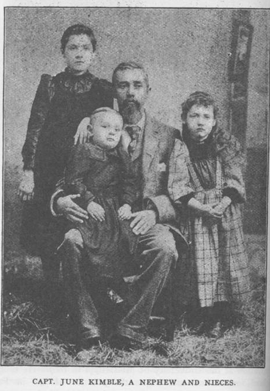
In his description of the failed July 3rd Confederate attack on the center of the Union line, author Shelby Foote includes the experience of Clarksville Tennessee's Junius (June) Kimble. Today I was fortunate enough to locate a photo of him, found in Confederate Veteran Magazine.
View attachment 264199
Junius Kimble : Residence was Clarksville, Tennessee, Enlisted there 4 /19/ 1861 as a sergeant in Co.A 14th Tennessee Infantry. Promoted to 1st Lieut. And later Captain. Surrendered at Appomattox, 4/9/1865. Born in Clarksville 4/1/1842. Died in Eastland, Texas 4/4/1911.
Mr. Foote wrote the following :
"Some managed to steal a look at the ground ahead, and like their officers were sobered by what they saw. One such, a Tennessee sergeant from Fry's brigade, walked forward to the edge of the woods, looked across the wide open valley at the bluecoats standing toylike in the distance on their ridge, and was so startled by the realization of what was about to be required of him, that he spoke aloud, asking himself the question :
"June Kimble, are you going to do your duty ?" The answer was also audible,
"I'll do it so help me God," he told himself. He felt better then. The dread passed from him, he said later. When he returned to his company, friends asked him how it looked out there, and Kimble replied,
"Boys, if we have to go it will be hot for us, and we'll have to do our best."
After the attack's failure: "June Kimble, the Tennessee sergeant that had resolved to do his duty and had done it, but who now admitted frankly,
"For about a hundred yards I broke the lighting speed record." Once more, however, his conscience intervened. With the horror of being shot in the back, he turned to face the bluecoats firing downhill at him and walked backward until he was out of musket range, then turned again and plodded uphill amid shell-bursts that plowed the farther reaches of what a Federal observer called "a square of Tophet." (a term for hell)
Another Gettysburg account. This time from a North Carolinian of the 53rd NC Infantry. I'm borrowing this from material I have to add shortly to another thread in progress.
https://civilwartalk.com/threads/1s...words-of-veterans-lewis-leon-t-c-land.157877/ I felt it should also be here.

July 1, 1863 - We left camp at 6 A.M., passed through Heidelsburg and Middleton. At the latter place, we heard firing in the direction of Gettysburg. We were pushed forward after letting the wagon trains get in our rear. We got to Gettysburg at 1 P.M., 15 miles. We were drawn up in line of battle about one mile south of town, and a little to the left of the Lutheran Seminary. We then advanced to the enemy's line of battle in double quick time. We had not gotten more than 50 paces when Norman of our company fell dead by my side. Katz was going to pick him up. I stopped him, as it is strictly forbidden for anyone to help take the dead or wounded off the field except the ambulance corps. We then crossed over a rail fence, where our Lieutenant McMatthews and Lieutenant Alexander were both wounded. That left us with a captain and one lieutenant. After this, we got into battle in earnest and lost in our company very heavily, both killed and wounded. This fight lasted four hours and a half when at last we drove them clear out of town, and took at least 3,000 prisoners. They also lost very heavily in killed and wounded, which all fell into our hands. After the fight, our company was ordered to pick up all straggling Yankees in town and bring them together to be brought to the rear as prisoners. One fellow I took up could not speak one word of English, and the first thing he asked me in German was "Will I get my pay in prison?" After we had them all put up in a pen we went to our regiment and rested. Major Iredell, of our regiment, came to me and shook my hand, and also complimented me for action in the fight. At dusk, I was about going to hunt up my brother Morris when he came to me. Thank God, we are both safe as yet. We laid all night among the dead Yankees, but they did not disturb our peaceful slumbers.
July 2 - Our division was in reserve until dark, but our regiment was supporting a battery all day. We lost several killed and wounded, although we had no chance to fire - only lay by a battery of artillery and be shot at. The caisson of the battery we were supporting was blown up and we got a big good sprinkling of the wood from it. Just at dark we were sent to the front under terrible cannonading. Still, it was certainly a beautiful sight. It being dark, we could see the cannon vomit forth fire. Our company had to cross a rail fence. It gave way and several of our boys were hurt by others walking over them. We laid down here a short time, in fact no longer than 10 minutes, when I positively fell asleep. The cannonading did not disturb me. One of the boys shook me and told me Katz was wounded by a piece of a shell striking him on the side, and he was sent to the rear. We went on to the Baltimore Turnpike until 3 in the morning of the 3d.
July 3 - When under very heavy fire, we were ordered on Culp's Hill, to the support of Gen. Allegany Johnson. Here we stayed all day - no, here, I may say, we melted away. We were on the brow of one hill, the enemy on the brow of another. We charged on them several times, but of course, running down our hill, and then to get to them was impossible, and every time we attempted it we came back leaving some of our comrades behind. Here our Lieutenant Belt lost his arm. We have now in our company a captain. All of our lieutenants are wounded. We fought here until 7 P.M. when what was left of us was withdrawn and taken to the first day's battlefield. At the commencement of this fight, our Brigade was the strongest in our division, but she is not now. We lost the most men, for we were in the fight all the time, and I have it from Colonel Owens that our regiment lost the most in the Brigade. I know that our company went into the fight with 60 men. When we left Culps Hill there were 16 of us that answered to the roll call. The balance were all killed and wounded. There were 12 sharpshooters in our company and now John Cochran and myself are the only ones that are left. This day none will forget, that participated in the fight. It was truly awful how fast, how very fast, did our poor boys fall by our sides - almost as fast as the leaves that fell as cannon and musket balls hit them, as they flew on their deadly errand. You could see one with his head shot off, others cut in two, then one with his brain oozing out, one with his leg off, others shot through the heart. Then you would hear some poor friend or foe crying for water, or for "God's sake to kill him. You would see some of your comrades, shot through the leg, lying between the lines, asking his friends to take him out, but no one could get to his relief, and you would have to leave him there, perhaps to die, or, at best, to become a prisoner. Our brigade was the only one that was sent to Culps Hill to support General Johnson. In our rapid firing today my gun became so hot that the ramrod would not come out, so I shot it at the Yankees, and picked up a gun from the ground, a gun that some poor comrade dropped after being shot. I wonder if it hit a Yankee; if so, I pity him. Our regiment was in a very exposed position at one time today, and our General Daniels ordered a courier of his to bring us from the hill. He was killed before he got to us. The General sent another. He was also killed before he reached us. Then General Daniels would not order anyone but called for volunteers. Capt. Ed. Stitt, of Charlotte, one of his aides, responded, and he took us out of the exposed position.
July 4 - We laid on the battlefield of the first day, this the fourth day of July. No fighting today, but we are burying the dead. They have been lying on the field in the sun since the first day's fight; it is dusty and hot, the dead smell terribly. The funny part of it is, the Yankees have all turned black. Several of our company, wounded, have died. Katz is getting along all right. The battle is over, and although we did not succeed in pushing the enemy out of their strong position, I am sure they have not anything to boast about. They have lost at least as many in killed and wounded as we have. We have taken more prisoners from them than they have from us. If that is not the case, why did they lay still all today and see our army going to the rear? An army that has gained a great victory follows it up while its enemy is badly crippled; but Meade, their commander, knows he has had as much as he gave, at least, if not more. As yet I have not heard a word from my brother Morris since the first day's fight.


 Well, he's not mine....but I say hi to him nearly every day.


 Bringing the