A Robin named "Rowley"

John Hartwell

Lt. Colonel
Forum Host
Joined
Aug 27, 2011
Location
Central Massachusetts
"Rowley wasn't an actual "Civil War" veteran. His ancestors, 50 or more generations before might well have been. But, he was known and loved by the last dwindling few old men of the 31st Iowa during the 1920s and 30s. And, his fame grew nation-wide among the vets.

Rowley was a young robin with a broken wing. He had been found in 1926 by Dr. Josephus White Benadom of Monticello, Iowa, who had begun life as a young fifer with the 31st Iowa. Now a physician, "Seph" Benadom, as he was universally known, set Rowley's broken wing, and decided to keep him. The bird stayed with him, apparently willingly, sitting on the end of his old fife, flitting occasionally to his hat or his shoulder. He accompanied the fifer-MD everywhere, including to meetings of the Grand Army of the Republic, where Seph was always ready to demonstrate his fifing.

In 1926, some months after Rowley's recuperation, the G.A.R.'s 60th National Encampment was held in DesMoines, and Seph and friend were in attendance. An alert photographer there snapped a picture that was printed in newspapers across the country:
Brandon - Edited.jpg
Seph and Rowley entertained at G.A.R. gatherings, and just about anywhere else, for that matter, for seven years -- a good lifespan for a robin. Rowley eventually passed away early in 1933. But, his spirit lived on, for Dr. Benadom found another young robin, and dubbed him "Rowley the Second." And, by the time of the 67th National Encampment (1933 in St. Paul), the 8-week-old bird was happily perched on a cork set into the end of Seph's treasured old fife (he had made it himself, back in 1862). The youngster was not quite as tame as the first Rowley, and his companionship was encouraged by a string tied around his leg, the other end attached to Seph's lapel. But, he rarely showed signs of trying to escape.
benadom-1933-09-17-gar-at-st-paul-mn.jpg
That was the first time young Rowley the Second had actually participated in a parade, and he handled it like a pro. "I was kind of afraid he'd get scared with all the noise ... all these drums and bugles, but he wasn't a bit afraid," Seph said proudly. (Fresno Bee, Sept. 20, 1933)

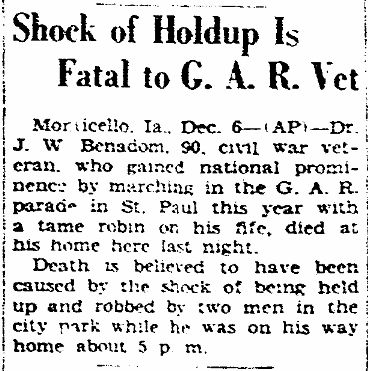
Sadly, that would be the last major event in which the two would appear together. On December 6th, many newspapers carried this nitice:
bntn.jpeg
What became of Rowley the Second is not recorded.
 
Last edited:
"Rowley wasn't an actual "Civil War" veteran. His ancestors, 50 or more generations before might well have been. But, he was known and loved by the last dwindling few old men of the 31st Iowa during the 1920s and 30s. And, his fame grew nation-wide among the vets.

Rowley was a young robin with a broken wing. He had been found in 1926 by Dr. Josephus White Benadom of Monticello, Iowa, who had begun life as a young fifer with the 31st Iowa. Now a physician, "Seph" Benadom, as he was universally known, set Rowley's broken wing, and decided to keep him. The bird stayed with him, apparently willingly, sitting on the end of his old fife, flitting occasionally to his hat or his shoulder. He accompanied the fifer-MD everywhere, including to meetings of the Grand Army of the Republic, where Seph was always ready to demonstrate his fifing.

In 1926, some months after Rowley's recuperation, the G.A.R.'s 60th National Encampment was held in DesMoines, and Seph and friend were in attendance. An alert photographer there snapped a picture that was printed in newspapers across the country:
Seph and Rowley entertained at G.A.R. gatherings, and just about anywhere else, for that matter, for seven years -- a good lifespan for a robin. Rowley eventually passed away early in 1933. But, his spirit lived on, for Dr. Benadom found another young robin, and dubbed him "Rowley the Second." And, by the time of the 67th National Encampment (1933 in St. Paul), the 8-week-old bird was happily perched on a cork set into the end of Seph's treasured old fife (he had made it himself, back in 1862). The youngster was not quite as tame as the first Rowley, and his companionship was encouraged by a string tied around his leg, the other end attached to Seph's lapel. But, he rarely showed signs of trying to escape.
That was the first time young Rowley the Second had actually participated in a parade, and he handled it like a pro. "I was kind of afraid he'd get scared with all the noise ... all these drums and bugles, but he wasn't a bit afraid," Seph said proudly. (Fresno Bee, Sept. 20, 1933)

Sadly, that would be the last major event in which the two would appear together. On December 6th, many newspapers carried this nitice:
What became of Rowley the Second is not recorded.

I love little stories like this. Thanks for sharing!
 
Seven years is about an average lifespan for a robin in safe conditions. They live between 2 and 12 years in the wild. We raised a pair of robins that fell out of a nest on our roof. One of them had a distinctive leg injury, so it was easy to identify after we released them. It came back to our yard for at least one year after release. They were pretty affectionate birds. It was really hard to let them go.
 
"Dr." J.W. Benadom was ,unfortunately, not a civil war soldier. Nor was he a "Doctor". A first rate candidate for stolen valor he was and he gave himself away in the pages of the Monticello Express before he died. The local paper decided it was time to interview the last remaining Civil War Veterans in the area, and by popular belief Benadom had made the news papers far and wide as a veteran, so he too was interviewed. As has always been supposed, Benadom claimed he was with the 31st Iowa, Co. H., but suggested he spent most of his time in the hospital, to cover the fact no one had ever seen him in the company. Even the GAR believed him until a records search did not find him and so they dropped his membership. What gave Benadom away is what usually gives away those who claim stolen valor, they just keep making themselves more and more important than they really are. So it was with "Dr." Benadom, in the midst of his interview he admitted he had been at Vicksburg, and the 31st was there, that there is no doubt, but later in the interview he also said he was at Gettysburg! Unfortunately since both happened at about the same time and accounting for no Iowa troops were at Gettysburg he obviously was lying! Even today, people in this area believe he was in the Civil War and believe he was a doctor, but he never went to a medical school and was convicted in court of several counts of calling himself a "doctor" in Colorado without any medical training. He published "testimonials" of patients he had "cured" and there are people in this area who still believe he did cure their forbearers. I have a great uncle who was treated by Benadom for skin cancer and although he had a huge pock mark on his face he was convinced Benadom had "saved" him. He later died from his untreated cancer that metastasized in other parts of his body.
The story of Rowley, however, is true. Benadom needed a kicker to get accepted by the "Boys of Blue" at the national GAR convention and Rowley was his ticket into the group. It also got him a place at the head of the parade and the rest is history as they say!
 
Very interesting. A wee bit disappointing, perhaps, but interesting nonetheless.

I did a bit further checking, and according to the NPS Civil War Database, there apparently was a musician named "J. W. Benedom" on the roster of Co. E, 31st Iowa. But, that, it seems, was Josephus Benedom's brother, James, who eventually moved to Maquoketa, IA, where he died in 1916. At just about the time of James' death, Josephus' name first appears on the rolls of Ben Paul Post No. 130, G.A.R., in nearby Wyoming, IA. So, Josephus was likely assuming his brother's war record.

One elderly Monticello resident recalled:

"Interestingly, Benadom was cremated and in 1933 that was a bit unusual, but Benadom the 'Doctor' was quite the charlatan and had 'Sanitariums' as far away as Denver, Colorado, claiming he could cure cancer and most anything! He apparently was a fifer in the Civil War and later in life tamed a wild robin to sit on the end of his fife as he played while marching in a fife and drum corps he put together of family members. He was also known for his homemade marquetry, building inlaid tables with thousands of pieces of wood. It is said he even made a snare drum this way. Back in my early days of Boy Scouts we had to make money for the troop and often put out fliers in the town of Monticello. His spooky old sanitarium was still standing, but falling down, a victim of a fight over the estate, I presume. It used to creep me out! The old boy died after a couple of characters thumped him over the head for his wallet, it didn't kill him, but he died later on the front porch of his sanitarium as a result. No one was ever caught."​

Quote from: http://iowajones.org/military/CWRoster06_31In.htm
See also: https://historyoftheancients.wordpress.com/2015/01/31/comrade-rowley-department-of-iowa-g-a-r/
 

Learn About Us
About CivilWarTalk
Contact the Webmaster
Meet the Staff
Link to CivilWarTalk
Join Our Community
Register
Browse Forums
View Today's Discussions
Search the Forum
Get Help
FAQ
Student Guide
Forum Rules & Etiquette
Copyright / DMCA

     Contact Us CivilwarTalk on Facebook CivilWarTalk on YouTube CivilWarTalk on Twitter RSS Feed

Bringing the American Civil War and More to Life.
© 1999 - , CIVILWARTALK, LLC - Site Version 10.0

SlaveryTalk.com - SecessionTalk.com - CivilWarTalk.com - ReconstructionTalk.com
Back
Top