
- Joined
- May 8, 2015
- Location
- Pittsburgh, PA
I apologize that I have no pictures to share yet - I'll post some this weekend. But I have a question about the presentation on it. But first, a general description of the item:
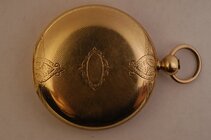
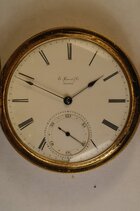
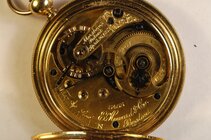
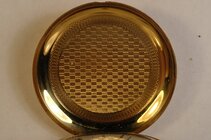
No one who knows me will be surprised to learn that the new item is a pocket watch. The movement is what collectors call either an E. Howard & Company (EH&Co) "Series III," in the older, more entrenched nomenclature, or a "Model 1862-N" in the more recent, and more informative nomenclature promulgated (by yours truly) beginning in 2002. The Howard factory records tell us that N Size movement S# 5,455, with Mershon's patent regulator was finished on September 19, 1864. My research indicates that this movement would have been valued at about $64, presumably the wholesale price, in the factory's inventory. All Howard movements of the period featured Reed's Patent protective mainspring barrels that protect the escapement from the consequences of mainspring failures, and keep watches running during winding. All EH&Co movements similarly featured Geneva style stopworks, an example of which is visible atop the barrel cock on Model 1862-N movement S# 5,455. Stopworks prevent overwinding and reduce the range of torque applied by the mainspring to the wheel train over the running period, promoting greater isochronism (i.e., rate uniformity over the running period). The movement is in its original 65 pennyweight 18K gold hunting style case, carrying the maker's mark of J. M. Harper. The "JMH" mark is seen on many early Howard watch cases. (The Howard firm itself never made cases for their movements.) The case contains 48.7 pennyweights, or 2.435 precious ounces net weight of pure gold, after subtracting the weight of the alloy metal, springs and crystal, which would have had a bullion value of about $50 in 1864. The quality of the case is evident not only from its weight but from the quality of the engraving and engine turning on its exterior and some interior surfaces. The retail price of this watch would have been around $150, which was about a year's pay for a Union private.
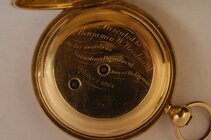
The dust cover (i.e., the interior rear lid, which has two keyholes, an eccentric one for the winding arbor, and a central one for the setting arbor) is engraved as follows:
"Presented to Benjamin W. Woodward by his Friends in the Subsistence Department, Army of the Potomac, October 1, 1864."
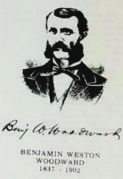
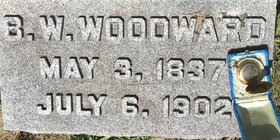
I have no idea who Benjamin W. Woodward was. (There was a Dr. Benjamin R. Woodward who was a major, serving as a surgeon in the 22nd Illinois Infantry, but the recipient of this watch is not him.) Given the cost of the watch, it's a sure bet that B. W. Woodward wasn't a laborer on some loading dock. He was very likely someone reasonably important to the AoP Subsistence Department's operation, whether a civilian employee (as no rank is attributed to him) or an important benefactor of some kind. I thought about looking into pension records, but I don't know whether civilian employees of the Subsistence Department would have received pensions. Does anyone know? An Internet search on numerous keyword combinations involving Woodward's name, both with and without various accompanying information, has turned up nothing useful. The source of the watch is no help, in this case, either. That trail ends with a deceased friend, and it's not clear he knew who Woodward was, either.
I seek suggestions from the Civil War collectors and artifact aficionados here on how to track this guy down.
Pictures to follow.
Thanks in advance for your help.
No one who knows me will be surprised to learn that the new item is a pocket watch. The movement is what collectors call either an E. Howard & Company (EH&Co) "Series III," in the older, more entrenched nomenclature, or a "Model 1862-N" in the more recent, and more informative nomenclature promulgated (by yours truly) beginning in 2002. The Howard factory records tell us that N Size movement S# 5,455, with Mershon's patent regulator was finished on September 19, 1864. My research indicates that this movement would have been valued at about $64, presumably the wholesale price, in the factory's inventory. All Howard movements of the period featured Reed's Patent protective mainspring barrels that protect the escapement from the consequences of mainspring failures, and keep watches running during winding. All EH&Co movements similarly featured Geneva style stopworks, an example of which is visible atop the barrel cock on Model 1862-N movement S# 5,455. Stopworks prevent overwinding and reduce the range of torque applied by the mainspring to the wheel train over the running period, promoting greater isochronism (i.e., rate uniformity over the running period). The movement is in its original 65 pennyweight 18K gold hunting style case, carrying the maker's mark of J. M. Harper. The "JMH" mark is seen on many early Howard watch cases. (The Howard firm itself never made cases for their movements.) The case contains 48.7 pennyweights, or 2.435 precious ounces net weight of pure gold, after subtracting the weight of the alloy metal, springs and crystal, which would have had a bullion value of about $50 in 1864. The quality of the case is evident not only from its weight but from the quality of the engraving and engine turning on its exterior and some interior surfaces. The retail price of this watch would have been around $150, which was about a year's pay for a Union private.
The dust cover (i.e., the interior rear lid, which has two keyholes, an eccentric one for the winding arbor, and a central one for the setting arbor) is engraved as follows:
"Presented to Benjamin W. Woodward by his Friends in the Subsistence Department, Army of the Potomac, October 1, 1864."
I have no idea who Benjamin W. Woodward was. (There was a Dr. Benjamin R. Woodward who was a major, serving as a surgeon in the 22nd Illinois Infantry, but the recipient of this watch is not him.) Given the cost of the watch, it's a sure bet that B. W. Woodward wasn't a laborer on some loading dock. He was very likely someone reasonably important to the AoP Subsistence Department's operation, whether a civilian employee (as no rank is attributed to him) or an important benefactor of some kind. I thought about looking into pension records, but I don't know whether civilian employees of the Subsistence Department would have received pensions. Does anyone know? An Internet search on numerous keyword combinations involving Woodward's name, both with and without various accompanying information, has turned up nothing useful. The source of the watch is no help, in this case, either. That trail ends with a deceased friend, and it's not clear he knew who Woodward was, either.
I seek suggestions from the Civil War collectors and artifact aficionados here on how to track this guy down.
Pictures to follow.
Thanks in advance for your help.
Last edited:
 Forum Host



 Bringing the