
 Forum Host
- Joined
- Aug 27, 2011
- Location
- Central Massachusetts
It was some time in 1864, the exact date is not recorded, that the actor Edwin Booth was on his way from New York to Washington to visit his friend, John T. Ford, owner of Ford's Theater. He had to change trains in Jersey City, New Jersey, and the platform was crowded with passengers buying sleeper berths from the conductor, at the carriage door. There, too, a young man was pressed by the crowd against the side of the car. Booth probably wouldn't have noticed him had the train not, at that moment, jerked, and moved a few feet. This movement whipped the man around and, losing his footing, he dropped into the space between the cars, an incredibly dangerous place to be. Had the train begun to move again, he would surely have been seriously injured, if not killed.

Edwin BoothReacting instantaneously Booth reached down and grabbed the young man by the coat collar, pulling him up onto the platform. Writing years later, that man recalled: "upon turning to thank my rescuer I saw it was Edwin Booth, whose face was of course well known to me, and I expressed my gratitude to him, and in doing so, called him by name." With thanks and handshakes, they parted, and went their separate ways.
Edwin Booth didn't know the identity of the young man whose life he had saved until early in 1865, when he received a note from an old friend, Col. Adam Badeau. Badeau congratulated him on the incident, saying that a fellow member of General Grant's staff had been telling everybody at City Point about his rescue by the famous actor. That young man, to Booth's surprise, was none other than Lieutenant Robert Todd Lincoln. The President's oldest son had been en route to Washington during a break from his studies at Harvard, and, like Booth, had had to change trains at that station.
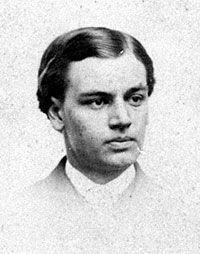
Robert LincolnThe story was told and retold in various newspapers and magazines for some 40 years, often with wildly inaccurate details. At the time of Edwin Booth's death in 1893, the Boston Morning Journal told a barely recognizable version: "At Bowling Green, Ky., it happened that Mr. Lincoln and Mr. Booth were waiting for a train. Neither was aware of the other's presence. Mr. Lincoln had strayed on a switching track. An engine came along, and he would have undoubtedly been struck and probably killed had not Mr. Booth, with a quick movement, pushed him out of harm's way." That account, it was said, came from "an eyewitness." It wasn't until 1909, that, at the request of Century Magazine editor Richard Watson Gilder, Robert Lincoln briefly described the gist of what actually happened. The "eyewitness" to the Bowling Green story, he said, "is simply a liar."
Too much can be made of the irony of a Booth saving Lincoln, and a Booth killing Lincoln. But, it is a curious coincidence -- particularly when including Booth's visit to John Ford.
[The above owes much to a more detailed article by Jason Emerson at Historynet.com, which originally appeared in Civil War Times magazine in April 2005]
Edwin Booth
Edwin Booth didn't know the identity of the young man whose life he had saved until early in 1865, when he received a note from an old friend, Col. Adam Badeau. Badeau congratulated him on the incident, saying that a fellow member of General Grant's staff had been telling everybody at City Point about his rescue by the famous actor. That young man, to Booth's surprise, was none other than Lieutenant Robert Todd Lincoln. The President's oldest son had been en route to Washington during a break from his studies at Harvard, and, like Booth, had had to change trains at that station.
Robert Lincoln
Too much can be made of the irony of a Booth saving Lincoln, and a Booth killing Lincoln. But, it is a curious coincidence -- particularly when including Booth's visit to John Ford.
[The above owes much to a more detailed article by Jason Emerson at Historynet.com, which originally appeared in Civil War Times magazine in April 2005]
Last edited:


 Bringing the