Davis A bitter angry old man

SSVilla

First Sergeant
Joined
Mar 25, 2024
Location
Virginia, USA
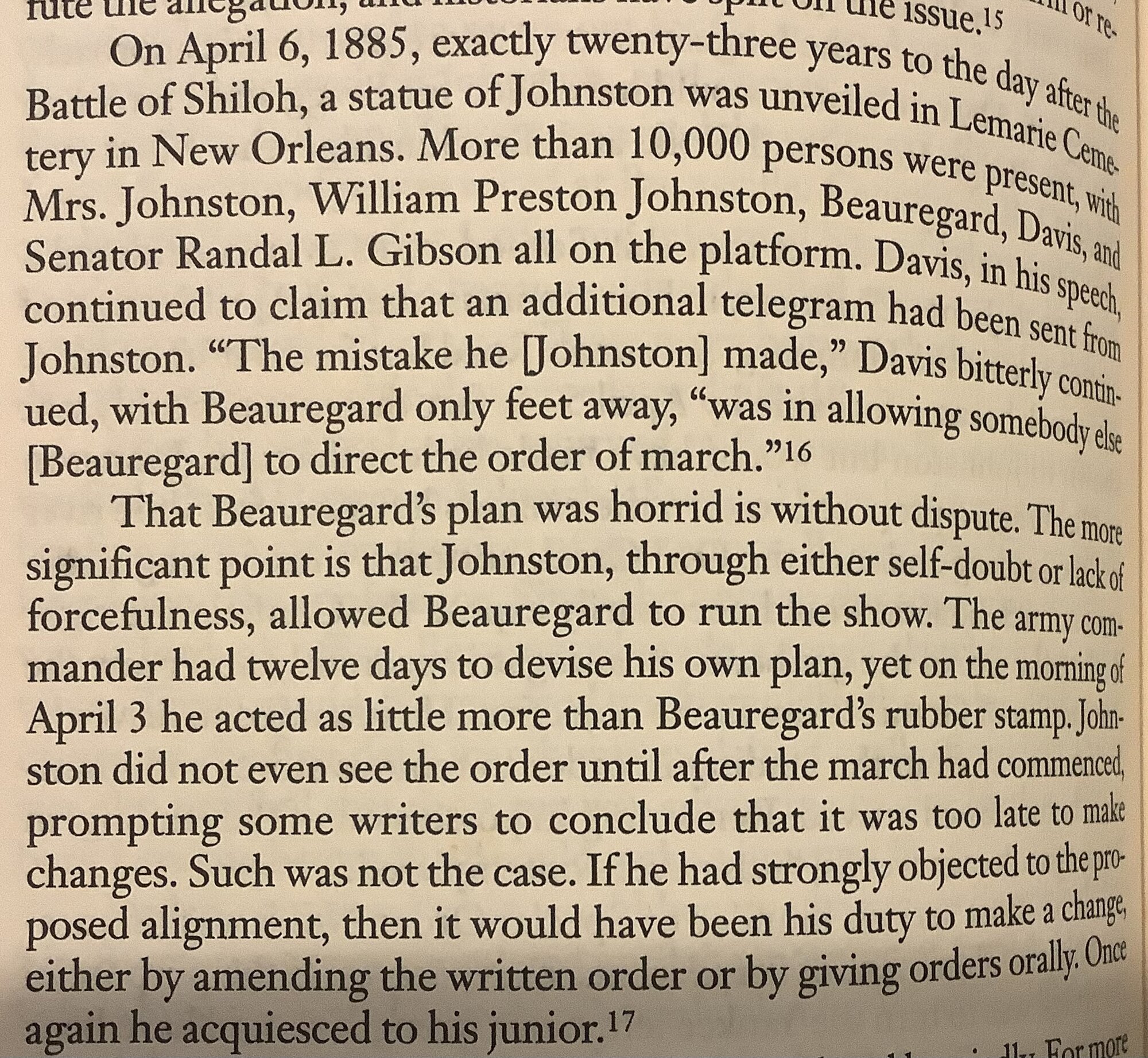
I am finding out that 23 years after the battle of Shiloh to the day, there was a statue of A.S. Johnston raised in a cemetery, an event at which many personalities of the day were present, including Johnston's widow, his son, Jeff Davis and Beauregard. Well this event is supposed to be solemn. Instead Davis launches a tirade from the platform blaming Beauregard for their defeat at Shiloh!

Tbh, all of a sudden I like Beauregard simply because he could get under the skin of this angry, bitter, and sour old man.

"That Beauregard's plan was horrid is beyond dispute" wrote Daniel, but that A.S. Johnston had anything else up his sleeve is daydreaming, a story.

IMG_0364.jpeg
 
From the papers:

1737604894015.png

Trenton Evening Times, Trenton, NJ, 4-7-1887.


The April 3, 1862 order of march was produced in the name of General Johnston.

1737605406942.png


Gen. Jordan noted later that as the Adjutant General of the whole army, he remained with Gen. Beauregard, and produced orders as necessary in Gen. Johnston's name.

1737605590426.png


Jordan notes that at that time, Gen. Beauregard was ill.

1737605750382.png

But laid out the order of march etc., and ordered Col. Roman to produce the marching order. Roman stated later that while doing so, Gen. Johnston arrived, and commenced a discussion on the subject, by which some alteration was evidently made, and Roman drew up the final marching order, etc. and commenced delivering it to the corps commanders. From a letter from Roman to Beauregard to this effect:

1737605983302.png

1737606036594.png


David Urquhart of Bragg's Staff stated he was present at some of these meetings, and confirms that the plans adopted for the movement were essentially those developed by Gen. Beauregard, approved by Gen. Johnston. It was generally acknowledged that Gen. Beauregard, second in command, received the notices from the corps commanders, and sent them their orders, etc., and more particularly provided the orders to the Army's chief of Staff, Gen. Bragg.

Mr. Daniel in the text suggests Davis' speech at the monument was a knock upon Gen. Beauregard. But it is more a criticism of Gen. Johnston. By detailing the movement of his troops to Beauregard, he was not entirely aware of where all of his troops were, and their condition, by the morning of April 5, and the difficulties they were having; with a portion of the army having failed to meet its deadline per the plan. This was a failure of time and movement, not of General Beauregard's orders, which were to have placed the attack on the morning of the 5th, with Buell's army a day away from Grant. Instead of the attack, they were having a meeting with Gen. Johnston on what to do. Beauregard suggested a withdrawal, given the undoubted proximity of Buell to Grant's camps in the lost hours. But Gen. Johnston determined to press the issue and attack the next morning.


Contrast Johnston's laxity in leaving troop movements to his subordinates, with General Lee. Lee as army commander concerned himself PRIMARILY with the movement of his troops... and let his subordinates concentrate upon preparing for battle and carrying them out.

1737606856141.png


IN contrast, Johnston before Shiloh, had charged Gen. Beauregard not only with the planning and execution of the march, but with the execution of the battle plan too.


1737605646064.png


In his 1881 "Rise and Fall of the Confederate Government" Vol II, Davis had stated the causes and who was responsible for the delays in the movement of Johnston's army to the front at Shiloh was immaterial.

1737607890290.png


However, as noted in the 1887 speech, he felt Johnston was ultimately in error for not personally managing the march so as to meet the approved timeline. I don't see how that could be construed that Gen. Beauregard somehow had erred.

1737608112094.png
 
Last edited:
From the papers:

View attachment 536322
Trenton Evening Times, Trenton, NJ, 4-7-1887.


The April 3, 1862 order of march was produced in the name of General Johnston.

View attachment 536324

Gen. Jordan noted later that as the Adjutant General of the whole army, he remained with Gen. Beauregard, and produced orders as necessary in Gen. Johnston's name.

View attachment 536325


Jordan notes that at that time, Gen. Beauregard was ill.

View attachment 536327
But laid out the order of march etc., and ordered Col. Roman to produce the marching order. Roman stated later that while doing so, Gen. Johnston arrived, and commenced a discussion on the subject, by which some alteration was evidently made, and Roman drew up the final marching order, etc. and commenced delivering it to the corps commanders. From a letter from Roman to Beauregard to this effect:

View attachment 536328
View attachment 536329

David Urquhart of Bragg's Staff stated he was present at some of these meetings, and confirms that the plans adopted for the movement were essentially those developed by Gen. Beauregard, approved by Gen. Johnston. It was generally acknowledged that Gen. Beauregard, second in command, received the notices from the corps commanders, and sent them their orders, etc.

Mr. Daniel in the text suggests Davis' speech at the monument was a knock upon Gen. Beauregard. But it is more a criticism of Gen. Johnston. By detailing the movement of his troops to Beauregard, he was not entirely aware of where all of his troops were, and their condition, by the morning of April 5, and the difficulties they were having; with a portion of the army having failed to meet its deadline per the plan. This was a failure of time and movement, not of General Beauregard's orders, which were to have placed the attack on the morning of the 5th, with Buell's army a day away from Grant. Instead of the attack, they were having a meeting with Gen. Johnston on what to do. Beauregard suggested a withdrawal, given the undoubted proximity of Buell to Grant's camps in the lost hours. But Gen. Johnston determined to press the issue and attack the next morning.


Contrast Johnston's laxity in leaving troop movements to his subordinates, with General Lee. Lee as army commander concerned himself PRIMARILY with the movement of his troops... and let his subordinates concentrate upon preparing for battle and carrying them out.

View attachment 536333

IN contrast, Johnston before Shiloh, had charged Gen. Beauregard not only with the planning and execution of the march, but with the execution of the battle plan too.


View attachment 536326


In his 1881 "Rise and Fall of the Confederate Government" Vol II, Davis had stated the causes and who was responsible for the delays in the movement of Johnston's army to the front at Shiloh was immaterial.

View attachment 536335

However, as noted in the 1887 speech, he felt Johnston was ultimately in error for not personally managing the march so as to meet the approved timeline. I don't see how that could be construed that Gen. Beauregard somehow had erred.

View attachment 536336
Thanks for sharing this. "The mistake he made was allowing somebody else to direct the order of march…" implies that person — the somebody else — did a bad job, while Johnston could have done better if he had done it himself.

I consider it an underhanded slap to both generals, the one doing the delegating and the one being delegated to. But the one delegated to was the one who messed up…
 
Thanks for sharing this. "The mistake he made was allowing somebody else to direct the order of march…" implies that person — the somebody else — did a bad job, while Johnston could have done better if he had done it himself.

I consider it an underhanded slap to both generals, the one doing the delegating and the one being delegated to. But the one delegated to was the one who messed up…

I just don't see any offense in the comment. I think the author is making a controversy where there was not any. Davis says Johnston, who was the commanding general, erred in turning over time-table and movement of his troops to a subordinate. In other words, he should have taken care of all that himself... because he was the commanding general and was responsible for it; and all the unit commanders were answerable to him. All the units of the army were answerable to him. Instead, as we are told, by the time he expected to attack, on the 5th, his troops were not in position, which was an unpleasant surprise he should have been aware of.

Staff officer William M. Polk with the army recalled of General Beauregard's assigned role:

1737647970557.png


General Bragg was, besides his corps command, charged with serving as the army's "chief of staff."

1737648060533.png


In carrying out the march, Beauregard and Bragg, and the corps commanders, were left to their own devices as regards getting to Shiloh, which they were ordered to reach by April 5. From W.M. Polk:

1737649095280.png

...

1737649153691.png


Gen. Johnston did not survive more than 24 hours after the April 5 meetings so no official report on his part was produced, which might or might not have levelled blame on any of his subordinates who failed to fulfill his orders for some inexcusable reason. But how would he, even were he to level blame on Beauregard, a subordinate, when he himself had ordered him to supervise the subject for him? Beauregard held no command with the army, so was not ultimately responsible for it or its movements until the moment of Johnston's death on the afternoon of April 6.

Prior to that time it was Johnston's and not Beauregard's army.

For example, the Confederate Army regulations of 1862 state the movement of troops is the responsibility of the commanding general. That his second takes his place at the head of the troops only when he is indisposed...

1737644482744.png


But in Johnston's case, he had ordered his junior, Beauregard, to both draft and execute the marching orders, though Beauregard held no command in the army, and his instructions were not official until approved and written out by the army's chief of Staff (Bragg).

The Confederate regulations note that in difficult marches, like that to Shiloh, the mode of handling the situations...

1737644835591.png


By most accounts General Johnston was personally tireless on the march... encouraging the troops, instructing officers, etc., but his subordinates and their staff officers could have done that. From his son William Preston Johnston:

1737645031524.png


Also, from the Confederate regulations, the troops on the march were to remain silent and not fire their guns, etc.

1737645390661.png


And again we are told again that Johnston concerned himself personally about the violation of this regulation, again, rather than leaving it to subordinate unit commanders...

1737645145296.png


General Beauregard had dealt with command issues before, the previous summer at Manassas. Once General Joe Johnston was on the scene, Beauregard was subordinate, and had to have his significant changes to orders approved before he could carry them out...

1737645995066.png


At Shiloh, the situation was different. Gen. Beauregard held no command, and could only give orders in the name of, and with the approval of, his commander, A.S. Johnston.

1737646144568.png


Only death relieved Gen. Johnston as the commander of the forces which marched to and entered the battle, and the responsibility for the same. That responsibility includes what Davis describes as his error in not providing a single head for the subject of the army's movement, but leaving it to subordinates who either had no command authority by which to enforce them, including Beauregard as second in command (as if a glorified adjutant), or Bragg as chief of staff.

And Bragg, as a corps commander, on the 4th, had employed his office as chief of staff, to impede the movement of the troops in an attempt to correct for delays in his own corps' movements...

1737650034019.png


Besides holding by Hardee's movement by instruction in Johnston and Beauregard's name, as Chief of Staff, Gen. Bragg as corps commander delayed his own corps, blocking the road of Polk's corps for a time into the next day.

As can be seen, Gen. Bragg did not seek approval of this modification from either Johnston or Beauregard before issuing the order delaying the march in their name (as army chief of staff) and secondly, even if Beauregard, who was responsible for the march timeline by Johnston's orders, had instantly objected, he was not in command of the army... Johnston was, and Bragg was only answerable to the latter as both corps commander and chief of staff.


General Beauregard, whom Johnston had ordered to conduct the march according to the orders, was really put out about all this, according to Gen. Polk, who joined Bragg and Beauregard in consultation the next day...

1737650457932.png


It was at that time, on the 5th, when Beauregard and the corps commanders were somewhat squabbling about the failure to get into position on time, and what to do about it, that Johnston finally (but too late to redeem the critical lost time) exercised his authority as head of the army to interject, and render the subject meaningless, by ordering a delay in the attack until the next morning, per his staff officer William Preston:

1737650871420.png


General Johnston ordered an attack order for dawn the next day, which replaced the standing orders since the 2nd to attack on the 5th, and rendering the subject in controversy, the failure to abide the marching orders, moot... in spite of the fearful battle order, Col. Roman says the subordinates were rendered in a good mood by the erasure of the errors in the march...

1737651947854.png
 
I think I see your point that Daniel is making more out of the speech than it was. Still I think it's implicit in Davis' criticism of Johnston for delegating, that the march was poorly planned by those delegated to. He made no reference to weather or road conditions but poor planning. However it's more nuanced than it would seem at first sight in Daniel's text.

Daniel was also citing Davis' speech in the context of discussing whether Johnston had a different battle plan, which Daniel raised questions about and pointed that historians have divided on it. And he persuaded me to doubt it quite honestly because the accounts of this different battle plan come mostly from his son and Davis. At any rate Johnston approved Beauregard plan so he assumed it as his own.

Davis speech doesn't refer to this alternate battle plan. In fact, Davis seemed to think the battle was conducted exactly as it had been designed… He was concerned with the delay in the march.

It's confusing.
 
I think I see your point that Daniel is making more out of the speech than it was. Still I think it's implicit in Davis' criticism of Johnston for delegating, that the march was poorly planned by those delegated to. He made no reference to weather or road conditions but poor planning. However it's more nuanced than it would seem at first sight in Daniel's text.

Daniel was also citing Davis' speech in the context of discussing whether Johnston had a different battle plan, which Daniel raised questions about and pointed that historians have divided on it. And he persuaded me to doubt it quite honestly because the accounts of this different battle plan come mostly from his son and Davis. At any rate Johnston approved Beauregard plan so he assumed it as his own.

Davis speech doesn't refer to this alternate battle plan. In fact, Davis seemed to think the battle was conducted exactly as it had been designed… He was concerned with the delay in the march.

It's confusing.

I don't think either Davis or Beauregard were confused. Gen. Johnston was in command of the army, as a unit. It was his responsibility to give it marching orders, etc. and see them carried out. He merely employed Gen. Beauregard to generate those orders while acting as a "second in command" to its commander (Johnston himself). Bragg was the chief of staff of Johnston's (not Beauregard's) army, responsible for communicating those army orders. Had Johnston ignored the details of his army's condition, etc., and simply managed the movement, and held the corps commanders to strict account to carry them out in time (without modifications to the army's movements of their own design, as in the case of Bragg, etc. on the 4th) then, and this appears to have been Davis' point, there could have been no delay such as occurred. In other words Johnston had not kept his "army" in hand during the march, but rather than presumed it could run like clockwork while he's concentrating on the internal parts.

Remember it was Beauregard on the 5th who suggested since the plan was busted by the march delays, that the army, as if sticking to Johnston's plan, withdraw. This would have placed the errors in the march in bold relief in a subsequent official report, as none of the subordinates had any right to believe their failure to abide the orders would be skipped over. Beauregard had never given any orders contrary to those approved.

But Johnston, who commanded the army, chose to issue NEW orders rendering his previous ones moot...and also officially expunging any dereliction relative to a failure to accomplish the previous ones... the new orders to now form and attack on the morning of the 6th which all commands performed without fail.

It was while the army was acting under these last orders that Gen. Johnston fell, and Beauregard, as second in command, assumed the role of commander of the Army. He continued Bragg as chief of staff, but from the afternoon of the 6th on, Bragg had only a single head, the commander of the army personally, (who personally generated his own orders) from whom to communicate orders, etc. And in his official report, Beauregard had little to say about the details of the march, as he had not been in command during the April 2-5 period in controversy. Johnston was, as Davis pointed out in the 1887 speech.
 
I don't think either Davis or Beauregard were confused. Gen. Johnston was in command of the army, as a unit. It was his responsibility to give it marching orders, etc. and see them carried out. He merely employed Gen. Beauregard to generate those orders while acting as a "second in command" to its commander (Johnston himself). Bragg was the chief of staff of Johnston's (not Beauregard's) army, responsible for communicating those army orders. Had Johnston ignored the details of his army's condition, etc., and simply managed the movement, and held the corps commanders to strict account to carry them out in time (without modifications to the army's movements of their own design, as in the case of Bragg, etc. on the 4th) then, and this appears to have been Davis' point, there could have been no delay such as occurred. In other words Johnston had not kept his "army" in hand during the march, but rather than presumed it could run like clockwork while he's concentrating on the internal parts.

Remember it was Beauregard on the 5th who suggested since the plan was busted by the march delays, that the army, as if sticking to Johnston's plan, withdraw. This would have placed the errors in the march in bold relief in a subsequent official report, as none of the subordinates had any right to believe their failure to abide the orders would be skipped over. Beauregard had never given any orders contrary to those approved.

But Johnston, who commanded the army, chose to issue NEW orders rendering his previous ones moot...and also officially expunging any dereliction relative to a failure to accomplish the previous ones... the new orders to now form and attack on the morning of the 6th which all commands performed without fail.

It was while the army was acting under these last orders that Gen. Johnston fell, and Beauregard, as second in command, assumed the role of commander of the Army. He continued Bragg as chief of staff, but from the afternoon of the 6th on, Bragg had only a single head, the commander of the army personally, (who personally generated his own orders) from whom to communicate orders, etc. And in his official report, Beauregard had little to say about the details of the march, as he had not been in command during the April 2-5 period in controversy. Johnston was, as Davis pointed out in the 1887 speech.
I am still trying to understand this. I had to reread the statement. I think the controlling words are "allow someone else to direct the order of march."

It seems you are interpreting that as Johnston not ensuring personally the execution of his orders (whether prepared by Beauregard or anyone else in his name), and holding people accountable, etc.

But the verb to direct in this context is vague. To direct, I interpret as issuing his own orders, ensuring the army can get to where he wants it in time by selecting the right roads, routes, and in what order, etc.

Am I confused in some military sense that my civilian understanding doesn't grasp?
 
Last edited:

Learn About Us
About CivilWarTalk
Contact the Webmaster
Meet the Staff
Link to CivilWarTalk
Join Our Community
Register
Browse Forums
View Today's Discussions
Search the Forum
Get Help
FAQ
Student Guide
Forum Rules & Etiquette
Copyright / DMCA

     Contact Us CivilwarTalk on Facebook CivilWarTalk on YouTube CivilWarTalk on Twitter RSS Feed

Bringing the American Civil War and More to Life.
© 1999 - , CIVILWARTALK, LLC - Site Version 10.0

SlaveryTalk.com - SecessionTalk.com - CivilWarTalk.com - ReconstructionTalk.com
Back
Top