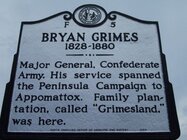
On the afternoon of 14 Aug. 1880, General Grimes was returning to Grimesland, in his buggy from "Little Washington," as it was then called, where he had been to attend the Beaufort County political convention and to take care of some business. His only companion was twelve-year-old Bryan Satterthwaite, the son of a neighbor. While they were crossing Bear Creek, approximately four miles from Grimesland, the gun of a concealed assassin was discharged, killing Grimes instantly. Young Satterthwaite drove to the nearest neighbor and received assistance in taking the dead man home. A few days later funeral services were held at Grimes's residence. After burial services at the Episcopal church, he was interred in the family burying grounds about three hundred yards from his residence.
The alleged cause of the assassination was to prevent Grimes from testifying in court about some criminal matter. One William Parker, described by the Raleigh News and Observer as a "sorry kind of a fellow with no particular occupation, and with a reputed bad character,"was arrested on suspicion of murder. The jury found him not guilty, however, and Parker was set free.
Except as a subject of conversation, the Grimes case lay dormant for the next seven years. What happened to Parker during this period is not known. At any rate, he was back in Washington on a Saturday night in early November 1888, when he got drunk and boasted that he had killed General Grimes. He was immediately picked up on a charge of drunkenness and placed in the Washington jail. Early the next morning, between ten and fifteen masked men entered the jail, took Parker out, and strung him up on the drawbridge across the Pamlico River. A coroner's jury assembled and returned a verdict of "death by hanging at the hands of parties unknown." Charges were never filed, and no serious effort was made to solve the new murder. The people had gaine

 Forum Host



 Bringing the