2nd Texas Infantry

I work at the Corinth Civil War Interpretive Center and Col. Roger's grave is about 100 yards from my desk.

Here is another view of the Confederate dead which is not so widely known. When you compare the two photos you can see how the photographer (Brown) moved the bodies to improve his image. Not unlike what Matthew Brady was known to do.

Battery Robinett 5.jpg
 

How has the identity of the sword's original owner been determined to be Col. Rogers? I presume the fellow holding it is the current owner, but surely Rogers' sword remained in Battery Robinette to be picked up by Federal soldiers. Since this type sword is usually unmarked how has its provenance been maintained?
 
How has the identity of the sword's original owner been determined to be Col. Rogers? I presume the fellow holding it is the current owner, but surely Rogers' sword remained in Battery Robinette to be picked up by Federal soldiers. Since this type sword is usually unmarked how has its provenance been maintained?
That is a good question. I was mildly shocked when I came across the article about the sword. I thought this is a real big discovery. The article mentioned a descendant of Rogers that met with the current owner at Corinth and inspected the sword, but I don't know if it really is what the article purports it to be. Anybody out there know what the background is?

In Joe Chance's book is a picture of Col. Roger's breast plate armor in the Wisconsin Historical Society, carried back by a Wisconsin soldier. I have always wondered if it is still on display.
 
How has the identity of the sword's original owner been determined to be Col. Rogers? I presume the fellow holding it is the current owner, but surely Rogers' sword remained in Battery Robinette to be picked up by Federal soldiers. Since this type sword is usually unmarked how has its provenance been maintained?
Just re-read the article, it says Alan Wandling's (the current owner) great-uncles were in the 63rd Ohio at Corinth (I presume picked it up) at Battery Robinett. Again don't know if any of it can be verified. Does anybody know if Wandling is ever on CWT? Says he is a civil war collector so maybe someone knows him.
 
I just got my copy of McCluney's "The Yazoo Pass Expedition" and Moore's Brigade and the 2nd Texas Regiment was listed as participants of the Battle of Fort Pemberton (Greenwood), Mississippi.
I'm thinking I want that one too. I believe my kin in the 40th AL Infantry was at Fort Pemberton.
 
What a great thread. I am loving this Regimental Histories forum.
 
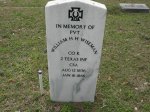
W. H. H. Wiseman marker.jpg N. W. Wiseman marker.jpg William's marker is at Edna. His actual gravesite is unknown, it may have been lost when they created Lake Texana. He was sick from the war service, and died at Texana in January 1866 at age 29.

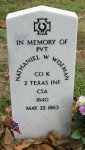
Nathaniel died at the Siege of Vicksburg and his marker is in Soldier's Rest at Cedar Hill in Vicksburg. He was buried either on the battlefield or in the City Cemetery (Cedar Hill) exact location unknown.

If any one else knows of any Second Texas grave markers please post a picture.
 
I'm thinking I want that one too. I believe my kin in the 40th AL Infantry was at Fort Pemberton.

No, sir.
There was the 54 AL in Tilghman's Bgde and the 37 & 42 AL in Moore's Bgde.
There were 9 Regiments from Mississipp, and 1 each from KY, & TN and 2 Texas & Wauls Texas plus a few cavalry units. Then artillery if course.

What Im not clear on is what units were moved to that area to defend other forts. Im guessing these units were at various locations at first but converged at Ft Pemberton after the Plan of Union advance was determined.

:::::Edited:::
I havent checked my web page against the Org Table in his booklet but I think it matches.
Note the Gen J Z George was in command of a group of state militia that only numbered 50 or so.

Link. http://custermen.com/DixieBoys/FtPembertonOrg.htm
 
Last edited:
No, sir.
There was the 54 AL in Tilghman's Bgde and the 37 & 42 AL in Moore's Bgde.
There were 9 Regiments from Mississipp, and 1 each from KY, & TN and 2 Texas & Wauls Texas plus a few cavalry units. Then artillery if course.

What Im not clear on is what units were moved to that area to defend other forts. Im guessing these units were at various locations at first but converged at Ft Pemberton after the Plan of Union advance was determined.

:::::Edited:::
I havent checked my web page against the Org Table in his booklet but I think it matches.
Note the Gen J Z George was in command of a group of state militia that only numbered 50 or so.

Link. http://custermen.com/DixieBoys/FtPembertonOrg.htm
The mystery deepens. That belief came from info obtained in another thread in this forum. Don't wanna mix up the Regimental Histories. Gonna post in the other one and tag you so you'll see where.
 
How has the identity of the sword's original owner been determined to be Col. Rogers? I presume the fellow holding it is the current owner, but surely Rogers' sword remained in Battery Robinette to be picked up by Federal soldiers. Since this type sword is usually unmarked how has its provenance been maintained?

Perhaps I can shed some light to this question. In January I had a letter from a man who had read about Rogers' sword and questions concerning its ownership, he also asked whether steps had been taken to place the sword on permanent display at the Corinth Civil War Interpretive Center. Below is my response.

Dear Mr. ----

Thank you for your letter concerning the sword of Colonel William P. Rogers, commanding officer of the 2nd Texas Infantry Regiment.

I am afraid there is no clear answer to your query as several people claimed to have had the sword over the years.

In your letter you refer to the National Tribune of May 3, 1894, and a letter submitted by J.F. McGinnis. This letter was in response to a statement in the National Tribune of March 15, 1894 when "Private, Co. H, 11th Mo.," wrote, "After the Johnnies were repulsed Lieut. E.R. Applegate of Co. H, 11th Mo., secured Col. Rogers's sword, and still has it in his possession." In the May 24th issue of this same newspaper J.B. Van Eman of the 39th Ohio wrote, "His revolver, with one of its cylinders dented in by a minie and part of the stock gone, was captured by Bennett Stout of Co. I, 39th Ohio; his sword, if he had one, I did not see…Relic-lovers first cut the lace from his coat, then the buttons; finally his clothing went piece by piece, until by nightfall there was nothing on him but his under-clothing."

This last letter was responded to in the same newspaper by George W. Henry of the 11th Missouri on June 28, 1894. "I went to him, and in his right hand he clasped his sword. I took it, and have it to-day, one of my most prized trophies of the war."

On August 15, 1912 the monument to Col. Rogers was dedicated in Corinth next to his grave. This monument is located directly behind the modern Corinth Civil War Interpretive Center. The March 1913 issue of Confederate Veteran, p. 102, has a detailed account of the event. Included in the article is the following passage: "Then the monument was unveiled by Mabel and Bollin Outlar, great-grandchildren of Colonel Rogers, and there was a salute to the monument by John Austin Saunders, great-grandson of Colonel Rogers, with the sword of his famous ancestor."

The story of the sword is picked up again a hundred years later in 2012 when Mr. Allen Wandling claimed to be the owner of the sword and scabbard and brought them to a Civil War relic show in Corinth. According to Mr. Wandling the sword was picked up on the field by William Rowley of the 58th Illinois Infantry who claimed to have cut the sword from Rogers's belt. Rowley, in turn, gave it to an unidentified officer in the 9th Illinois Infantry. According to an interview on www.auctioncentralnews.com "He bought the leather scabbard of the sword in 2006 from a man who was selling it for his grandfather in Joplin, Mo. The man said his grandfather had inherited it from a sister who was married to a Belleville police officer, who got the sword when the GAR headquarters was sold at auction. Three years later he bought the sword from the same family who found the artifact "in a closet after the old man died."

The earlier accounts by men of the 39th Ohio and 11th Missouri are supported by their proximity on the battlefield to Battery Robinett. This would place them in excellent position to witness the death of Rogers and also be on hand to secure the sword from other soldiers wishing to acquire such a prize. The 58th Illinois Infantry, on the other hand, was nearly a half mile away, just south of Battery Powell. Rowley's position on the field does not support the likelihood that he traversed the battlefield, while some fighting was still occurring, and beat the soldiers of two other infantry brigades to the prize.

In short, the waters are very muddy. If the documented sword ever becomes available we would consider it an honor to place it on exhibit in our visitor center in Corinth.
 
The death of Col. Rogers was witnessed by hundreds, if not thousands. You might think this event would be well documented and the facts to be straight-forward and accepted. The truth of the matter is, few of the witnesses could agree on even the barest details of his death.
I gave a talk on his death on Oct. 4, 2016 to show how there was as much disagreement on the details as there was agreement. I looked at newspapers, diaries, OR reports, articles, etc. and of forty-two "eyewitnesses" this is some of the information gleaned:

Col. Rogers fell near the ditch in front of Battery Robinett – 8 eyewitnesses

40 feet from ditch – 1

100 feet from ditch – 1

Less than 50 yards - 1

100 yards from ditch – 2

While in retreat – 1

On College Hill (1/2 a mile from Robinett!) – 1

Died on the breastworks of Robinett – 11

Carried the colors of the 2nd Texas – 9

Never carried the colors - 1

Planted the colors on the parapet - 7

Rode his horse onto the parapet – 7

Horse killed near tree line (300 yards) - 1
 
The death of Col. Rogers was witnessed by hundreds, if not thousands. You might think this event would be well documented and the facts to be straight-forward and accepted. The truth of the matter is, few of the witnesses could agree on even the barest details of his death.
I gave a talk on his death on Oct. 4, 2016 to show how there was as much disagreement on the details as there was agreement. I looked at newspapers, diaries, OR reports, articles, etc. and of forty-two "eyewitnesses" this is some of the information gleaned:

Col. Rogers fell near the ditch in front of Battery Robinett – 8 eyewitnesses

40 feet from ditch – 1

100 feet from ditch – 1

Less than 50 yards - 1

100 yards from ditch – 2

While in retreat – 1

On College Hill (1/2 a mile from Robinett!) – 1

Died on the breastworks of Robinett – 11

Carried the colors of the 2nd Texas – 9

Never carried the colors - 1

Planted the colors on the parapet - 7

Rode his horse onto the parapet – 7

Horse killed near tree line (300 yards) - 1

A big part of the problem is that likely few if any of the Federals actually knew (or cared) who Rogers or any of the other fallen Confederate officers were at the time and once his body had been identified and subsequently robbed by souvenir hunters as described by @Tom P it might have no longer been in its original place. The famous photo has been admittedly re-arranged by the photographer and possibly even after the bodies were gathered (and moved) for burial. With such cloudy provenance and based on the photographs the most I would venture to say about the sword in question is that it is a regulation U.S. M.1850 Sword for Foot Officers (captains and lieutenants of infantry or foot artillery) and from the grip wrap which appears to be leather instead of shagreen or rayskin *might* be of Confederate manufacture. This would be possible in Rogers' case because the same type sword was carried by Gen. Lewis Armistead when he was mortally wounded at Gettysburg but is in no way conclusive that this was indeed Rogers' sword. Here's my thread on pieces of this type: http://civilwartalk.com/threads/regulation-officers-swords.111513/

Expired Image Removed
 
The famous photo has been admittedly re-arranged by the photographer and possibly even after the bodies were gathered (and moved) for burial.

James N., Have you seen a statement from Nicholas Brown that he moved the bodies? This is exciting if you do as we know very little about his activities in Corinth.

In the book, "Lens of War: Exploring Iconic Photographs of the Civil War" the author gives credit for the photos to G.W. Armstead claiming that Brown was based in St. Louis. and only produced the image as a second generation type marketer. This is not correct. Nicholas Brown had a studio adjacent to Armstead's on the east side of the Tishomingo Hotel in Corinth and advertised in the "Corinth Chanticleer" a newspaper produced by soldiers of the garrison.
 
James N., Have you seen a statement from Nicholas Brown that he moved the bodies? This is exciting if you do as we know very little about his activities in Corinth...

No, I was going by your statement in post#22 above; but it definitely looks like the bodies have been to at least a degree "laid out" as if for burial indicating that some of them were likely moved. Of course he may have done no more than prop up Rogers' corpse so it would show up better in his photo.
 
These three photographs are the only known images of dead soldiers in the western theater. I have seen one claim that it is the only example of an identified body (Rogers) from the entire war. I have my doubts concerning this claim, and as stated earlier, the man lying against Rogers is Capt. Foster of the 42nd Alabama.
 
The death of Col. Rogers was witnessed by hundreds, if not thousands. You might think this event would be well documented and the facts to be straight-forward and accepted. The truth of the matter is, few of the witnesses could agree on even the barest details of his death.
I gave a talk on his death on Oct. 4, 2016 to show how there was as much disagreement on the details as there was agreement. I looked at newspapers, diaries, OR reports, articles, etc. and of forty-two "eyewitnesses" this is some of the information gleaned:

Col. Rogers fell near the ditch in front of Battery Robinett – 8 eyewitnesses

40 feet from ditch – 1

100 feet from ditch – 1

Less than 50 yards - 1

100 yards from ditch – 2

While in retreat – 1

On College Hill (1/2 a mile from Robinett!) – 1

Died on the breastworks of Robinett – 11

Carried the colors of the 2nd Texas – 9

Never carried the colors - 1

Planted the colors on the parapet - 7

Rode his horse onto the parapet – 7

Horse killed near tree line (300 yards) - 1
Thanks for this. I've read several accounts of Rogers' death - all conflicting - and I'm not surprised that there are even more. I'm sure a lot of it was generated from talk among Federal soldiers after the battle, and perhaps some confused his death with other Confederate officers they witnessed. I imagine rather few actually witnessed his death, while many probably walked up to view his body after the battle and were told how it happened.

I have seen one claim that it is the only example of an identified body (Rogers) from the entire war. I have my doubts concerning this claim
There are one or two photos from Gettysburg of Confederate dead lying in open graves with headboards placed above to identify them, so certainly not only case of identified bodies in photographs.
 
I imagine rather few actually witnessed his death, while many probably walked up to view his body after the battle and were told how it happened.
Most of the Union men who claimed to have seen his death were actually in a position to do so. They were primarily from John Fuller's Ohio Brigade (27th, 39th, 43rd and 63rd Infantry) as well as the 11th Missouri of Mower's brigade. I have a much harder time believing the accounts of a few men whose regiments were on the other side of the town. No less an observer than Maj. Gen. William S. Rosecrans stated that Rogers was shot down by a drummer boy; an interesting claim given he was better than 500 yards away across a very smoky battlefield.
 
I am currently working on an article for the local newspaper about a drummer boy of the 43rd Ohio Infantry who created a fascinating drawing of the Battle of Corinth. This drawing later became a well known lithograph. He was 18 at the time of the battle and he wrote a gripping account "What a Drummer Boy Saw" which can be found in The History of Fuller's Ohio Brigade by Charles H. Smith.

The drummer, David Auld, stated he saw Rogers who, "was instantly shot dead by a soldier of Company A, 43rd*"
At the bottom of the page he explains the asterisk -
"But one bullet struck Colonel Rogers, and that in the right breast. The writer cut the gold stars from his collar a few minutes later, supposing him the be a Major-General until informed differently by one of his men. His body lay a few feet from the ditch where it was placed by his men when shot. Many of those present supposed that the officer lying in the road by the dead horse about forty feet from the ditch was Colonel Rogers, but this is not correct. This officer was Colonel of an Arkansas Regiment and must have been killed by canister from Robinett, as more than a dozen balls had struck him in the breast. He was of slight build, dressed in dark blue clothes. Rogers was a rather fleshy man dressed in gray with high patent leather boots."

Though there are a few details which are certainly wrong (the deal Arkansas colonel) his painting was obviously done by a man who was there and saw the 2nd Texas make their two tragic charges. David and his younger brother Demas can be seen carrying the stretcher. The wounded man was their older brother Bradford with a mortal wound to the shoulder. The 43rd Ohio is on the left of the fort, the 63rd to the right, and the 11th Missouri is lying down in the foreground. The flag of the 2nd Texas is in front of the small fort.
VEH337.Map.Auld.jpg
 

Learn About Us
About CivilWarTalk
Contact the Webmaster
Meet the Staff
Link to CivilWarTalk
Join Our Community
Register
Browse Forums
View Today's Discussions
Search the Forum
Get Help
FAQ
Student Guide
Forum Rules & Etiquette
Copyright / DMCA

     Contact Us CivilwarTalk on Facebook CivilWarTalk on YouTube CivilWarTalk on Twitter RSS Feed

Bringing the American Civil War and More to Life.
© 1999 - , CIVILWARTALK, LLC - Site Version 10.0

SlaveryTalk.com - SecessionTalk.com - CivilWarTalk.com - ReconstructionTalk.com
Back
Top