
East Tennessee Roots
Major
- Joined
- Dec 31, 2010
- Location
- Kingsport, Tennessee
Historian Carol Reardon, I believe a native of Minnesota, was asked by a caller on the c-span coverage Sunday why Minnesota had two monuments at Gettysburg ? She quickly answered they actually have three, because they deserved them !
Gettysburg after battle report:
Report of Capt. Henry C. Coates, First Minnesota Infantry.
Near Ellis' Ford, Va.,
August 3, 1863.
Sir: Pursuant to circular of this date, I respectfully submit the following
statement of the part taken by this regiment in the late battle
near Gettysburg, Pa.:
About 3 o'clock on the morning of July 2, we were ordered into
position near the center of our line of battle, to the left of the town.
The battle commenced at daylight, and raged with fury the entire day.
We remained under a severe artillery fire, but were not actively engaged
until about 5 p. m., when we were moved to support Battery C,
Fourth U. S. Artillery. Company F was about this time detached
from the regiment as skirmishers, and Company L as sharpshooters.
Our infantry in front of us had advanced upon the enemy and pushed
him for a while, but were in turn driven back in some confusion,
the enemy following in heavy force. To check the enemy, we were
ordered to advance, which we did, moving at double-quick down the
slope of the hill right upon the rebel line. The fire we encountered
here was terrible, and, although we inflicted severe punishment
upon the enemy, and stopped his advance, we there lost in killed and
wounded more than two-thirds of our men and officers who were engaged.
Here Capt. Muller, of Company E, and Lieut. Farrar, of
Company I, were killed; Capt. Periam, of Company K, mortally
wounded. Col. Colvill, Lieut.-Col. Adams, Maj. Downie,
Adjutant Peller, and Lieut.'s Sinclair, Company B; Demarest,
Company E; De Gray, Company G; and Boyd, Company I,
were severely wounded.
The command of the regiment now devolved upon Capt. Nathan
S. Messick, and we were moved again to the right, near the position
first occupied by us, where we slept on our arms during the night.
At daybreak the next morning the enemy renewed the battle with
vigor on the right and left of our line with infantry, and about 10 a.
m. opened upon the center, where we were posted, a most severe fire
of artillery, which continued without intermission until 3 p. m., when
heavy columns of the enemy's infantry were thrown suddenly forward
against our position. They marched resolutely in the face of a
withering fire up to our lines, and succeeded in planting their colors
on one of our batteries. The point of attack was to the right of our
position, and held by the Second Brigade of our division (Second
Division, Second Army Corps). As the enemy approached, we were
moved by the right flank to oppose them, firing upon them as we approached,
and sustaining their fire, together with the fire of batteries
which they had brought up to within short range. The fighting
here was desperate for a time. At length the regiment and others
closed in upon the enemy, and nearly the whole of the rebel force
which remained alive were taken prisoners. About 500 were captured
by this regiment; also the colors of the Twenty-eighth Virginia
Regt., taken by Private Marshall Sherman, of Company C.*
The regiment here again lost severely. Capt. Nathan S. Messick,
while gallantly leading the regiment, fell early in the action. Capt.
W. B. Farrell, Company C, was mortally wounded, and died on the
day following. Lieut.'s Mason and Heffelfinger, Company D,
Harmon, Company C, and May, Company B, were wounded.
The enemy did not recover from this repulse, and the battle was
now won. The entire regiment, excepting Company L, was in this
last fight. This company had been detached as sharpshooters, to
support Kirby's battery, where it did very effective service. Every
man in the regiment did his whole duty.
The accompanying list of killed and wounded shows the severity
of our loss.
Your obedient servant,
H. C. COATES,
Capt., Comdg. Regt.
Lieut. F. W. Haskell,
Acting Assistant Adjutant-Gen.
Source: Official Records: Series I. Vol. 27. Part I. Reports. Serial No. 43
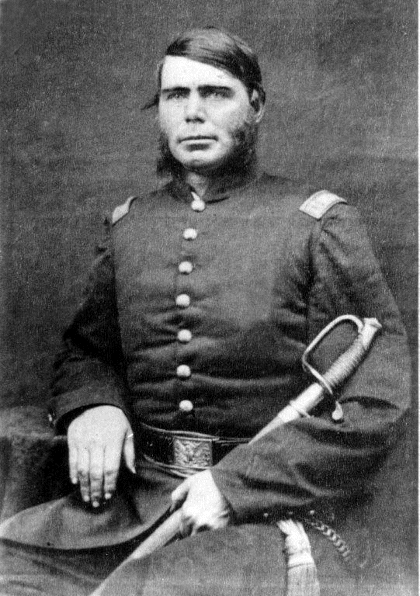
William Colville, Jr
Residence was not listed; 30 years old.
Enlisted on 4/29/1861 at Red Wing, Goodhue County, MN as a Captain.
On 4/29/1861 he was commissioned into "F" Co. MN 1st Infantry
He was Mustered Out on 5/4/1864
On 4/26/1865 he was commissioned into Field & Staff MN 1st Heavy Artillery
He was discharged on 5/6/1865
He was listed as:
* Wounded 5/8/1862 Glendale, VA
* Wounded 7/2/1863 Gettysburg, PA
Promotions:
* Capt 4/29/1861
* Major 8/28/1862
* Lt Colonel 9/26/1862
* Colonel 5/6/1863
* Brig-General 3/13/1865 by Brevet
* Colonel 4/26/1865 (As of 1st MN HA)
Intra Regimental Company Transfers:
* 8/28/1862 from company F to Field & Staff
Other Information:
born 4/5/1830 in Forestville, NY
died 6/13/1905 in Minneapolis, MN
- Minnesota in the Civil and Indian Wars 1861-65
- Minnesota Adjutant General's Report of 1866
- Dyer: A Compendium of the War of the Rebellion
- Brevet Brigadier Generals in Blue
- Heitman: Register of United States Army 1789-1903
Gettysburg after battle report:
Report of Capt. Henry C. Coates, First Minnesota Infantry.
Near Ellis' Ford, Va.,
August 3, 1863.
Sir: Pursuant to circular of this date, I respectfully submit the following
statement of the part taken by this regiment in the late battle
near Gettysburg, Pa.:
About 3 o'clock on the morning of July 2, we were ordered into
position near the center of our line of battle, to the left of the town.
The battle commenced at daylight, and raged with fury the entire day.
We remained under a severe artillery fire, but were not actively engaged
until about 5 p. m., when we were moved to support Battery C,
Fourth U. S. Artillery. Company F was about this time detached
from the regiment as skirmishers, and Company L as sharpshooters.
Our infantry in front of us had advanced upon the enemy and pushed
him for a while, but were in turn driven back in some confusion,
the enemy following in heavy force. To check the enemy, we were
ordered to advance, which we did, moving at double-quick down the
slope of the hill right upon the rebel line. The fire we encountered
here was terrible, and, although we inflicted severe punishment
upon the enemy, and stopped his advance, we there lost in killed and
wounded more than two-thirds of our men and officers who were engaged.
Here Capt. Muller, of Company E, and Lieut. Farrar, of
Company I, were killed; Capt. Periam, of Company K, mortally
wounded. Col. Colvill, Lieut.-Col. Adams, Maj. Downie,
Adjutant Peller, and Lieut.'s Sinclair, Company B; Demarest,
Company E; De Gray, Company G; and Boyd, Company I,
were severely wounded.
The command of the regiment now devolved upon Capt. Nathan
S. Messick, and we were moved again to the right, near the position
first occupied by us, where we slept on our arms during the night.
At daybreak the next morning the enemy renewed the battle with
vigor on the right and left of our line with infantry, and about 10 a.
m. opened upon the center, where we were posted, a most severe fire
of artillery, which continued without intermission until 3 p. m., when
heavy columns of the enemy's infantry were thrown suddenly forward
against our position. They marched resolutely in the face of a
withering fire up to our lines, and succeeded in planting their colors
on one of our batteries. The point of attack was to the right of our
position, and held by the Second Brigade of our division (Second
Division, Second Army Corps). As the enemy approached, we were
moved by the right flank to oppose them, firing upon them as we approached,
and sustaining their fire, together with the fire of batteries
which they had brought up to within short range. The fighting
here was desperate for a time. At length the regiment and others
closed in upon the enemy, and nearly the whole of the rebel force
which remained alive were taken prisoners. About 500 were captured
by this regiment; also the colors of the Twenty-eighth Virginia
Regt., taken by Private Marshall Sherman, of Company C.*
The regiment here again lost severely. Capt. Nathan S. Messick,
while gallantly leading the regiment, fell early in the action. Capt.
W. B. Farrell, Company C, was mortally wounded, and died on the
day following. Lieut.'s Mason and Heffelfinger, Company D,
Harmon, Company C, and May, Company B, were wounded.
The enemy did not recover from this repulse, and the battle was
now won. The entire regiment, excepting Company L, was in this
last fight. This company had been detached as sharpshooters, to
support Kirby's battery, where it did very effective service. Every
man in the regiment did his whole duty.
The accompanying list of killed and wounded shows the severity
of our loss.
Your obedient servant,
H. C. COATES,
Capt., Comdg. Regt.
Lieut. F. W. Haskell,
Acting Assistant Adjutant-Gen.
Source: Official Records: Series I. Vol. 27. Part I. Reports. Serial No. 43
William Colville, Jr
Residence was not listed; 30 years old.
Enlisted on 4/29/1861 at Red Wing, Goodhue County, MN as a Captain.
On 4/29/1861 he was commissioned into "F" Co. MN 1st Infantry
He was Mustered Out on 5/4/1864
On 4/26/1865 he was commissioned into Field & Staff MN 1st Heavy Artillery
He was discharged on 5/6/1865
He was listed as:
* Wounded 5/8/1862 Glendale, VA
* Wounded 7/2/1863 Gettysburg, PA
Promotions:
* Capt 4/29/1861
* Major 8/28/1862
* Lt Colonel 9/26/1862
* Colonel 5/6/1863
* Brig-General 3/13/1865 by Brevet
* Colonel 4/26/1865 (As of 1st MN HA)
Intra Regimental Company Transfers:
* 8/28/1862 from company F to Field & Staff
Other Information:
born 4/5/1830 in Forestville, NY
died 6/13/1905 in Minneapolis, MN
- Minnesota in the Civil and Indian Wars 1861-65
- Minnesota Adjutant General's Report of 1866
- Dyer: A Compendium of the War of the Rebellion
- Brevet Brigadier Generals in Blue
- Heitman: Register of United States Army 1789-1903


 Bringing the