Museum 1828 Musketoon

Eric 43

Cadet
Joined
Nov 22, 2019
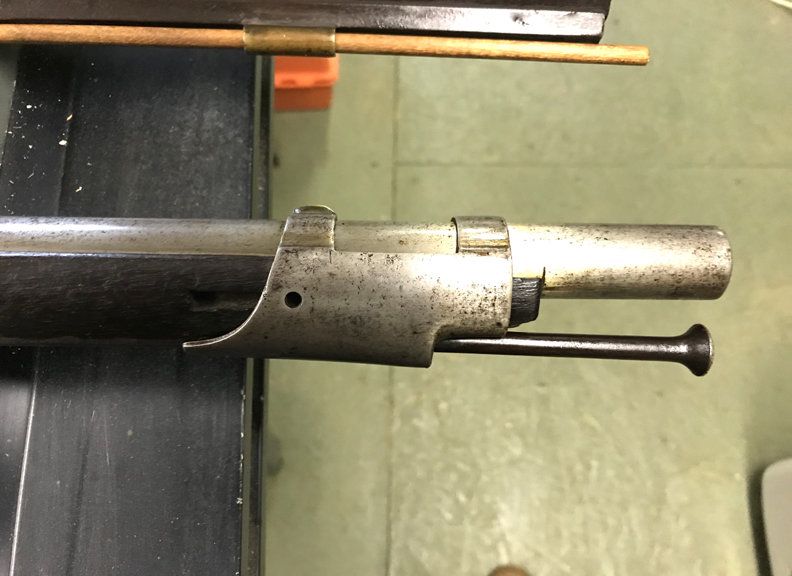
Hello to the forum. Thanks for adding me. I am starting to clean and oil the firearms/edged weapon collection at a local museum. One of our pieces is this interesting musket. I believe that it, originally, was a model 1816. The lockplate is dated 1828 and it has been converted to percussion. The barrel has also been cut down to 31" and the nose cap/front sight refitted. Actually it is loose and can be slid off after removing the ramrod.

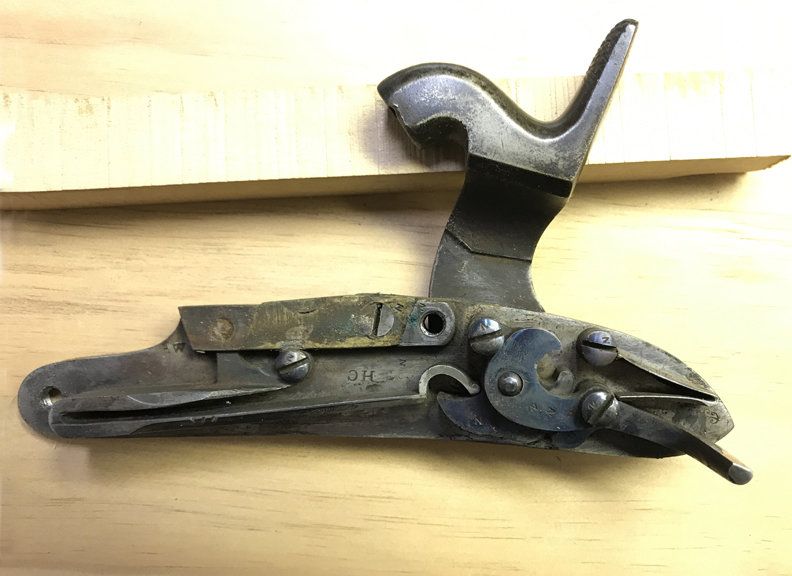
I removed the lock to clean and oil and found it to be in great shape - the strongest mainspring I've ever encountered. The top bridle screw is broken. The threads are in the lockplate and the remainder will fall out if the lock is turned over. Other than that there's no rust and the bluing is still in place on the bridle and tumbler.

The .69 smoothbore barrel is also in great shape. I used a 12 ga. shotgun wire brush and patches to clean the bore. I don't have a bore light, but other than a lot of surface rust the bore felt smooth. I oiled the bore and wiped the outside.

I would like to add some information on the gun when I take it back to the archives. I've added some photos of the markings. Can anyone add some information on the piece. Was it converted and cut down by the army or was it sold and privately modified? Anything unique about the stock and lock markings?

Any info would be appreciated.

Thanks.
Lock Inside.jpg
Lock Outside.jpg
Muzzle.jpg
Sideplate markings.jpg
 
It was converted to percussion by the government, the cone-in-barrel alteration is the type done by them. The markings on the stock, opposite the lock, denote the inspections done at the time of alteration. The muskets in inventory were graded regarding the suitability for alteration, considering factors such as overall condition. The number 3 inside the cartouche on the right is the grade this particular musket received.

The subsequent alteration to the length was not done by the government. They would not have done such a poor job of it. Your guess is as good as mine as to whom and when.
 
It was converted to percussion by the government, the cone-in-barrel alteration is the type done by them. The markings on the stock, opposite the lock, denote the inspections done at the time of alteration. The muskets in inventory were graded regarding the suitability for alteration, considering factors such as overall condition. The number 3 inside the cartouche on the right is the grade this particular musket received.

The subsequent alteration to the length was not done by the government. They would not have done such a poor job of it. Your guess is as good as mine as to whom and when.
Thanks much. I thought that it may have been converted to a cavalry or artillery carbine but I agree that the government arsenals would have done a better conversion.
 
Welcome From THE Heart Of Dixie. @rob63 is spot on. Most were converted to percussion in the 1850's, this one by the Belgian cone alteration, this method was performed at the arsenals. The flintlock pan was milled flat to the lock, the void filled with brass and the top milled flush with the lock, the flintlock hole was plugged, a nipple lug was placed on top of the barrel slightly to the side of lock, and a new hammer was placed to achieve the correct alignment. Hewes & Phillips did some of these conversions in 1862 and will have an H&P stamped on the bolster. Nice piece, Thanks for sharing it with us.
 
It was converted to percussion by the government, the cone-in-barrel alteration is the type done by them. The markings on the stock, opposite the lock, denote the inspections done at the time of alteration. The muskets in inventory were graded regarding the suitability for alteration, considering factors such as overall condition. The number 3 inside the cartouche on the right is the grade this particular musket received.

The subsequent alteration to the length was not done by the government. They would not have done such a poor job of it. Your guess is as good as mine as to whom and when.
My assumption, and it's only that, is that the gun was sold as surplus and someone cut the barrel down, sanded the front of the stock where the barrel band was, and pushed the nose cap into place. Being a .69 smoothbore it was probably used as a shotgun. It wasn't used that much since the lock and barrel are in great condition. There's also very little corrosion around the nipple area.
 
Welcome from Central Missouri. I can't add any info about this particular piece, but you're receiving that from others. I think you're doing a nice, cautious job. Good work!
 
Maybe a coach gun used to back-up a double barrel shotgun after the war? Once could pack just about anything into a .69 smoothbore. As long as a proper powder charge was loaded/ wadded correctly the results on the receiving end of the bore were often fatal at close range. "Scatter gun" comes to mind.
 
It might have been chopped down by a Confederate arsenal or maybe a soldier hacked it off himself to make a cavalry carbine out of it. All you needed was a hack saw and some files and get after it. Some of the Confederate alterations look pretty rough, but often the lack of tools and in some cases experienced workmen were the cause. Some civilian long rifles were hacked off and bored out to take a minie and a few had the barrels re-worked for a bayonet. I once saw an original double percussion shotgun that had a double socket bayonet. It was obviously made from a standard bayonet that had two sockets attached by brazing. Wicked looking beast ! :eek:
 
Hello to the forum. Thanks for adding me. I am starting to clean and oil the firearms/edged weapon collection at a local museum. One of our pieces is this interesting musket. I believe that it, originally, was a model 1816. The lockplate is dated 1828 and it has been converted to percussion. The barrel has also been cut down to 31" and the nose cap/front sight refitted. Actually it is loose and can be slid off after removing the ramrod.

I removed the lock to clean and oil and found it to be in great shape - the strongest mainspring I've ever encountered. The top bridle screw is broken. The threads are in the lockplate and the remainder will fall out if the lock is turned over. Other than that there's no rust and the bluing is still in place on the bridle and tumbler.

The .69 smoothbore barrel is also in great shape. I used a 12 ga. shotgun wire brush and patches to clean the bore. I don't have a bore light, but other than a lot of surface rust the bore felt smooth. I oiled the bore and wiped the outside.

I would like to add some information on the gun when I take it back to the archives. I've added some photos of the markings. Can anyone add some information on the piece. Was it converted and cut down by the army or was it sold and privately modified? Anything unique about the stock and lock markings?

Any info would be appreciated.

Thanks.View attachment 335543View attachment 335544View attachment 335547View attachment 335548
The band spring for the nose cap is missing, you can see the area where it has been inletted, if you push the nose towards barrel end.

1574808472810.jpeg


The above for a M1842
 

Learn About Us
About CivilWarTalk
Contact the Webmaster
Meet the Staff
Link to CivilWarTalk
Join Our Community
Register
Browse Forums
View Today's Discussions
Search the Forum
Get Help
FAQ
Student Guide
Forum Rules & Etiquette
Copyright / DMCA

     Contact Us CivilwarTalk on Facebook CivilWarTalk on YouTube CivilWarTalk on Twitter RSS Feed

Bringing the American Civil War and More to Life.
© 1999 - , CIVILWARTALK, LLC - Site Version 10.0

SlaveryTalk.com - SecessionTalk.com - CivilWarTalk.com - ReconstructionTalk.com
Back
Top