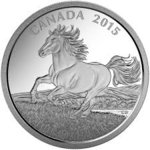
The Canadian Horse-A hero of the Civil War

Northern Light

Lt. Colonel
Joined
Jul 21, 2014
The Canadian Horse is a sturdy fellow who has had a big place in the history of Canada and also in the American Civil War.
canadian-mareandfoal-0716.png


Though often unacknowledged, the Canadian Horse has nevertheless been an integral part of Canada's history and development. Roxanne Salinas of Legacy Canadians in Mission, BC, thinks it's important for people to know how "intertwined [Canadian Horses] are with Canadian history. They are part of our heritage. [They] go back to the founding families. They go back generations and generations."

"They were the horses that helped our forefathers on the homesteads and were ridden in wars to keep us free," said Carol Lanz of CanaLanz Canadians in Cedar, BC. (www.horsejournals.com/heritage-and-heart-canadian-horse)
 
In 1665, the King (of France sent to New France) a French infantry garrison, the Carignan-Salières Regiment, to shore up security, but along with shipments of settlers and soldiers went two stallions and twenty mares selected from the King's Royal Stables where up to 700 fine saddle horses were kept. The King was no slouch when it came to prized horses and he was an expert horseman.
The rough voyage, though, resulted in eight mares perishing but on July 16, 1665, the stallions and the 12 remaining mares stepped onto Canadian soil to begin a legacy that, this year, celebrates the 350th anniversary of the Canadian horse.

Shipments continued and between 1665 and 1671, some 82 horses arrived in New France from the Royal Stables. Those horses most likely originated from native herds in France (Normandy, Brittany, and the historical province of Poitou) and Spain (Andalusia), regions renowned for the quality of their horses since before the Middle Ages.

The book The Horse and his Diseases by veterinarian Robert Jennings, published in 1861, described the Canadian as having "ears wide apart and not unfrequently a basin face, the latter, perhaps, a trace of the far remote Spanish blood said to exist in his veins."

The Quebec-based horses proved to be very tough. They adapted to the climate and geographical conditions, much of which was extremely challenging. They could accomplish any task put before them, and developed an enviable reputation as the "little iron horse" that Americans and later the English (after France formerly ceded the territory to Britain in the Treaty of Paris in 1763) came to love and admire.

(www.horsejournals.com/popular/breed-profiles/canadian-horse)

image.jpg
 
From 1665 to 1793, the horse population in New France grew from 12 animals to 14,000 animals. To the end of the French regime in 1760, the horses sent from France are the only ones to be developed in the colony. Contact with the English to the South was forbidden because England and France were at war. The topography of the Appalachian Mountains was also a formidable obstacle to outside communication. At that time there were no roads and the only means of long distance travel was by foot or by canoe. For almost one hundred years, these horses multiplied in a closed environment without the benefit of other bloodlines. Their common source, lack of cross breeding, and their rapid reproduction created a particular genetic group giving rise to a unique breed: the Canadian Horse.

http://www.canadianhorsebreeders.com/the-breed.html)
images?q=tbn:ANd9GcTw_tePE_XqSlm5ozBbJVfJxyr6_hOMTJ5LcOPginDlLgNJc0BXVA.jpg
 
Okay, you have been patient, so here is the Civil War part.

When the War of 1812 broke out, Canadian Horses found themselves in the heat of battle — and it was far from the only time. During the American Civil War, as many as thirty thousand Canadian Horses were used by the Union Army as cavalry mounts and to pull artillery. As the historian Fran Lynghaug puts it, "The Canadian Horse played a major role in the history of that war; it has even been said that the North won simply on the fact that its soldiers had the better horse — the Canadian." But the breed paid a heavy toll for that contribution to the fight against slavery. Thousands upon thousands of Canadian Horses were killed.

The massacre helped to nearly wipe out the breed — as did its popularity for less dangerous work in the United States. So many of the horses had been exported out of Canada and mixed with other breeds — and so many lay dead on battlefields — that their numbers were suddenly plummeting. By the 1880s, the Canadian Horse was nearly extinct.

That's when the Canadian Horse Breeders Association was founded with a mission to save the breed. Quebec banned the export of Canadian Horses entirely. And soon, the federal government started an official breeding program. The Canadian Horse was saved. But barely. In 1970, there were only four hundred left — of a breed that once boasted more than 150,000. http://thisiscanadiana.com/blogposts/2018/10/9/the-tragic-tale-of-the-canadian-horse

So now you know how the Civil War was really won; by the staunch and sturdy Canadians! :giggle:
 
Wasn't Traveller of Canadian origin?
According to Wikipedia, "An American Saddlebred, he was of Grey Eagle stock;[2] as a colt, he took the first prize at the Lewisburg, Virginia fairs in 1859 and 1860. As an adult he was a sturdy horse, 16 hands (64 inches, 163 cm) high and 1,100 pounds (500 kg) ". Sixteen hands is a the top of the height of Canadians, which are generally closer to 14 hands high. The American Saddlebred had some Canadian Pacer in it, which had Canadian in it,
 
"The Canadian Horse played a major role in the history of that war; it has even been said that the North won simply on the fact that its soldiers had the better horse — the Canadian."

Do you know of a source that gives some information about how fast these horses could cover ground at gallop, trot, etc?
 
Do you know of a source that gives some information about how fast these horses could cover ground at gallop, trot, etc?
I found this, which doesn't really answer answer your question, as to speed but tells what they are at their best.
"You can have an English saddle on them one day, a Western saddle the next day, and then go up into the mountains," said Betty Baxter, Chairperson of the Canadian Horse Heritage and Preservation Society and owner of Five Winds Farm Canadians in Roberts Creek, BC.

But while they are very versatile, with strength, good gaits, and flowing movement, "they're not ever going to be super fast," said Yvonne Hillsden of Cherry Creek Canadians in Kamloops, BC. "They've got good endurance, but were bred to trot forever, not gallop forever like a Thoroughbred." Hillsden describes them as an energy conserving horse — not lazy, but only wanting to expend as much energy as is necessary to get the job done. www.horsejournals.com/heritage-and-heart-canadian-horse
 
Very nice read. I'm recovering from some minor surgery, so my job today is to sit with my favorite websites and read! And horses will always be one of my favorite subjects.

I'd love to ride one of these. 14 hands is a nice size for me. I'm super short!
 
Very nice read. I'm recovering from some minor surgery, so my job today is to sit with my favorite websites and read! And horses will always be one of my favorite subjects.

I'd love to ride one of these. 14 hands is a nice size for me. I'm super short!
I'm glad that you enjoyed it! This comes from Horse Journals:
Kelly Twordik of Ebony Breeze Farm on Vancouver Island, who views the Canadian as an amazing all-around horse that is people and child friendly, adjusts easily to their surroundings, and is not moved by machinery, traffic, or loud noises, which is why they can make a good police patrol horse.

"My Canadian, Pennylane, helped babysit my eight-year-old daughter in a breed show when she rode English and Western," says Twordik. "The horse would move its body over and catch my daughter's seat so she stayed balanced in the saddle. It was so amazing and smooth that my daughter won the judge's choice award by Dorothy Kirby. My daughter is a good rider but it was an amazing example of the relationship between horse and rider and how the horse looked after the rider as well."

Hope you feel better soon!
 

Learn About Us
About CivilWarTalk
Contact the Webmaster
Meet the Staff
Link to CivilWarTalk
Join Our Community
Register
Browse Forums
View Today's Discussions
Search the Forum
Get Help
FAQ
Student Guide
Forum Rules & Etiquette
Copyright / DMCA

     Contact Us CivilwarTalk on Facebook CivilWarTalk on YouTube CivilWarTalk on Twitter RSS Feed

Bringing the American Civil War and More to Life.
© 1999 - , CIVILWARTALK, LLC - Site Version 10.0

SlaveryTalk.com - SecessionTalk.com - CivilWarTalk.com - ReconstructionTalk.com
Back
Top