
dvrmte
Major
- Joined
- Sep 3, 2009
- Location
- South Carolina
This is what Longstreet stated in in his memoirs regarding the Second Manassas Campaign.
"A cursory review of the campaign reveals the pleasure
ride of General Fitzhugh Lee by Louisa Court-House
as most unseasonable. He lost the fruits of our summer's
work, and lost the Southern cause. Proud Troy was laid
in ashes. His orders were to meet his commander on the
afternoon of the 17th, on the plank-road near Raccoon
Ford, and upon this appointment was based General Lee's
order of march for the 18th. If the march had been
made as appointed, General Lee would have encountered
the army of General Pope upon weak ground from Rob-
ertson River to near Raccoon Ford of the Rapidan, and
thus our march would have been so expedited that we
could have reached Alexandria and Washington before
the landing of the first detachment of the Army of the
Potomac at Alexandria on the 24th. The artillery and
infantry were called to amend the delinquency by severe
marches and battles."
After Jackson's victory at Cedar Mountain, Pope had positioned his army in the fork of the Rapidan and Rappahannock rivers.
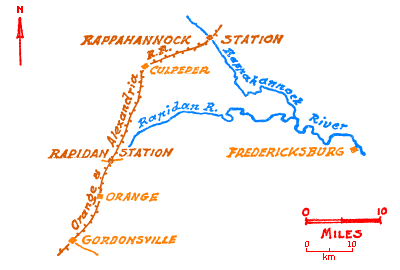
D. S. Freeman explains it: http://penelope.uchicago.edu/Thayer/E/Gazetteer/People/Robert_E_Lee/FREREL/2/21*.html
"Thanks to Jackson's forethought, when Lee sat down in council with him and
 Longstreet on the 15th, he had a good map and adequate intelligence reports. The Rapidan River on the south and the Rappahannock on the north form a great "V" laid on its side with its apex to the east, where the two rivers unite, •about nine miles west of Fredericksburg. Across the open end of this "V," at an average distance of •twenty miles from the confluence of the streams, ran the Orange and Alexandria Railroad, which constituted Pope's line of supply. Into the angle between the two rivers, before Burnside had sent reinforcements, Pope had brought a force which Jackson estimated at 45,000 to 50,000. Pope's front was to the Rapidan. Behind him lay the Rappahannock. Twenty thousand men, Lee estimated, had reached Pope from Burnside and from King, the latter being now first identified as in command at Fredericksburg before the coming of Burnside. These accessions, the Confederates computed, made Pope's full strength 65,000 to 70,000 men. No troops were coming down the railroad from Alexandria, escaped civilians said, but all the supplies of Pope's army were moving by that line and across a bridge that spanned the northern river at Rappahannock Station.
Pope's ignorance of Lee' movements had caused him incautiously to present his adversary as fair an opportunity as ever a soldier was offered. If the infantry of the Army of Northern Virginia could be concentrated close to the Rapidan, the cavalry could be dispatched quickly to burn the bridge at Rappahannock Station, and then the veteran brigades from the Peninsula could be hurled across the Rapidan. Pope would thus be caught within the "V" between the two rivers and might be destroyed."
Was this the great chance for Confederate victory or at least foreign recognition? Read the rest of D. S. Freeman's account to see how things played out.
http://penelope.uchicago.edu/Thayer/E/Gazetteer/People/Robert_E_Lee/FREREL/2/21*.html
"A cursory review of the campaign reveals the pleasure
ride of General Fitzhugh Lee by Louisa Court-House
as most unseasonable. He lost the fruits of our summer's
work, and lost the Southern cause. Proud Troy was laid
in ashes. His orders were to meet his commander on the
afternoon of the 17th, on the plank-road near Raccoon
Ford, and upon this appointment was based General Lee's
order of march for the 18th. If the march had been
made as appointed, General Lee would have encountered
the army of General Pope upon weak ground from Rob-
ertson River to near Raccoon Ford of the Rapidan, and
thus our march would have been so expedited that we
could have reached Alexandria and Washington before
the landing of the first detachment of the Army of the
Potomac at Alexandria on the 24th. The artillery and
infantry were called to amend the delinquency by severe
marches and battles."
After Jackson's victory at Cedar Mountain, Pope had positioned his army in the fork of the Rapidan and Rappahannock rivers.
D. S. Freeman explains it: http://penelope.uchicago.edu/Thayer/E/Gazetteer/People/Robert_E_Lee/FREREL/2/21*.html
"Thanks to Jackson's forethought, when Lee sat down in council with him and
Pope's ignorance of Lee' movements had caused him incautiously to present his adversary as fair an opportunity as ever a soldier was offered. If the infantry of the Army of Northern Virginia could be concentrated close to the Rapidan, the cavalry could be dispatched quickly to burn the bridge at Rappahannock Station, and then the veteran brigades from the Peninsula could be hurled across the Rapidan. Pope would thus be caught within the "V" between the two rivers and might be destroyed."
Was this the great chance for Confederate victory or at least foreign recognition? Read the rest of D. S. Freeman's account to see how things played out.
http://penelope.uchicago.edu/Thayer/E/Gazetteer/People/Robert_E_Lee/FREREL/2/21*.html


 Bringing the