-
Welcome to CivilWarTalk, a forum about the American Civil War! - Join today! It's fast, simple, and FREE!
You are using an out of date browser. It may not display this or other websites correctly.
You should upgrade or use an alternative browser.
You should upgrade or use an alternative browser.
Cotton bale
- Thread starter gary
- Start date

gary
Major
- Joined
- Feb 20, 2005
You are correct in that I am not from cotton pick'n country. I had a colleague who picked cotton and I asked him about the gin. He held up his hand and pinched his fingers together and pulled his hand back. He did it the old fashion way in the 1950s as a child.This comment made me laugh, you obviously aren't from a cotton growing part of the country. When cotton gets wet it gets rotten very quickly. Cotton left on the ground where the combines & trucks meet turns into compost. Cotton bales that were stacked up to form the core of a berm would become water logged. That actually made them denser. In time, the temporary works were a great mulch pile.
Cotton, in ordered to be useful has to be ginned to remove the seeds. Cotton that is even barely damp cannot be ginned.
Cotton is grown all around where I live in Middle Tennessee. For years I passed cotton fields taking & picking up children from school. In the 1970's the cotton fields near my aunt & uncle's place in Arkansas were still being picked by hand. So, I have reason to know about cotton farming.
Winters "The Civil War in Louisiana" added clarification and says the bags were about 3 ft long. Seep page 267. Does that sound right for 30 lbs?

Rhea Cole
Colonel
- Joined
- Nov 2, 2019
- Location
- Murfreesboro, Tennessee
You are correct in that I am not from cotton pick'n country. I had a colleague who picked cotton and I asked him about the gin. He held up his hand and pinched his fingers together and pulled his hand back. He did it the old fashion way in the 1950s as a child.
Winters "The Civil War in Louisiana" added clarification and says the bags were about 3 ft long. Seep page 267. Does that sound right for 30 lbs?
The engineers were making fascines. I can't imagine them wandering about the countryside collecting cotton picking bags would have been at all useful.
The cotton could have been rolled up in burlap. Wrapping the cotton with sticks was also done. The whole point of a fascine was to fill a ditch & facilitate the passage of men & horses. In the cotton growing regions, cotton was abundant & readily performed the function.
FASCINE
"A bundle of rods or small sticks of wood bound at both ends and in the middle, used in fortification, raising batteries, filling ditches, strengthening ramparts, and making parapets." -Whitney, 1911
Clipart Etc
SAP ROLLERS WERE ALSO MADE OF COTTON.
Cotton sap roller Vicksburg.
Note the (+/-) 30-40 pound cotton fascines used to makeup the sap roller.
Link:

- Joined
- Apr 4, 2017
- Location
- Denver, CO
That price number was misleading. The price in British pence did not increase by that amount. The US currency vs the pound was very weak. Most people knew there was going to be rapid inflation in the US at some point.View attachment 561420
View attachment 561419
Even bales of hay can weigh 80 pounds. The U.S. standard cotton bale then & now weighed (+/-) 500 pounds.
View attachment 561421
This is one of those a picture is worth a thousand words images. The bales had to be very carefully loaded & unloaded to prevent a catastrophic capsize.
View attachment 561422
McPherson's floating cotton bale bridge from Harper's Weekly.
In his memoir Grant described the events leading up to construction of a floating cotton bale bridge.
Link:
Cotton was (+/-) $1.89 / pound in 1863. That was up from 10-13 cents / pound in 1860.
- Joined
- Apr 4, 2017
- Location
- Denver, CO
The numbers I recall were that a bale weight 400 lbs in that era. Peak production had been about 2 billion lbs by 1860. The crop sold for about $260million. Corn was the biggest agricultural crop, because of its many uses. But cotton was the biggest export crop by far.
- Joined
- Apr 4, 2017
- Location
- Denver, CO
About 20% of the cotton crop went to the US. About 80% went to England, France, and a few other countries.
Ben Ford 987
Private
- Joined
- Apr 2, 2025
Neither 30 or 80 lbs of cotton do not constitute a bale of cotton.Here's why I asked. At Port Hudson some soldiers slung their muskets and carried 30 lb cotton bales. They were to throw them down the ditch so it would be easier to scale. I couldn't want to carry a 400 lb bale of cotton.
Those bales on the steamboat look awfully large; too large to carry. Even those 80 lb bales would be a task if you're going to carry it by hand. I can see rolling a bale like breastwork (Battle of Lexington).
Unless they incorrectly used the word bale to mean a clump or armful of cotton.
Important for you to remember. A 400 to 500 lb bale of cotton has been highly compressed.
Machine called compresses are used to squeeze the cotton into a bale.
The building where these machines are housed are also called compresses.
Compresses are frequently located adjacent to cotton gins, where the leaves, seeds, sticks and other debris are removed.
30 lbs of noncompressed cotton would be a much larger volume than a man could manage and run across a field with a rifle.
Besides making him a huge white target.
There were no compresses to produce 30 lb bales. At most bundles of cotton might have been tied up with rope, similar to soldiers' blankets. These would have been manageable to carry, but would hardly have been firm enough to significantly help fill a ditch.
On the other hand a true bale of cotton is very firm, even when wet. They stopped most bullets fired directly into them. That's why there were used at Port Hudson and other places as sap rollers and other defensive works.
Rhea Cole
Colonel
- Joined
- Nov 2, 2019
- Location
- Murfreesboro, Tennessee
Neither 30 or 80 lbs of cotton do not constitute a bale of cotton.
Unless they incorrectly used the word bale to mean a clump or armful of cotton.
Important for you to remember. A 400 to 500 lb bale of cotton has been highly compressed.
Machine called compresses are used to squeeze the cotton into a bale.
The building where these machines are housed are also called compresses.
Compresses are frequently located adjacent to cotton gins, where the leaves, seeds, sticks and other debris are removed.
30 lbs of noncompressed cotton would be a much larger volume than a man could manage and run across a field with a rifle.
Besides making him a huge white target.
There were no compresses to produce 30 lb bales. At most bundles of cotton might have been tied up with rope, similar to soldiers' blankets. These would have been manageable to carry, but would hardly have been firm enough to significantly help fill a ditch.
On the other hand a true bale of cotton is very firm, even when wet. They stopped most bullets fired directly into them. That's why there were used at Port Hudson and other places as sap rollers and other defensive works.
The 30 pound "bales" referred to in this thread were fascines, indicated in detail up thread. Traditionally made up of bundles of sticks, the available supply of cotton inspired the Army of Tennessee engineers to make creative use of it.
gary
Major
- Joined
- Feb 20, 2005
"Bale" was the term used by the Union soldiers and I concur that it is a misapplication of the term. Bags stuffed with cotton would be more accurate. That's hardly a bale. Rhea Cole mentions fascines and why they weren't resorted to by the assault troops to fill the ditches isn't explained in any of the material I've read. There is an abundance of wood sources at Port Hudson to draw from and it's certainly cheaper than cotton which was a commodity that could be sold. Fascines were used in making Union zig-zag approaches at Port Hudson and as late as WW II with the Churchill fascine carrier tanks.
One of these days I should go to the Audie Murphy Cotton Museum.
One of these days I should go to the Audie Murphy Cotton Museum.
Ben Ford 987
Private
- Joined
- Apr 2, 2025
Bags of cotton would be, at best, like very soft pillows and would contribute next to nothing in filling a ditch, The ditch needed to be filled so men could climb over the earthworks. And again 30 lbs of unbaled, cotton would be a very large volume."Bale" was the term used by the Union soldiers and I concur that it is a misapplication of the term. Bags stuffed with cotton would be more accurate. That's hardly a bale. Rhea Cole mentions fascines and why they weren't resorted to by the assault troops to fill the ditches isn't explained in any of the material I've read. There is an abundance of wood sources at Port Hudson to draw from and it's certainly cheaper than cotton which was a commodity that could be sold. Fascines were used in making Union zig-zag approaches at Port Hudson and as late as WW II with the Churchill fascine carrier tanks.
One of these days I should go to the Audie Murphy Cotton Museum.
In decades past mechanical pickers would dump the cotton into trailers for transportation to the gin.
Kids would be encouraged, and sometimes paid a little money to climb in the trailers and stomp down the raw cotton. It was great fun. We could also jump from the sides of the trailer It was called "trailer trompin' " Any one who ever did it can tell you that the biggest arm load of cotton you could grab and hold didn't weigh 5 pounds.
- Joined
- Apr 4, 2017
- Location
- Denver, CO
The cotton growers could not separate cotton from slavery. Their advantage was in superior varieties, and more efficiency in growing, packing and shipping cotton. They were unable to perceive that cotton could be grown under different land tenancy conditions, and the advantages of the US south would still remain. Their success happened too quickly, and they didn't think about protecting their advantage and modernizing their section.Bags of cotton would be, at best, like very soft pillows and would contribute next to nothing in filling a ditch, The ditch needed to be filled so men could climb over the earthworks. And again 30 lbs of unbaled, cotton would be a very large volume.
In decades past mechanical pickers would dump the cotton into trailers for transportation to the gin.
Kids would be encouraged, and sometimes paid a little money to climb in the trailers and stomp down the raw cotton. It was great fun. We could also jump from the sides of the trailer It was called "trailer trompin' " Any one who ever did it can tell you that the biggest arm load of cotton you could grab and hold didn't weigh 5 pounds.
Last edited:
Trooper "D"
Sergeant Major
- Joined
- May 20, 2018
Worst cases of tunnel vision in our country's history.The cotton growers could not separate cotton from slavery. Their advantage was in superior varieties, and more efficiency in growing, packing and shipping cotton. They were unable to perceive that cotton could be grown under different land tenancy conditions, and the advantages of the US south would still remain. Their success happened too quickly, and they didn't think about protecting their advantage and modernizing their section.
Rhea Cole
Colonel
- Joined
- Nov 2, 2019
- Location
- Murfreesboro, Tennessee
The cotton bales & cotton fasines were made up at a cotton press. Once compacted, cotton is anything but fluffy.
Cast iron presses came into use circa 1800. By the 1860's, 500 pound bales were the standard size. If you think about it, a standard bale was not only market driven, it was essential for distribution. A hodgepodge of different size & proportioned bales would have been all but impossible to ship efficiently. Think of them as 500 pound Legos.
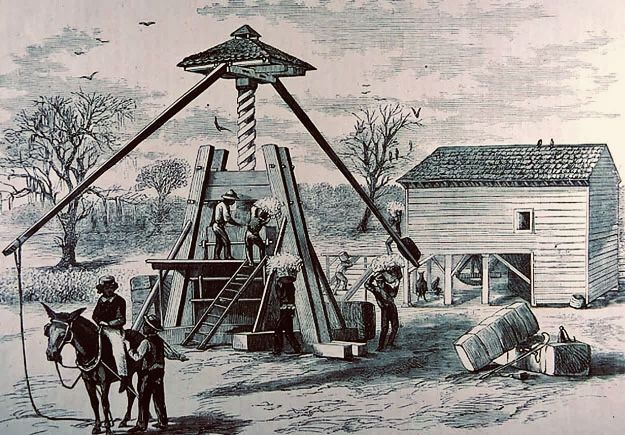
Cotton press with gin house on the background. Leslie's Illustrated Magazine.
An integral element of Grant's Vicksburg Campaign was on the Western Bank of the Mississippi River. That was a major cotton growing area. Cotton presses would have been ubiquitous.
Link:

 www.battlefields.org
Wrapped in burlap, the pressed cotton fasines would have been very durable.
Link:
 www.knowitall.org
The next question is, where did the essential burlap come from? That is an interesting side bar of its own. Flax fiber was the leading agricultural export from Kentucky, (+/-) 40%. It was hemp & flax that made the fortunes of the great plantations in the Blue Grass. Woven into burlap, Kentucky hemp & flax was a strategic material in the Civil War.
Link:
Cast iron presses came into use circa 1800. By the 1860's, 500 pound bales were the standard size. If you think about it, a standard bale was not only market driven, it was essential for distribution. A hodgepodge of different size & proportioned bales would have been all but impossible to ship efficiently. Think of them as 500 pound Legos.
Cotton press with gin house on the background. Leslie's Illustrated Magazine.
An integral element of Grant's Vicksburg Campaign was on the Western Bank of the Mississippi River. That was a major cotton growing area. Cotton presses would have been ubiquitous.
Link:
Arkansas Post (1863)
The Battle of Arkansas Post, also known as the Battle of Fort Hindman, was a combined land-river assault by Union forces on the Confederate Fort Hindman,...
Wrapped in burlap, the pressed cotton fasines would have been very durable.
Link:
Photo Asset | Cotton Press | History of SC Slide Collection | Knowitall.org
A cotton press for compressing short-staple cotton.
The next question is, where did the essential burlap come from? That is an interesting side bar of its own. Flax fiber was the leading agricultural export from Kentucky, (+/-) 40%. It was hemp & flax that made the fortunes of the great plantations in the Blue Grass. Woven into burlap, Kentucky hemp & flax was a strategic material in the Civil War.
Link:
Last edited:

- Joined
- Sep 15, 2018
- Location
- South Texas
Wasn't there a story of some general , Beauregard I think,spending the night in a cotton press? He was arrested and falsely accused at the close of the war for possibly hiding the wanted fugituve, Gen. Kirby Smith. No jail was readily handy in New Orleans so they used a cotton press. I'm not sure if this incident ever really happened or it was just a story but I did read it somewhere.
Last edited:
Rhea Cole
Colonel
- Joined
- Nov 2, 2019
- Location
- Murfreesboro, Tennessee
Wasn't there a story of some general , Beauregard I think,spending the night in a cotton press? He was arrested and falsely accused at the close of the war for possibly hiding the wanted fugituve, Gen. Kirby Smith. No jail was readily handy in New Orleans so they used cotton press. I'm not sure if this incident ever really happened or it was just a story but I did read it somewhere.
There were plenty of jails available in New Orleans. It was the epicenter of the slave trade. There were slave jails all over the city, so no shortage of accommodations… Cotton presses were associated with cotton production, cotton gins & preparing the cotton for shipment. None of which would have been in the city. I am by way of supposing that anything that outrageous would have been cited regularly.
Reported it was, however. Polloco found a three sentence reference in the Wikipedia post about Beauregard.
Last edited:

- Joined
- Mar 22, 2009
- Location
- Collierville, TN
Does anyone have an image of a Civil War period cotton bale? I know they were used to "armor" ships, make breastworks and even sap rollers. I read that they were 30 lbs and were man portable.
30 lbs?? More like 500 lbs. i had a summer job in college where I was an assistant forklift operator(I held the clipboard) move bales of cotton seed lint. This plant processes cotton seeds extracted by gins to obtain oil, meal & lint— the thin bit of cotton still clinging to the seed.
After the battle at Fort Pemberton, Greenwood, MS, the Federal engineers returned to see how the earthworks were made such they deflected the cannon balls.
They discovered they were made by stacking 3 cotton bales along the line, 2 on bottom and 1 on top. Then they covered them with dirt and leather skins and more dirt.
- Joined
- Sep 15, 2018
- Location
- South Texas
They're on a Cotton
 T shirt too
- Joined
- Mar 22, 2009
- Location
- Collierville, TN
My aunt painted still art and flower vases and sold them. Her best selling subject was a old house in a cotton field.Another of Mom's cotton pictures
She also painted cotton bolls or flowers on snuff bottles.
Rhea Cole
Colonel
- Joined
- Nov 2, 2019
- Location
- Murfreesboro, Tennessee
30 lbs?? More like 500 lbs. i had a summer job in college where I was an assistant forklift operator(I held the clipboard) move bales of cotton seed lint. This plant processes cotton seeds extracted by gins to obtain oil, meal & lint— the thin bit of cotton still clinging to the seed.
After the battle at Fort Pemberton, Greenwood, MS, the Federal engineers returned to see how the earthworks were made such they deflected the cannon balls.
They discovered they were made by stacking 3 cotton bales along the line, 2 on bottom and 1 on top. Then they covered them with dirt and leather skins and more dirt.
As indicated up thread, the "30 pound cotton bales" were, in fact, fascines. As evidenced by your example of the cotton bale berms, once compacted in a press & wrapped in burlap, it is a remarkably resilient material.
Last edited:
milhistbuff1
First Sergeant
- Joined
- Nov 19, 2005
- Location
- NY
May not be quite what you're looking for but relatively close...Antebellum bringing cotton to house.Anybody got an image of a cotton bag that would be used to collect cotton?
Similar threads

- Question
- Replies
- 9
- Views
- 292

- Question
- Replies
- 10
- Views
- 238
- Replies
- 23
- Views
- 557

- Replies
- 22
- Views
- 395
Similar threads
- Question
- Replies
- 18
- Views
- 249
- Learn About Us
- ►About CivilWarTalk
- ►Contact the Webmaster
- ►Meet the Staff
- ►Link to CivilWarTalk
- Join Our Community
- ►Register
- ►Browse Forums
- ►View Today's Discussions
- ►Search the Forum
- Get Help
- ►FAQ
- ►Student Guide
- ►Forum Rules & Etiquette
- ►Copyright / DMCA
 Bringing the