What Books Do You Read When Diving Into A Topic?

Rhea Cole

Colonel
Joined
Nov 2, 2019
Location
Murfreesboro, Tennessee
What Books Do You Read When Diving Into A Topic?

IMG_4534.webp


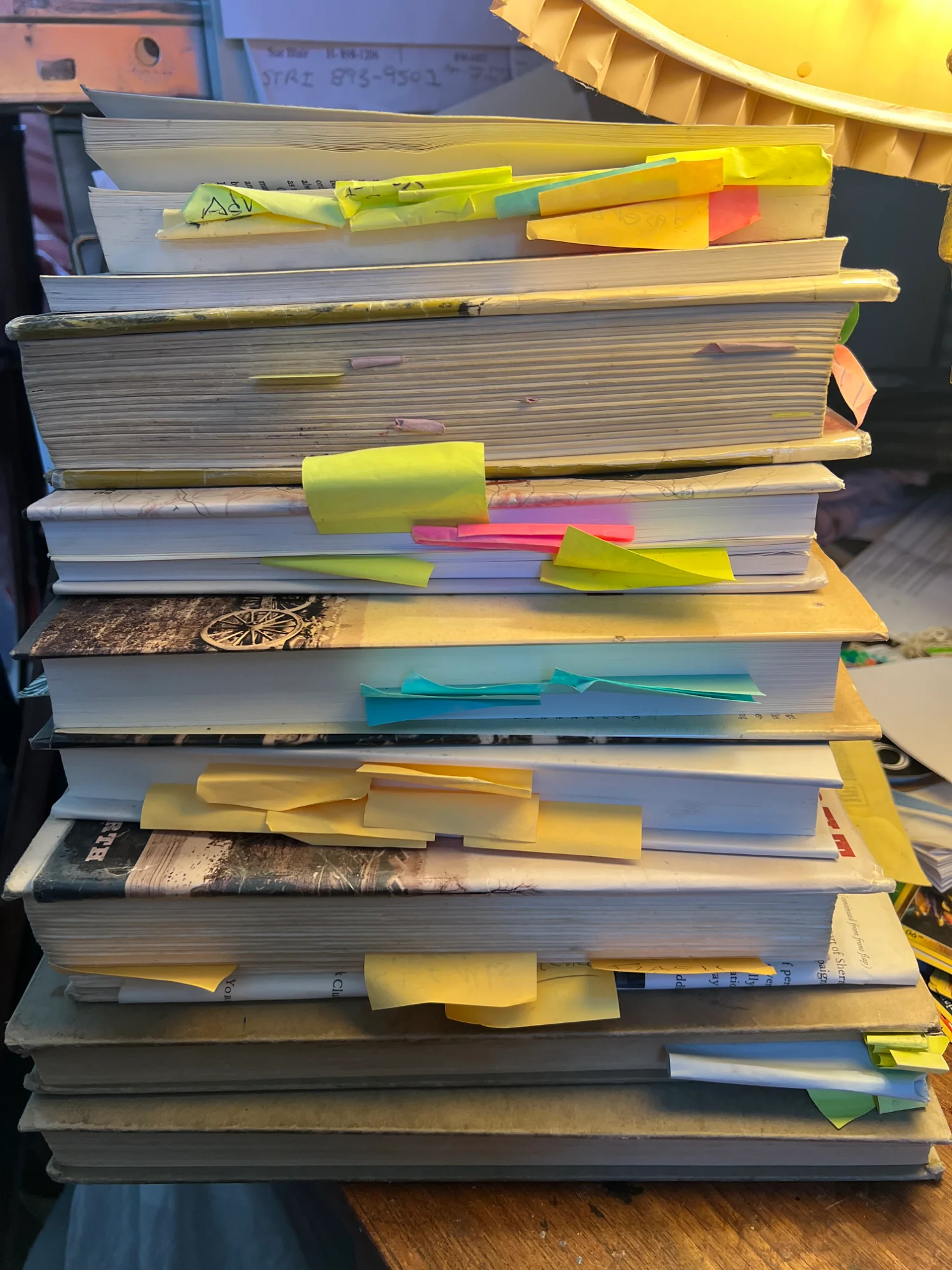
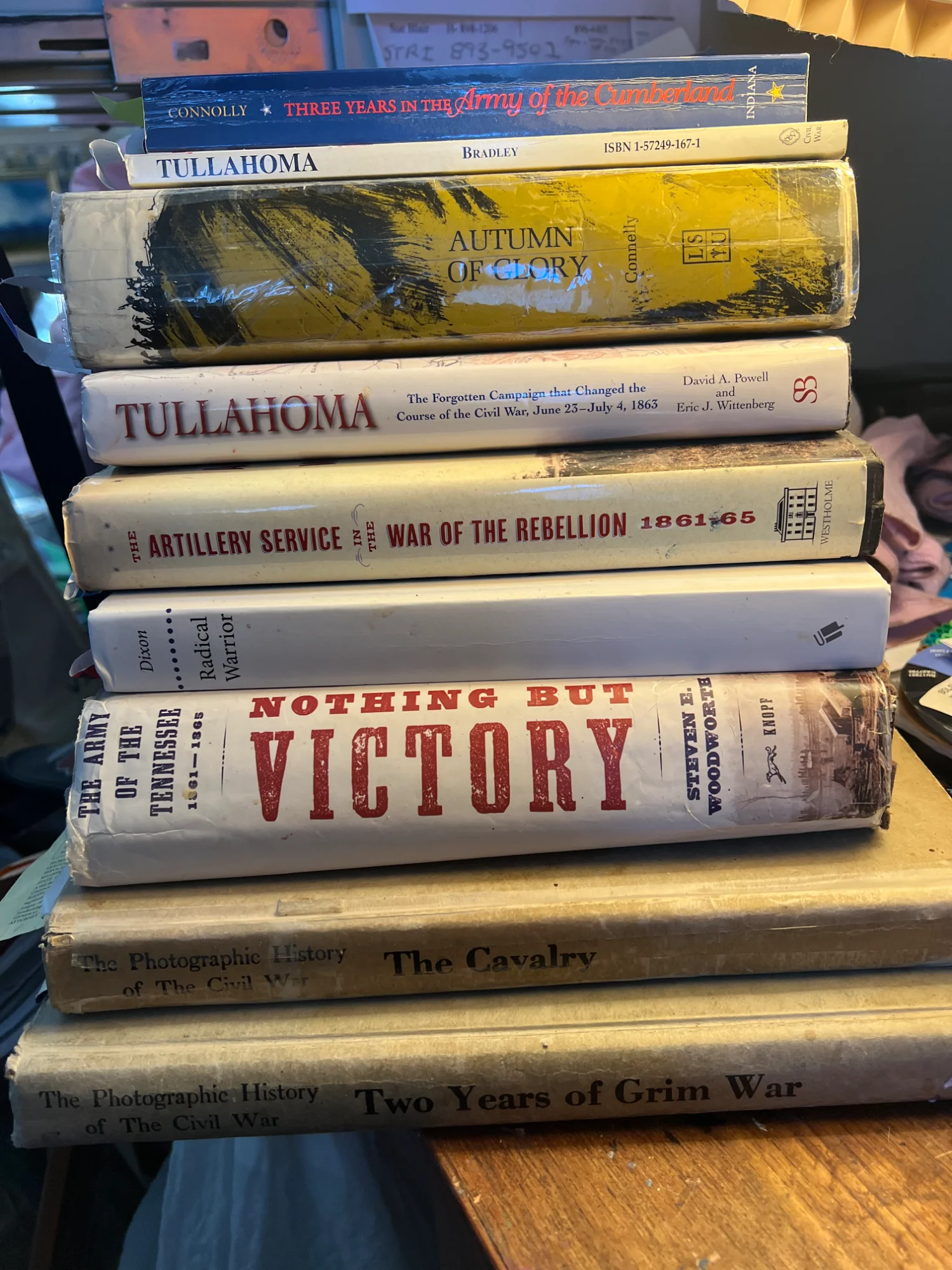
I received an interesting question. What books would I recommend for a dive into the Tullahoma Campaign. I included "Nothing But Victory" because the Vicksburg, Tullahoma & Chattanooga Campaigns were intertwined.

IMG_4535.webp


I have a technique of using color coded PostIt Notes to mark citations. In this case, the yellow Post its are from a cavalry study.

Finding page numbers & where the citations are on the page is kind of vexing. Marking a PostIt & sticking it next to the text is very effective. It saves a lot of hassle.

So, how do you all mark references when homing in on a topic?
 
Last edited:
My wife and I have many, many books, all adorned with too many Posits to count. When we break down and sell one our books, it's a chore just removing the Posits. Do they help us find things later? Well...sometimes.

The beauty of it is that you aren't folding over page corners & the like. Not only that, but I recently changed topics & took out the old Postits. It can leave the book looking a little wacky ¿no?
 
Dornbusch - find out what there is to read.
1) All first hand accounts on your shelves or at the library (or via interlibrary loan). This is where Dornbusch is useful to ID those books.
2) Battles & Leaders, Annals of War and More Annals of War, Encyclopedia of the Civil War (Faust) and Civil War Dictionary (Boatner)
3) Reputable scholars/researchers.
4) I also like books from Morningside Press (RIP Younger) and currently like Savas-Beatie.
5) O. R.
6) If you live around Vicksburg, the National Tribune (they have microfilm)

6) Mebbe Southern Historical Society Papers
7) Confederate Military History
 
Dornbusch - find out what there is to read.
1) All first hand accounts on your shelves or at the library (or via interlibrary loan). This is where Dornbusch is useful to ID those books.
2) Battles & Leaders, Annals of War and More Annals of War, Encyclopedia of the Civil War (Faust) and Civil War Dictionary (Boatner)
3) Reputable scholars/researchers.
4) I also like books from Morningside Press (RIP Younger) and currently like Savas-Beatie.
5) O. R.
6) If you live around Vicksburg, the National Tribune (they have microfilm)

6) Mebbe Southern Historical Society Papers
7) Confederate Military History
Dornbusch - find out what there is to read.
1) All first hand accounts on your shelves or at the library (or via interlibrary loan). This is where Dornbusch is useful to ID those books.
2) Battles & Leaders, Annals of War and More Annals of War, Encyclopedia of the Civil War (Faust) and Civil War Dictionary (Boatner)
3) Reputable scholars/researchers.
4) I also like books from Morningside Press (RIP Younger) and currently like Savas-Beatie.
5) O. R.
6) If you live around Vicksburg, the National Tribune (they have microfilm)

6) Mebbe Southern Historical Society Papers
7) Confederate Military History
I am curious, what filters do you use when referencing SHS publications? It must be challenging.

For very different reasons, the O.R. is very challenging. How do you mark your citations for cross referencing?

If you would please define "Confederate military history" for me. That is not a term I am familiar with. What do you mean by that?

The reason I am looking into this is a question one of my great granddaughters posed. She has learned about what some people refer as the "Old Testament Fallacy." It is a form of inductive logic. That is, combing through the evidence discarding anything that does not conform with a preconceived conclusion.

There is also what is referred to as "autistic logic." Don't know the technical term. It goes like this:

I wouldn't believe anything that is not true.

I believe X.

Therefore X is true.

My talk with her stimulated a thread asking how folks on CWT mark & cross check sources. Like the Old Testament, you can find citations to support everything up to & including alien intervention. As a friend is fond of saying, there really is something about the Civil War that brings out the ranting crank in some people.

Then again, there is the blatantly racist agenda of the SHS & historians at Vanderbilt & the University of the South who consciously wrote the contribution of self-liberating black people out of their historical narrative.

A concrete example was when the military records of Tennesseans on both sides were copied & made available at the state library & archive… except for the 20,000 USCT. A researcher could easily conclude that slaves contributed nothing to their liberation… which was the point.

Anyways, that is why I am curious about how CWT folks filter their citations & how they keep tract of them. My granddaughter wants to know, she is writing a paper.
 
Last edited:
Start with a 30,000 foot overview to refresh general context. Depending on the topic this might (example 1st Bull Run) mean I go to Foote, Mc Phearson or Canton.
Second, get a map book out for orientation.
Third, look up the order of battle and after battle reports.
Forth- search for rankings of the best / most popular books on the topic and get those. Usually get two.
Fifth- Then read 1st hand accounts and reports of Generals that fought there.
This top down method compliments the way many people use conceptual thinking. It's not for everyone as some might like a bottom up approach.
In my young life I worked for a Judge while in law school and then was a trial lawyer for a few years before I moved into business. The Judge trined me and it's how I helped Judge prepare his opinions. Context- players- facts- evidence-first hand witnesses.
This method was also taught in many law school writining classes and is known as IRAC. Issue. Rule. Application. Conclusion.
Hope it's helpful.
 
I am curious, what filters do you use when referencing SHS publications? It must be challenging.
Cross reference with other sources. See if there's confirmation. SHSP was a forum for lost cause. I have it DVD which I haven't seen since I moved out of Californiastan.
For very different reasons, the O.R. is very challenging. How do you mark your citations for cross referencing?
O. R., Series I, Vol. XV, p. 323. I do that by habit now and you should check the Chicago Manual of Style. I have an old version that was given to me. First time you use or in an abbreviation page you cite Official Records of the War of the Rebellion.... Then Hereafter cited as O. R.
If you would please define "Confederate military history" for me. That is not a term I am familiar with. What do you mean by that?
Confederate Military History is a 12 volume set written by Confederates.
The reason I am looking into this is a question one of my great granddaughters posed. She has learned about what some people refer as the "Old Testament Fallacy." It is a form of inductive logic. That is, combing through the evidence discarding anything that does not conform with a preconceived conclusion.

There is also what is referred to as "autistic logic." Don't know the technical term. It goes like this:

I wouldn't believe anything that is not true.

I believe X.

Therefore X is true.

My talk with her stimulated a thread asking how folks on CWT mark & cross check sources. Like the Old Testament, you can find citations to support everything up to & including alien intervention. As a friend is fond of saying, there really is something about the Civil War that brings out the ranting crank in some people.

Then again, there is the blatantly racist agenda of the SHS & historians at Vanderbilt & the University of the South who consciously wrote the contribution of self-liberating black people out of their historical narrative.

A concrete example was when the military records of Tennesseans on both sides were copied & made available at the state library & archive… except for the 20,000 USCT. A researcher could easily conclude that slaves contributed nothing to their liberation… which was the point.

Anyways, that is why I am curious about how CWT folks filter their citations & how they keep tract of them. My granddaughter wants to know, she is writing a paper.
It's good to look at multiple of sources. A soldier only sees what's in his immediate presence and a lot of what they know could be second hand/hearsay. So you check and cross reference from the other side.

One Union captain at Fredericksburg was pinned down before Marye's Heights (Battles and Leaders). His sergeant brought his atttention to a Confederate officer with a spyglass and asked if he could shoot the old cuss. I asked at Fredericksburg but no help. It took me years to identify that officer and E. Porter Alexander admits he was one of the officers with a spyglass and likely the old cuss whose life was spared. Methinks it was in Figthing for the Confederacy.

BTW, I like the old fashion footnote/endnote system. Each citation gets its own endnote or footnote. If there's a half dozen citations under one endnote/footnote, you have to figure out which one. I hate that. I've only done it once or twice in my book on Port Hudson, but am uncertain if the editor won't just wipe them off just to save space (and maximize profit). Footnotes were actually for me so I can look things up and find them again. I tried to keep information other than source out of the footnote and weave it into the narrative.
 
To expand on what is mentioned above, if you are using library books, then please DO NOT dog-ear the pages. That's considered damage, especially if you do it every couple of pages. It's disrespectful to the library and to other patrons. If it's an interlibrary loan item, then that may lead to the sharing library blacklisting your library when it comes to future requests.

If you use Post-Its in a library book, then please remove them before you return the book. Removing many Post-Its from a book is a tedious task for shelvers, and it keeps them from shelving that item, as well as many others on the cart, in a timely manner which makes it difficult for patrons (including you) to find what they need.

What you do to your own books, of course, is up to you.
 
I am curious, what filters do you use when referencing SHS publications? It must be challenging.

For very different reasons, the O.R. is very challenging. How do you mark your citations for cross referencing?

If you would please define "Confederate military history" for me. That is not a term I am familiar with. What do you mean by that?

The reason I am looking into this is a question one of my great granddaughters posed. She has learned about what some people refer as the "Old Testament Fallacy." It is a form of inductive logic. That is, combing through the evidence discarding anything that does not conform with a preconceived conclusion.

There is also what is referred to as "autistic logic." Don't know the technical term. It goes like this:

I wouldn't believe anything that is not true.

I believe X.

Therefore X is true.

My talk with her stimulated a thread asking how folks on CWT mark & cross check sources. Like the Old Testament, you can find citations to support everything up to & including alien intervention. As a friend is fond of saying, there really is something about the Civil War that brings out the ranting crank in some people.

Then again, there is the blatantly racist agenda of the SHS & historians at Vanderbilt & the University of the South who consciously wrote the contribution of self-liberating black people out of their historical narrative.

A concrete example was when the military records of Tennesseans on both sides were copied & made available at the state library & archive… except for the 20,000 USCT. A researcher could easily conclude that slaves contributed nothing to their liberation… which was the point.

Anyways, that is why I am curious about how CWT folks filter their citations & how they keep tract of them. My granddaughter wants to know, she is writing a paper.

"I wouldn't believe anything that is not true.

I believe X.

Therefore X is true."

In the above argument, the term for this logical fallacy is called "begging the question" whereby the conclusion is assumed in the premise without providing independent evidence. :smile coffee:
 
The reason I am looking into this is a question one of my great granddaughters posed. She has learned about what some people refer as the "Old Testament Fallacy." It is a form of inductive logic. That is, combing through the evidence discarding anything that does not conform with a preconceived conclusion.

Cherry Picking is sometimes ignorance or carelessness, but it's often deliberate.

With history or politics, it tends to be a form of apologia or other partisan writing. However, outside of those fields, it's consistent with the tendency of many people to just ignore problems until they can't.

There is also what is referred to as "autistic logic." Don't know the technical term. It goes like this:

I wouldn't believe anything that is not true.

I believe X.

Therefore X is true.

I concur with JCJ: Begging The Question fallacy, a kind of Circular Reasoning.

I wouldn't call it "autistic logic." Autistics are prone to tunnel vision so they probably have a tendency to miss counter-arguments. They will reach a seemingly logical conclusion, but miss what should be an obvious flaw in their reasoning. Non-autistics with high anxiety seem prone to a similar issue, albeit for different reasons.

For normal people, it's more an emotional thing - a refusal to admit when you are wrong. Fragile egos and a lack of self-reflection are two common causes.

A lot of people feel the need to "always be right" but most of them simply want to be told they are already right. They are not concerned about the reality, only the perception. Someone who actually cares about always being right has to constantly question whether they are actually wrong and, if they determine they are, shift their thinking and beliefs and conclusions. Most people can't or wont do that. This is somewhat understandable: not only does it require admitting fault (perceived by many as weakness) but it requires a lot of thinking and reflecting, and it almost inevitably makes a person kind of neurotic.

As a friend is fond of saying, there really is something about the Civil War that brings out the ranting crank in some people.

I think it's mostly the personal stake; a perceived need to defend ancestors. Lincoln is also a polarizing figure.
 
To expand on what is mentioned above, if you are using library books, then please DO NOT dog-ear the pages. That's considered damage, especially if you do it every couple of pages. It's disrespectful to the library and to other patrons. If it's an interlibrary loan item, then that may lead to the sharing library blacklisting your library when it comes to future requests.

If you use Post-Its in a library book, then please remove them before you return the book. Removing many Post-Its from a book is a tedious task for shelvers, and it keeps them from shelving that item, as well as many others on the cart, in a timely manner which makes it difficult for patrons (including you) to find what they need.

What you do to your own books, of course, is up to you.

I am with you 100%. Borrowed books are a trust. Somebody five years on deserves to read a clean book. My own books, however, are filled with notes. I write definitions of words I do not know in the margin. That way I won't have to look it up next time. Sometimes I will tape a fold out page in the back of a book. That way I can make notes & definitions as I go along. Barbara Tuchman's 'A Distant Mirror' page amounted to a glossary.
 
Last edited:
I write in my books, but in pencil and very tiny (about the size of the script on the screen).

Prof. John McManus (US Army in the Pacific trilogy: Fire & Fortitude, Islands Inferno and To the End of the Earth among other books) told me he builds a database/spreadsheet as he reads the book. That way he finds things quite quickly. Beats the olde memory and useful to others.

Like my late friend, Helen Trimpi, I also buy mylar with which to cover the dustjacket. Save those books for the next generation please (and don't smoke around your books).
 
Prof. John McManus (US Army in the Pacific trilogy: Fire & Fortitude, Islands Inferno and To the End of the Earth among other books) told me he builds a database/spreadsheet as he reads the book. That way he finds things quite quickly. Beats the olde memory and useful to others.

I never got the hang of using notecards for notetaking. What I do instead is when I'm taking notes from a book I have a notepad. I write the page number in the margin then either write a 1-2 line summary of the relevant information or a brief note that there is a quote or statistics I need to transcribe. Then later I sit at the computer with my notes and I enter them into the manuscript or outline, checking them off with a different colored pen. This helps the information stick better in my brain, lets me read without having to have space for a laptop (which in any case I don't own), and allows me to gather information that seems relevant then organizing it later after it's had a little time to mentally marinate and I have a better overall sense of where I want to slot things in.
 

Learn About Us
About CivilWarTalk
Contact the Webmaster
Meet the Staff
Link to CivilWarTalk
Join Our Community
Register
Browse Forums
View Today's Discussions
Search the Forum
Get Help
FAQ
Student Guide
Forum Rules & Etiquette
Copyright / DMCA

     Contact Us CivilwarTalk on Facebook CivilWarTalk on YouTube CivilWarTalk on Twitter RSS Feed

Bringing the American Civil War and More to Life.
© 1999 - , CIVILWARTALK, LLC - Site Version 10.0

SlaveryTalk.com - SecessionTalk.com - CivilWarTalk.com - ReconstructionTalk.com
Back
Top