Recreated Fun with Hardtack

Dan Kohli

First Sergeant
Joined
May 5, 2021
Location
Northern Midwest or thereabouts
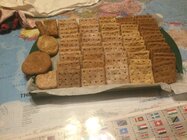
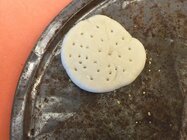
I have been producing several batches of hardtack over the past 2-3 weeks. Unfortunately I forgot to document the process, but here two of the finished batches.

image.jpg
I have used the method and ratio of water to flower and baking temps and times used by Mr. Max Miller.


Has anyone tried making hardtack, and what had you tried to make it edible?
 
Would hard tack and a navy ships biscuit have been the same ?
The difference was the shape of the bread. The round shape of the ship's biscuits made them easier to pack in barrels. Hardtack was a name given to that type of bread in the mid to late 19th century, and is more often associated with the square shape of the bread.
 
Very similar to hardtack is knäckebröd or crispbread (sold in stores as Väsabröd) Its wonderful with cheese.

In my pre-vegetarian days I often had lapskaus, a Scandinavian stew because it was often made by frugal relatives; I didn't know that the English ate it--and hope that their version tastes better. 😒
Yeah it's a big thing in Liverpool, England . It's a thick type of beef stew. It's not gourmet dining but is a pub staple over there.
 
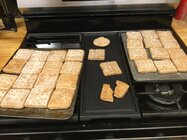
image.jpg

Here's a picture of the end product of all four batches of hardtack. The three round ones are on the left are ship's biscuits. The rest is hard bread/ hardtack, these were often made in squares for ease of packing in boxes.
Two of the batches are made with all purpose flour, one batch was completely made of whole wheat flour, and one is a mixture of both.
 
Well, perhaps if my grandmother had served stout with her lapskaus, it would have been improved!


The tasting history channel did a video on it aswell.

 
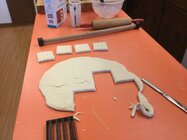
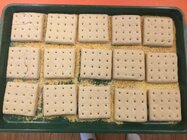
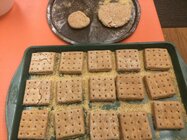
Here's some more pictures that I haven't posted yet.
I made these with cake flour, which is to my understanding the modern equivalent of fine or superfine flour used in hardtack around time of the Civil War. I also added a small amount whole wheat flour too. The pan had a covering of course corn meal.

3CA47CD0-8802-4B15-B678-8F9E8A99BE32.jpeg

1698573A-BA03-40CC-8C56-FA4AE24C6133.jpeg

59B177E6-B08D-4AEA-B3A4-4D3731DEA380.jpeg
I also made some ship's biscuits.8F362BEF-D8AE-44A4-A126-515D893EB624.jpeg
 
I don't know exactly when the Army changed the shape of its biscuits from round to square, but in the W1812, biscuits were round. Soldiers were issued sheet iron bake ovens in which to bake their daily flour ration. Typically, they'd mix the flour with water, divide the dough into 4 or 5 ounce portions, roll the dough into balls, and flatten them out, and bake the biscuits in the oven, giving the biscuit the familiar flat, round shape. In 1818, Winfield Scott estimated that a 190 pound barrel of flour would yield 171 biscuits.
 
Think just about every reenactor or history buff has taken their hand in the kitchen to see what they can produce. Hoards of various "recipes" for them out there, some close, some not so much. Most appear similar, yet the consistency can vary greatly from cookie crumbles to rock hard hockey pucks that a ball-peen hammer upon it over an anvil couldnt crack.

Years ago some of my history pards sat out to analyze and create the accurate and authentic hardtack. Its what happens when you gather some history folks mustered up with science nerds, Chemists, and professional bakers. They were able to conduct chemical analysis on a fragment of a surviving piece of hardtack, then the race was on. In anything baked goods related the type and composition of the flour in question is the make or break factor. The Gluten levels within was one of the primary key factors. The usual array of grocery store flour types available today ie: all purpose, general purpose, self-rising, cake mix flours, etc werent even remotely close to a match. Hence the end product result was either crumbly, or rock hard. Nothing made today was an exact match but the closest found was between what is today called "Pastry Flour" and "Cracker Flour". Usually only found in specialty stores. They experimented with those and got fairly favorable results in both appearance and consistency. Taking it a step further it was quickly noted that the baking temperature was also a factor. Next batch they used the bakers commercial oven since it could easily reach and properly maintain the desired higher than average temps. Poof it worked. It accurately matched the original in all regards. For longevity it is also very important that all moisture allowed to properly evaporate out of the cracker to prevent any mold from forming. Just because it seemed totally dried out many times discovering soon that it actually wasn't.
 
I don't know exactly when the Army changed the shape of its biscuits from round to square, but in the W1812, biscuits were round. Soldiers were issued sheet iron bake ovens in which to bake their daily flour ration. Typically, they'd mix the flour with water, divide the dough into 4 or 5 ounce portions, roll the dough into balls, and flatten them out, and bake the biscuits in the oven, giving the biscuit the familiar flat, round shape. In 1818, Winfield Scott estimated that a 190 pound barrel of flour would yield 171 biscuits.
I do believe that some bakeries during the Civil War made the round biscuits for civilians and for the Confederate Army and both navies.
 
Think just about every reenactor or history buff has taken their hand in the kitchen to see what they can produce. Hoards of various "recipes" for them out there, some close, some not so much. Most appear similar, yet the consistency can vary greatly from cookie crumbles to rock hard hockey pucks that a ball-peen hammer upon it over an anvil couldnt crack.

Years ago some of my history pards sat out to analyze and create the accurate and authentic hardtack. Its what happens when you gather some history folks mustered up with science nerds, Chemists, and professional bakers. They were able to conduct chemical analysis on a fragment of a surviving piece of hardtack, then the race was on. In anything baked goods related the type and composition of the flour in question is the make or break factor. The Gluten levels within was one of the primary key factors. The usual array of grocery store flour types available today ie: all purpose, general purpose, self-rising, cake mix flours, etc werent even remotely close to a match. Hence the end product result was either crumbly, or rock hard. Nothing made today was an exact match but the closest found was between what is today called "Pastry Flour" and "Cracker Flour". Usually only found in specialty stores. They experimented with those and got fairly favorable results in both appearance and consistency. Taking it a step further it was quickly noted that the baking temperature was also a factor. Next batch they used the bakers commercial oven since it could easily reach and properly maintain the desired higher than average temps. Poof it worked. It accurately matched the original in all regards. For longevity it is also very important that all moisture allowed to properly evaporate out of the cracker to prevent any mold from forming. Just because it seemed totally dried out many times discovering soon that it actually wasn't.
That's actually very interesting.
 
Very similar to hardtack is knäckebröd or crispbread (sold in stores as Väsabröd) Its wonderful with cheese.

In my pre-vegetarian days I often had lapskaus, a Scandinavian stew because it was often made by frugal relatives; I didn't know that the English ate it--and hope that their version tastes better. 😒
England has never, EVER been known for its advances in the culinary arts.

They sort of peaked at fish and chips and back slided from there.
 
England has never, EVER been known for its advances in the culinary arts.

They sort of peaked at fish and chips and back slided from there.
I dunno--although the English have the reputation of leaving things to cook since the War of the Roses, there are very few meat dishes better than steak and kidney pie. And non-meat, Yorkshire Pudding. And what about the best of all foods, the trifle?
 
I dunno--although the English have the reputation of leaving things to cook since the War of the Roses, there are very few meat dishes better than steak and kidney pie. And non-meat, Yorkshire Pudding. And what about the best of all foods, the trifle?

Imo the pie is where the English are really world leaders in the art. I've had many fine pies there from suet to shortcrust and even the odd puff pastry type it's a nation that know their pies.
 

Learn About Us
About CivilWarTalk
Contact the Webmaster
Meet the Staff
Link to CivilWarTalk
Join Our Community
Register
Browse Forums
View Today's Discussions
Search the Forum
Get Help
FAQ
Student Guide
Forum Rules & Etiquette
Copyright / DMCA

     Contact Us CivilwarTalk on Facebook CivilWarTalk on YouTube CivilWarTalk on Twitter RSS Feed

Bringing the American Civil War and More to Life.
© 1999 - , CIVILWARTALK, LLC - Site Version 10.0

SlaveryTalk.com - SecessionTalk.com - CivilWarTalk.com - ReconstructionTalk.com
Back
Top