
- Joined
- Aug 17, 2011
- Location
- Birmingham, Alabama
Someone remarked that one source of Yankee opposition to the FSL of 1850 was a fear that slave hunters would target whites to enslave them and take them down South. So far I am unable to find confirming evidence of this.
However....
Ellen and William Craft
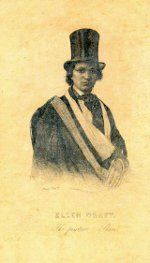
With mulatto slaves becoming more and more white as slave owners propagated with mulatto slaves, it appears that such a incident(White person claimed as a slave by a slave hunter) falls into the realm of possibility. One of the problems causing concerns down South was the fact that slaves were becoming whiter and whiter. Racism used to subordinate blacks works best when there is a definite color difference. As that diminishes the difference between master and slave becomes indistinguishable. Some Southerner writers such as George Fitzhugh and his works Sociology for the South and Cannibals All! along with Henry Hughes and his Sociology for the South, or, the Failure of Free Society proposed enslaving poor whites.
This brings a whole new meaning to the term white slavery with stories of young white Yankee women hauled down south by slave catchers all enabled by the 1850 FSL.

However....
Ellen and William Craft
Ellen Craft (1826–1897) and William Craft (September 25, 1824 – January 29, 1900)[1] were slaves from Macon, Georgia in the United States who escaped to the North in December 1848 by traveling openly by train and steamboat, arriving in Philadelphia on Christmas Day. She posed as a white male planter and he as her personal servant. Their daring escape was widely publicized, making them among the most famous of fugitive slaves. Abolitionists featured them in public lectures to gain support in the struggle to end the institution. As the light-skinned mixed-race daughter of a mulatto slave and her white master, Ellen Craft used her appearance to pass as a white man, dressed in appropriate clothing.
Threatened by slave catchers in Boston after passage of the Fugitive Slave Act of 1850, the Crafts escaped to England, where they lived for nearly two decades and reared five children.
...
In 1850, the US Congress passed the Fugitive Slave Act, making it a federal crime to aid an escaped slave and requiring law enforcement even in free states to aid efforts to recapture fugitives. Bounty hunters and slave catchers sought fees for finding fugitive slaves. William Craft described the new law as "an enactment too infamous to have been thought of or tolerated by any people in the world except the unprincipled and tyrannical Yankees".[citation needed] A month after the new law was effective, Collins sent two bounty hunters to Boston to retrieve the Crafts. Abolitionists in Boston had formed the biracial Vigilance Committee to resist the new Slave Bill; its members protected the Crafts by moving them around various "safe houses" (such as the Tappan-Philbrick house in the nearby town of Brookline[8]) until they could leave the country. Collins appealed to the President of the United States, Millard Fillmore, asking him to intervene so he could regain his property. The President agreed that the Crafts should be returned to their owners in the South, and authorized the use of military force if necessary to take them.[9]
With mulatto slaves becoming more and more white as slave owners propagated with mulatto slaves, it appears that such a incident(White person claimed as a slave by a slave hunter) falls into the realm of possibility. One of the problems causing concerns down South was the fact that slaves were becoming whiter and whiter. Racism used to subordinate blacks works best when there is a definite color difference. As that diminishes the difference between master and slave becomes indistinguishable. Some Southerner writers such as George Fitzhugh and his works Sociology for the South and Cannibals All! along with Henry Hughes and his Sociology for the South, or, the Failure of Free Society proposed enslaving poor whites.
This brings a whole new meaning to the term white slavery with stories of young white Yankee women hauled down south by slave catchers all enabled by the 1850 FSL.


 Forum Host


 Bringing the