syrup making
(from The Confederate Union, of Milledgeville, Georgia, September 22, 1863)
Ingredients:
Instructions:
(from The Confederate Union, of Milledgeville, Georgia, September 22, 1863)
Ingredients:
sugarcane stalks
Instructions:
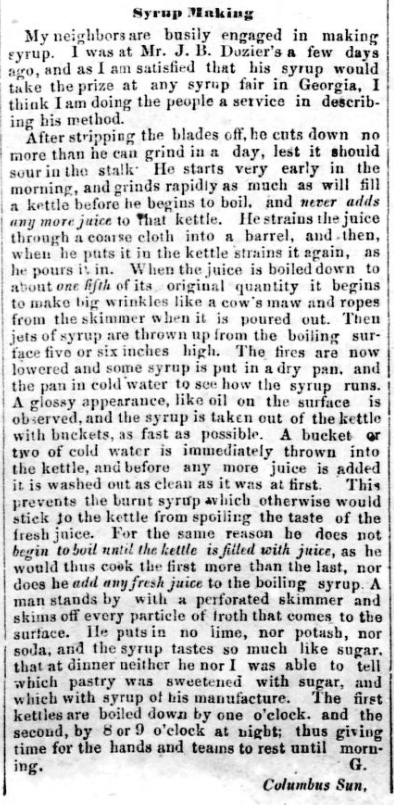
My neighbors are busily engaged in making syrup. I was at Mr. J. B. Dozier's a few days ago, and as I am satisfied that his syrup would take the prize at any syrup fair in Georgia, I think I am doing the people a service in describing his method.
After stripping the blades off, he cuts down no more than he can grind in a day, lest it should sour on the stalk. He starts very early in the morning, and grinds rapidly as much as will fill a kettle before he begins to boil, and never adds any more juice to that kettle. He strains the juice through a coarse cloth into a barrel, and then, when he puts it in the kettle strains it again, as he pours it in. When the juice is boiled down to about one fifth of its original quantity it begins to make big wrinkles like a cow's maw and ropes from the skimmer when it is poured out. Then jets of syrup are thrown up from the boiling surface five or six inches high. The fires are now lowered and some syrup is put in a dry pan. and the pan in cold water to see how the syrup runs. A glossy appearance, like oil on the surface is observed, and the syrup is taken out of the kettle with buckets, as fast as possible. A bucket or two of cold water is immediately thrown into the kettle, and before any more juice is added it is washed out as clean as it was at first. This prevents the burnt syrup which otherwise would stick to the kettle from spoiling the taste of the fresh juice. For the same reason he does not begin to boil until the kettle is filled with juice, as he would thus cook the first more than the last, nor does he add any fresh juice to the boiling syrup. A man stands by with a perforated skimmer and skims off every particle of froth that comes to the surface. He puts in no lime, nor potash, nor soda, and the syrup tastes so much like sugar, that at dinner neither he nor I was able to tell which pastry was sweetened with sugar, and which with syrup of his manufacture. The first kettles are boiled down by one o'clock, and the second, by 8 or 9 o'clock at night; thus giving time for the hands and teams to rest until morning.
G.
Columbus Sun.
Last edited by a moderator:


 Bringing the