Needle in a Haystack? ID Officer of Semmes' Brigade Killed by Concussion July 2nd

lelliott19

Brigadier General
Moderator
* OFFICIAL *
CWT PRESENTER
Forum Host
Silver Patron
Regtl. Staff Chickamauga 2018
Joined
Mar 15, 2013
I'm trying to track down the identity of a specific officer of Semmes' brigade who was killed by the concussion of a cannonball on July 2nd.

During a walk over the Gettysburg battlefield with former officers and soldiers of both sides June 7-8, 1882, Colonel David Wyatt Aiken states that during the fighting on July 2nd, he saw an officer from Semmes' brigade killed by a "round shot." While the round never physically touched the officer, he was killed instantly by the sheer concussion.

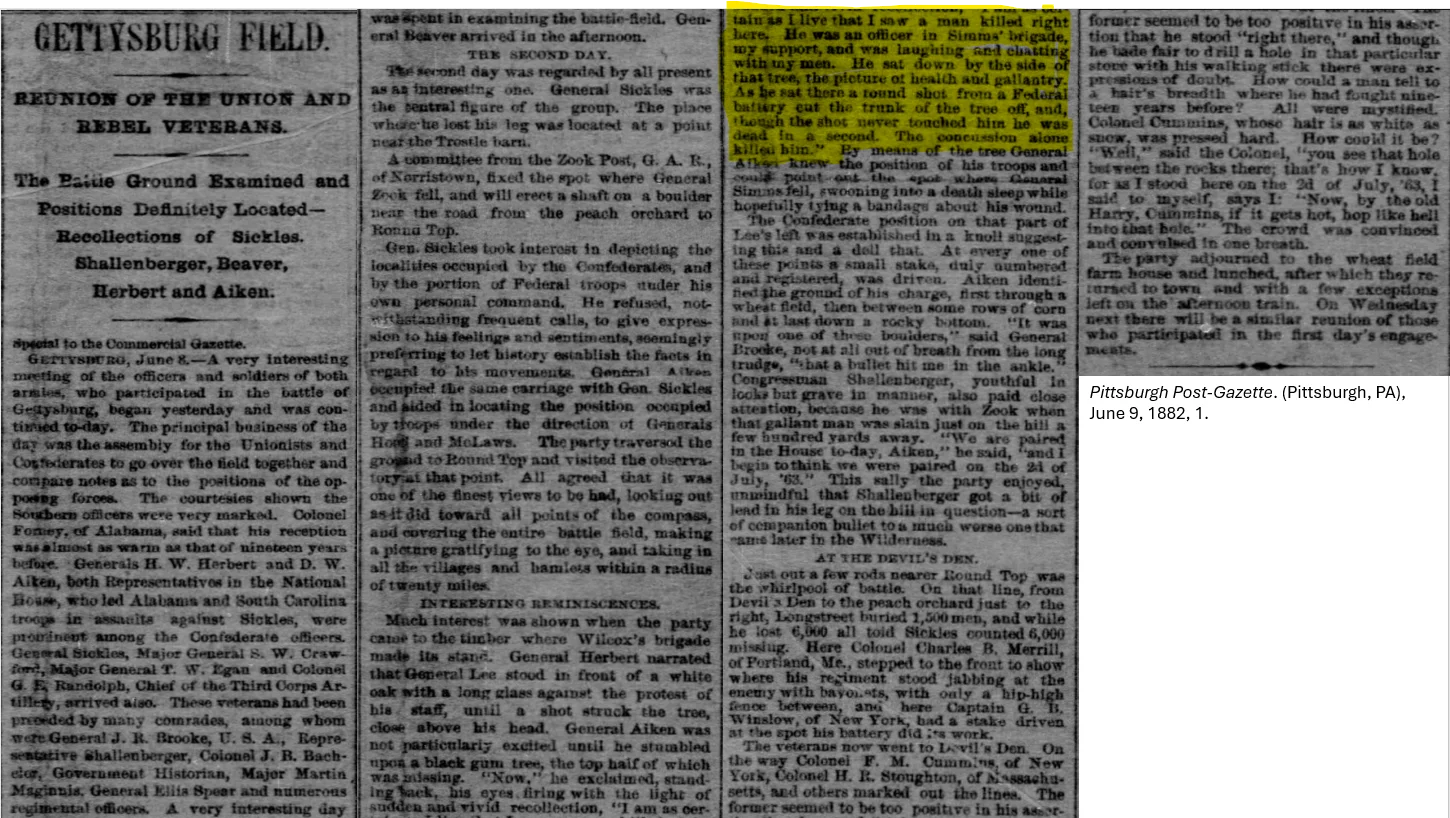
Ill post the entire article below since it has some clues as to the specific location, but this is the part that caught my attention:
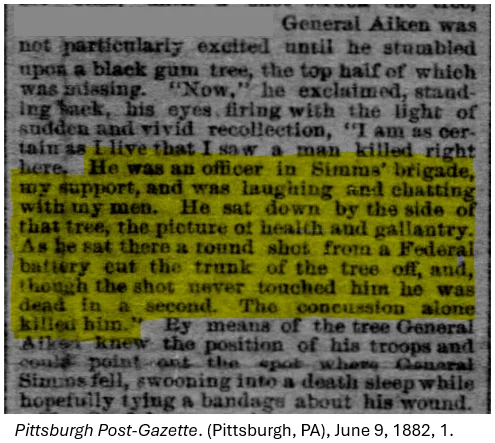
"General Aiken was not particularly excited until he stumbled upon a black gum tree, the top half of which was missing ... I am as certain as I live that I saw a man killed right here. He was an officer in Simms' [sic] brigade, my support, and was laughing and chatting with my men. He sat down by the side of that tree, the picture of health and gallantry. As he sat there a round shot from a Federal battery cut the trunk of the tree off, and though the shot never touched him, he was dead in a second. The concussion alone killed him."

1784398961429.webp


Later in the article, General Brooke points out the boulders right next to this spot where a bullet hit him in the ankle. If I recall correctly, this location is at the southern edge of the Wheatfield / northern edge of Rose Woods along the Plum Run ravine, near the 53rd Pennsylvania?

Aiken tells us that this man who was killed by concussion, was 1.) an officer in Semmes brigade 2.) the picture of health and gallantry. Looking at the casualties for Semmes' Brigade, I've compiled a list of candidates - field and company officers - who were killed in action that day. I'm hoping the good folks of CWT can help identify the officer and/or the location of the black gum tree?

Here are some possibilities: Semmes Brigade Officers Reported as Killed July 2
Major Henry M. Dunwoody (51st Georgia) - His death may have been caused by an exploding shell?
Lt. Col. James Washington Hance (53rd Georgia)
Capt. Thomas Washington Atkins (Acting Major, 53rd Georgia)
Capt. J. M. Bond (Co. I, 53rd Georgia)
Lt. Col. Francis Kearse (50th Georgia) - I believe some accounts attribute his death to "grape shot." Certainly other casualties indicate the 50th GA was pounded by artillery as their advance got underway.
Capt. E. M. Ford (Co. A, 50th Georgia)
Capt. Isaac Burkhalter (Co. G, 50th Georgia)

Does anyone know if one of these officers in Semmes brigade (or another not listed) was killed by concussion? Can anyone match the 1882 description of the broken black gum tree to its location? I'm including entire article below. I'm hopeful that interpretation of the direction of travel and order of locations visited, may provide the context needed for someone with more specific knowledge of the terrain to pinpoint the location of the tree?

@Tom Elmore @pmuskett @rpkennedy @Gettysburg Greg do yall have any idea?
1784400435738.webp

Note: I posted another version of this same report back in March 2020, but at that time, I had not located the casualty reports from Semmes brigade for comparison purposes. We never identified the concussion casualty in 2020, so I figured I'd give it another shot.

Here are the links to the regimental reports naming the casualties for regiments in Semmes brigade at the Battle of Gettysburg
Casualties in the 51st Georgia at Gettysburg: https://civilwartalk.com/threads/semmes-brigade-at-gettysburg.175379/#post-2692081
Casualties in the 53rd Georgia at Gettysburg: https://civilwartalk.com/threads/semmes-brigade-at-gettysburg.175379/#post-2692379
Casualties in the 10th Georgia at Gettysburg: https://civilwartalk.com/threads/semmes-brigade-at-gettysburg.175379/#post-2692408
Casualties in the 50th Georgia at Gettysburg: https://civilwartalk.com/threads/semmes-brigade-at-gettysburg.175379/#post-2692642
 
My bet would be either Capt. E. M. Ford or Capt. Isaac Burkhalter of the 50th Georgia. In my preparation of maps of the Warfield Ridge positions, I show the 50th Georgia (Semmes' far left regiment) and also the left of the 10th Georgia immediately behind the 7th South Carolina prior to their advance on July 2.

I don't doubt Aiken's memory. Round shot (cannonball) delivered an enormous amount of kinetic energy. If the officer was leaning against that tree with his head and back touching the trunk, I suppose a round shot striking the trunk above his head could impart sufficient energy to cause instantaneous death. A section of Carlton's battery was to the immediate right of the 7th South Carolina, with Manly's battery and Carlton's other section just beyond, which was the most likely intended target.
 
Last edited:
Thought the following officers of Semmes's brigade who were reportedly killed in action (presumably instantly) on Jul. 2 could be added to the list shown as possibles:-

Lt. James Douglass (Co. G, 50 GA)
Lt-Col. John Thomas Key (Co. E, 10 GA)
Lt. Etheldred Langford (Co. D, 50 GA)

If Col. Aiken (7th SC) stated he saw an officer from Semmes's support brigade, who while mixing with his own men, was killed by the concussion from a fired round shot that struck a nearby tree.

Then, judging from the Jul. 2 battlefield map viewed (see https://www.battlefields.org/learn/...eld-and-peach-orchard-july-2-1863-545pm-630pm ), it seems that the 50th GA was the only regiment of Semmes's brigade that would have directly supported the 7th SC in its advance. The 50th GA was also close enough to the 7th SC at the time, for Aiken to have a clear uninterrupted view of the alleged incident.

On the basis of proximity, have narrowed down the seen officer to likely belonging to the 50th GA. Also thought he was possibly only a junior officer (say, a Lt.) as he was seen intermingling with soldiers in the ranks of another regiment at the tree. Have discounted the fallen officer being either Capt. Isaac Burkhalter (Co. G, 50th GA) or Capt. Edward Ford (Co. A, 50th GA), if either of them were not recorded as being killed instantly- both these officers presumably had witnesses to their deaths and were reburied in known places. Also, Lt-Col. Francis Kearse (50th GA) is ruled out because he was reportedly killed by grape shot.

By a process of elimination, thought the possible officer who was killed instantly in the questioned way on Jul. 2 was either Lt. Etheldred Langford or Lt. James Douglass (See https://babel.hathitrust.org/cgi/pt?id=wu.89059402313&seq=333 @ p. 313 & p. 339).
 
Alternatively. The reproduced article extract states Aiken refers to the killed officer belonging to Simm's brigade. Could this identified unit size have mistakenly referred to a 'brigade', instead of a 'regiment'.

At Gettysburg, the 53rd GA was commanded by Col. James P. Simms. So could the observed fallen officer have belonged to the 53rd GA? If so, then from the list of killed officers, only Capt. John Bond Jnr and Lt-Col. James Hance were members of that regiment and might be in consideration for being the fallen officer.
 
I think that there are some good possibilities offered above.

I am currently on vacation and several hundred miles away from all of my resources but I'll try to look them up when I get home at the end of this week.

Ryan
 
Good luck. It took me years to figure out who "the old cusss with the spyglass was." Ames wrote about him in a B&L article about being before the stone wall. Sergeant asked if he could take out that old cuss. I asked at Fredericksburg and the ranger didn't know. Years later I found where Edward Porter Alexander confesssed to being the old cuss. He was one of the few in the ANV who still used one instead of binoculars.
 
extract states Aiken refers to the killed officer belonging to Simm's brigade.
Thank you for weighing in @Nathan Stuart I appreciate your thoughtful evaluation and input. Misspelling of BG P J Semmes' name was pretty common. A lot of people who didn't know how to spell his name wrote it as Sims or Simms. Even guys in the regiments of his brigade.

Regarding Semmes' brigade vs. Simms' regiment - I suppose it's possible that the reporter mis-quoted Aiken, but Aiken himself would have definitely used the correct terminology. All those guys on the battlefield that day including Aiken were veterans and would have used "brigade" or "regiment" correctly. Besides, Aiken seems to make it clear that the encounter occurred while they were lined up waiting. It's pretty well established that only the 50th GA and perhaps the left of the 10th GA overlapped behind the 7th SC of Kershaw's brigade during that waiting period. So I don't think it was an officer of J P Simms 53rd GA down on the far right.

When I read Aiken's statement, I immediately thought it must be an adult officer of the 50th GA. Mainly because of proximity but also because Aiken referred to him as "the picture of health and gallantry." And because he was up there mingling with Aikens men. Aiken's 7th SC was about to go in first so maybe he was trying to keep their morale up. Joking around to try and keep their mind off of what they were about to be called to do? Picture of health and gallantry --- sounds like a mid-twenties to mid-thirties man to me. Someone who would know that was important and demonstrate the initiative to go ahead and do it.

I just don't normally think of 18-23 year old soldiers as having accumulated the life experiences yet to develop "gallantry" or to be labeled by Col Aiken as "gallant." But I could be wrong. It could be a younger guy. Obviously, if he went to sit down by a tree, he was preserving his strength for the impending task - sitting in the shade instead of standing out in the blazing sun. Something a smart guy with some life experience would do.

I do think your rationale is very well thought out and well presented @Nathan Stuart . I'm going to take your suggestion and add the younger officers of the 10th and 50th GA to the list (based on the map overlap). Then I'll find all their ages and add those to the list. Ill be back when I have compiled that information. @Tom Elmore thanks for the maps and your input. @rpkennedy thank you for taking a look when you're back in front of your sources. @gary thanks for sharing the story about the "old cuss" - it gives me hope that the officer killed by concussion can be identified.
 
Revised List Semmes Brigade Officers Reported as Killed July 2

Possibilities in the 50th GA (most likely due to proximity to 7th SC and reliable indications the 50th GA was pounded by artillery as their advance got underway.)

1. Lt. Col. Francis Kearse
(50th Georgia) - I believe some accounts attribute his death to "grape shot" so I don't think it was him.

2. Capt. E. M. Ford (Co. A, 50 GA)
Capt. Ford was 21yo (b. 1842 in NC). I can't locate him on the 1860 US Census, but all his kin (including his widowed mother) lived in Wayne County, GA next door to Pierce County where the Satilla Rangers (CoA) was organized. Capt. Ford originally enlisted as a Private but rose through the ranks to command Co. A at Gettysburg where he was killed instantly; not mortally wounded.
1784495205942.webp


3. Lt. Etheldred Langford (Co. D, 50 GA)
We can eliminate Lt. Langford. He was was mortally wounded while commanding Co. D and reported as "since dead." So he was not killed instantly.
1784492395519.webp


4. Capt. Isaac Burkhalter (Co. G, 50 GA)
Capt. Burkhalter was 32 years old (b. 1831 in GA) when he was killed at Gettysburg. He was married to Charlotte (age 25) with at least 3 small children back home - ages 3 1/3 to 7 years. Isaac had real estate valued at $1200 and personal property valued at $2500. They lived in Magnolia, GA which is in Clinch County -- where the Clinch Invincibles aka Co G was primarily recruited.

Burkhalter was elected Justice of the Peace in 1857. People in the local community had confidence in him. He would have had the maturity and confidence to step out and mingle casually with the South Carolinians. And he would have inherently understood the immense tension holding those lines. Mingling, joking, and chatting with the 7th SC - who were about to bear the brunt of the opening assault - is classic veteran leadership behavior designed to project calm confidence and ease the panic of younger men.

Burkhalter originally enlisted as 2nd Lieutenant. The original Captain was John Riley O'Steen (b. 1832), but he was mortally wounded at South Mountain in September 1862 and Isaac Burkhalter was promoted to Captain. Then Captain Burkhalter was killed July 2nd at the Battle of Gettysburg - less than a year later.
1784495301592.webp


5. Lt. James Douglass (Co. G, 50 GA) - We can eliminate Douglass. He wasn't killed; he was promoted to 1st Lieut. July 2 and his name is not included on casualty reports.


Possibilities in 10th GA (fairly likely based on proximity)

6. Lt. John Thomas Key (Co. E, 10 GA)

John Key (b. 1841 in GA) was 22 years old at the Battle of Gettysburg. He married Elizabeth Jennie Russell February 9, 1860 and a daughter, Mattie Jannie Key, was born in December. She was just 2 1/2 when her father was killed. Key was no teenager. He was a married man, but he doesn't fit quite as neatly in that mid-twenties bracket of physical peak and developing maturity I mentioned earlier.

However, in the 1860 U.S. Census for Clayton County, Georgia (Jonesboro district), John's father Dr James Barton Key is listed as a Mill Wright with real estate valued at $2500 and personal property valued at $10,000. (He is still listed as a mill wright in 1870, so I'm not sure when he became a doctor.) This is a critical detail. A 22-year-old son of a mill wright in a county hub would have been literate, highly organized, and socially adept. He grew up surrounded by abundance and was accustomed to managing accounts and speaking confidently to a diverse public. Exactly the kind of man Aiken might have labeled "gallant."

Lt. Key's background perfectly accounts for calmly resting in the shade. He was smart and knew how to manage resources and project a steady, "gallant" presence to those around him. If he was the officer mingling and chatting with the men of Aiken's 7th South Carolina, it was likely easy for him to strike up a conversation to break the pre-battle tension.

John Key originally enlisted as a 2nd Lt. at Jonesboro Clayton County GA on May 20, 1861. In Oct 1861, he was promoted to 1st Lieutenant. In Mar 1862, he was sent back to Georgia for recruiting duty. Captured at South Mountain or Antietam, paroled, and exchanged, then detailed to serve on the court in April 1863. He was evidently killed immediately - not mortally wounded - so remains a strong possibility.
1784499238540.webp


IMHO either Burkhalter or Key could be the man. Both possessed the exact life experiences, maturity, and community clout to step out, mingle casually with Aiken's South Carolinians, and carry themselves with the "gallantry" that caught Colonel Aiken's eye. Right before a solid shot severed the tree.

Here are the ones I still have to look up:
51st GA & 53rd GA (less likely due to proximity but still possible?)
Major Henry M. Dunwoody (51 GA) - His death may have been caused by an exploding shell?
Lt. Col. James Washington Hance (53 GA)
Capt. Thomas Washington Atkins (Acting Major, 53 GA)
Capt. J. M. Bond (Co. I, 53 GA)
 
Thank you for weighing in @Nathan Stuart I appreciate your thoughtful evaluation and input.
You are welcome.

Misspelling of BG P J Semmes' name was pretty common. A lot of people who didn't know how to spell his name wrote it as Sims or Simms. Even guys in the regiments of his brigade.

Regarding Semmes' brigade vs. Simms' regiment - I suppose it's possible that the reporter mis-quoted Aiken, but Aiken himself would have definitely used the correct terminology.
As further consideration of the possibility of mistaken newspaper reporting of 'brigade' instead of 'regiment' in support of the notion that the fallen officer may have in fact belonged to 'Simms' regiment' - being the 53rd GA.

The article appearing in the 'Pittsburgh Post-Gazette' (June 9, 1882, @ p. 1) refers to 'General Aiken'. But Aiken's highest ever rank attained was of 'Colonel'.

So was there a tendency for reporting errors to occur (or to embellish) in this particular published article? Is it possible that the reporting in this published article also got the unit size wrong too (in relation to referencing 'brigade' instead of 'regiment')? At this stage, would personally not rule out this possibility entirely.

When I read Aiken's statement, I immediately thought it must be an adult officer of the 50th GA.
I would tend to agree. The 53rd GA appears to have been deployed too far to the right of the 7th SC for Aiken to have had a clear enough detailed view of the alleged incident. Seems more likely that the fallen officer belonged to the 50th GA (Also see 'OR': Vol. 27, Part 2, 2 pp. 368-69).
 
Lieutenant Colonel Francis Kearse of the 50th Georgia was killed by a grape shot after the regiment had advanced 200 yards, according to the reminiscences of 5th Sergeant William M. Jones of Company K, 50th Georgia.

A fellow by the name of Ambrose Emory went over the ground circa August 18, 1863, recording graves of deceased Southerners, and near the Rose house, a few yards from the spring house, he recorded the burial of Cpt. I. M. D. Bond, Co. I, 53rd Georgia, which would be Captain John M. D. Bond. (A Strange and Blighted Land, by Gregory A. Coco, p. 45)
 
From Gregory A. Coco's Gettysburg's Confederate Dead:
-Captain Edward M. Ford, A/50 GA - Buried on Rose farm "in orchard near springhouse."
-Captain Isaac Burkhalter, G/50 GA - Buried on Rose farm "in orchard near springhouse."
-Major Henry Macon Dunwody, 51 GA - Buried on Rose farm "in the gravl [gravel?] walk in the woods."
-Lieutenant Colonel James Washington Hance, 53 GA - Buried on the Rose farm, possibly "on the gravl walk in the woods."
-Captain Thomas W. Atkins, A/53 GA - Buried near Black Horse Tavern "in burying ground," or Francis Bream's farm.

But there is one name conspicuously absent from Coco's list: Lieutenant John Thomas Key, E/10 GA. One could expect someone killed on Warfield Ridge prior to the charge to have been buried near where he fell, or perhaps taken a short distance to the rear to be buried in the woods, or edge of the woods, where his grave might have been overlooked when it came time to remove bodies to cemeteries in the South a few years after the war. Checking Elliott's map of the battlefield, I see no grave marked in that immediate vicinity, but there are some not too far away.

The mystery deepens because one of the few good sources on Semmes' brigade is Captain Andrew Jackson McBride of Company E, 10th Georgia. Just now checking his writings, he mentions that Lt. Key was shot through the neck in what must have been Rose woods. In that case, he may have bled to death and been buried as an unknown. So back to the drawing board.
 
Last edited:
IMHO either Burkhalter or Key could be the man.
Thanks for the extra information and reasoned analysis - I agree with you that there is a strong possibility it was either Capt. Burkhalter (50 GA) or Lt. Key (10 GA). But after reading Tom Elmore's above post (#12), it looks like Key can now be firmly eliminated as a possibility.

I need to correct my earlier reference to Key as holding the rank of 'Lt-Col.', when in fact he was a 'Lt.' (I misread 'Co.' as 'Col.' in the entry viewed).
 
-Captain Thomas W. Atkins, A/53 GA - Buried near Black Horse Tavern "in burying ground," or Francis Bream's farm.
So it seems we can eliminate Capt. Atkins who was acting Major 53 GA? If he was buried back at the Black Horse Tavern, he must have been wounded but still alive? And carried to the hospital where his wounds were examined but he succumbed there.

But there is one name conspicuously absent from Coco's list: Lieutenant John Thomas Key, E/10 GA. One could expect someone killed on Warfield Ridge prior to the charge to have been buried near where he fell, or perhaps taken a short distance to the rear to be buried in the woods, or edge of the woods, where his grave might have been overlooked when it came time to remove bodies to cemeteries in the South a few years after the war. Checking Elliott's map of the battlefield, I see no grave marked in that immediate vicinity, but there are some not too far away.

The mystery deepens because one of the few good sources on Semmes' brigade is Captain Andrew Jackson McBride of Company E, 10th Georgia. Just now checking his writings, he mentions that Lt. Key was shot through the neck in what must have been Rose woods. In that case, he may have bled to death and been buried as an unknown. So back to the drawing board.
If Andrew J McBride says John Thomas Key was shot through the neck, then I think we can safely eliminate him from the list of possibilities too. McBride's recollections have always been spot-on. I have no reason to doubt anything he says. If Capt. Key was shot through the neck and bled to death, he is not the officer who Aiken describes as killed instantly by concussion at the black gum tree.

-Captain Isaac Burkhalter, G/50 GA - Buried on Rose farm "in orchard near springhouse."
I still think Burkhalter might be be a contender. If Aiken was observing from the center of his line or moving back to speak with BG Semmes, he would have been just in front of Capt Isaac Burkhalter (Co. G, 50th GA), the mature 32-year-old family man and Justice of the Peace whose natural poise and life experiences made him stand out as the "picture of health and gallantry." I can see a Justice of the Peace striking up a conversation with the 7 SC to project calm confidence and keep their minds off the task ahead. And the incoming artillery.
 
After reviewing all of the information presented so far, it seems likely that the fallen officer belonged to the 50th GA (based mainly on proximity).

That would narrow down the possibilities to being either:-

Capt. Edward Ford or
Capt. Isaac Burkhalter

From the additional source of 'Find-a-Grave' listings for both of these men.

The listing for Capt. Ford (see https://www.findagrave.com/memorial/23556828/edward_m-ford/photo ) has a photo of his grave marker showing his date of death as Jul. 3, not Jul. 2, '63.

The listing for Capt. Burkhalter (see https://www.findagrave.com/memorial/69829828/isaac-burkhalter ) mentions that he died on Jul. 2, '63, and was ...'buried at the Rose Farm orchard, near fence, until disinterred in 1871'...

Although 'Find-a-Grave' information is not infallible, it appears from this further information that it's more likely to be Burkhalter. At this stage, my bets remain on it being Capt. Burkhalter.
 
Last edited:
Revised List with eliminations marked for Quicker Reference:

1. Lt. Col. Francis Kearse (50th Georgia) - Eliminated. Killed by a "grape shot" after the regiment had advanced 200 yards, according to the reminiscences of 5th Sergeant William M. Jones of Company K, 50th Georgia.

2. Capt. E. M. Ford (Co. A, 50 GA) Remains a possibility, but without knowing more about his physical bearing, not much to indicate Aiken would have considered him "gallant." Buried on Rose farm "in orchard near springhouse." [Coco.]

3. Lt. Etheldred Langford (Co. D, 50 GA) Eliminated. Mortally wounded; wounded and "since dead."

4. Capt. Isaac Burkhalter (Co. G, 50 GA) Remains a possibility. A 32 year old family man and Justice of the Peace. Buried on Rose farm "in orchard near springhouse." [Coco.]

5. Lt. James Douglass (Co. G, 50 GA) - Eliminated. He wasn't killed; he was promoted to 1st Lieut. July 2 and his name is not included on casualty reports.

6. Lt. John Thomas Key (Co. E, 10 GA) Eliminated. Shot through the neck as reported by Capt. A J McBride (E/10 GA), a reliable source.

7. Major Henry M. Dunwoody (51 GA) - Eliminated. 37 yo. @Tom Elmore has a source that says Dunwoody's death was caused by "grape shot." Buried on Rose farm "in the gravl [gravel?] walk in the woods." [Coco]

8. Lt. Col. James Washington Hance (53 GA) Col. Aiken was probably more likely to notice and specifically remember a 34 yo fellow field officer like Hance over a younger company level officer. Especially when you consider that Hance was born in South Carolina. Even though the companies of the 7 SC were mostly recruited from Edgefield and Abbeville, Hance would have been able to easily strike up a conversation with the Carolinians.

But Lt. Col. Hance's gravestone in Laurens City Cemetery says "53rd Ga Reg't / was mortally wounded / and died on the Battle / field of Gettysburg / July 2, 1863 / aged 34 years 8 months / and 2 days." Notation on his FindAGrave say Hance was killed in a clearing on the Rose Farm, while attacking Stony Hill. Hance was first buried at the door to the Rose's Summer Kitchen. Farmer Rose personally removed his remains to the edge of a "gravel path by the woods," where they were later recovered and returned to his family. Coco said Hance was Buried on the Rose farm, possibly "on the gravl walk in the woods." - which means he was buried with or near Dunwoody. If we can get confirmation that Hance was leading his regiment in an attack when he was killed, then he is not our black gum concussion guy either. https://www.findagrave.com/memorial/8161458/james_washington-hance

9. Capt. Thomas Washington Atkins (Acting Major, 53 GA) Eliminated. Buried back at the Black Horse Tavern [Coco] so he must have been mortally wounded not killed on the field.

10. Capt. John Mitchell Dooly Bond, Jr. (Co. I, 53 GA) He was 24-26 yo and the original Captain of the Butts Volunteers. His father was the Tax Collector for Butts County. In 1860, he married 16yo Charity S Goddard and two children followed - Sarah Henry Elizabeth b. 1860 and John Mitchell Dooly, III b. 1862. Sarah was 2 1/2 yo and JMD,III was 18 months old when their father was killed. Some accounts say that he was killed while leading a charge but I'll keep him on the list as a possibility.
 
Re Capt. Burkhalter. To throw a possible wrench in the works. If he was initially buried at the Rose Farm orchard, near the fence (presumably close to where he fell), is it likely that there would be a tall gum tree growing in that vicinity (so close to the orchard trees fence line)? To roughly illustrate, without having seen a period picture of the scene. A modern day photograph viewed seems to show the subject area devoid of any tall tree vegetative growth (See https://www.facebook.com/groups/689176581275256/posts/2267753703417528/ ).
 
Last edited:
This doesn't solve the mystery, but maybe someone will notice something I'm not seeing. Besides I couldn't give up without at least attempting to match up the burial locations.

In April 1866, Hiram Warren, a Gettysburg citizen, provided Dr. James Camack with this list of identified graves of Georgia soldiers. Long before there was organized effort to locate and remove Confederate burials.* The list was first published in The Daily Intelligencer. (Atlanta, GA), April 29, 1866, 2.

Hiram Warren was an absolute hero! I've always assumed that at least some kind of identifying headboard was present on these graves when Hiram first began his work to locate and identify them. I've also always assumed that Hiram compiled his list "by group" and "by area" so that names appearing near each other on the list, correspond to graves that were found in close proximity to one another on the ground. That has proved out in past research, so it's really not just a "theory" anymore. It's been tested as @Tom Elmore can attest.

So here's the list with my conclusions to the right. Like I said, it doesn't solve the mystery but might add something.
1784523721514.webp

The Daily Intelligencer. (Atlanta, GA), April 29, 1866, 2.

*It would be five more years before Dr. Rufus Weaver began his work. Aided by Dr. J. W. C. O'Neal's journal of temporary burials, Dr. Weaver superintended a mass disinterment of Confederate dead beginning in 1871.
 
Last edited:
This list illustrates exactly why I said Hiram Warren was a hero.

David Wills sent this list in 1871. It looks as long (or maybe longer) than Hiram Warren's. But only one of the names we are looking for is included on Wills' list -- Capt. Thomas Washington Atkins, listed as Capt. J H Atkins, 53d Ga.
1784524239828.webp

Weekly Chronicle & Sentinel. (Augusta, GA), August 30, 1871, 1.
 
One could expect someone killed on Warfield Ridge prior to the charge to have been buried near where he fell, or perhaps taken a short distance to the rear to be buried in the woods, or edge of the woods, where his grave might have been overlooked when it came time to remove bodies to cemeteries in the South a few years after the war. Checking Elliott's map of the battlefield, I see no grave marked in that immediate vicinity, but there are some not too far away.
There is what appears to possibly be a fairly large black gum tree marked with the white circle on the attached snip. That section of ground was imaged in Fall -- which makes it easier to tell what kind of tree it might be when it's enlarged on google maps. Of course, there may be others in the adjoining section that was imaged in Summer, but there's not enough detail to tell without being there in person.
1784581793756.webp


Ad here is the (sort of) corresponding section of the Elliott burial map.
1784581961257.webp


And an attempt at overlaying the Elliott Map on the google snip
1784582547224.webp
 
Last edited:

Learn About Us
About CivilWarTalk
Contact the Webmaster
Meet the Staff
Link to CivilWarTalk
Join Our Community
Register
Browse Forums
View Today's Discussions
Search the Forum
Get Help
FAQ
Student Guide
Forum Rules & Etiquette
Copyright / DMCA

     Contact Us CivilwarTalk on Facebook CivilWarTalk on YouTube CivilWarTalk on Twitter RSS Feed

Bringing the American Civil War and More to Life.
© 1999 - , CIVILWARTALK, LLC - Site Version 10.0

SlaveryTalk.com - SecessionTalk.com - CivilWarTalk.com - ReconstructionTalk.com
Back
Top