Were Color Bearers Armed?

RaggedAssSecond

Corporal
Joined
Nov 26, 2024
Did regulations stipulate that color bearers were not to be armed? Are there any documented instances where color bearers were armed in battle?


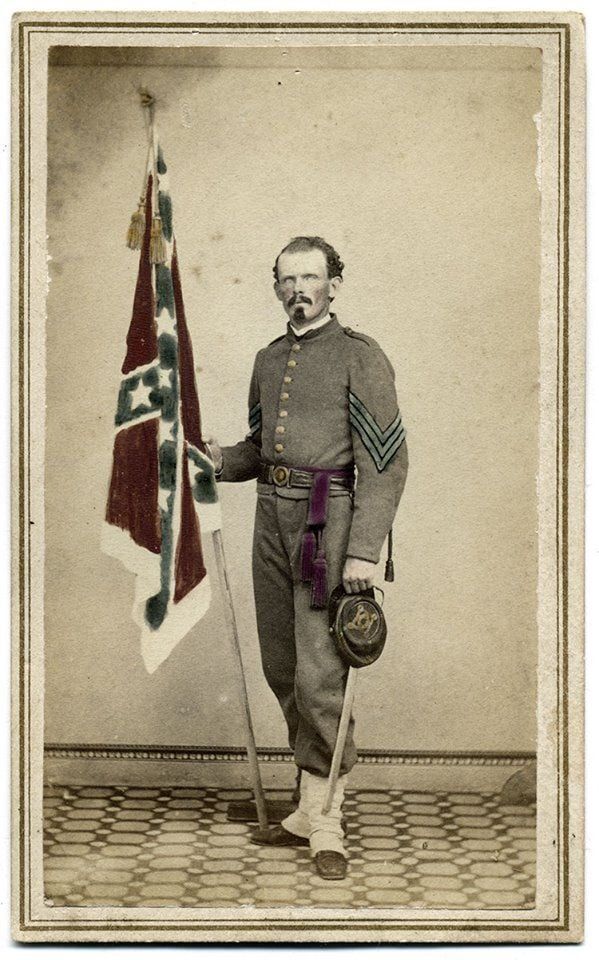
Sgt. William Crawford Smith of the 12th Virginia Infantry.

IMG_1746.jpeg
 
Best Answer
They were armed with incredible courage.

When teaching the Civil War to my 8th graders, I like to talk about how the color bearers went into battle unable to defend themselves, knowing that they would be a primary target of the enemy. Almost without exception, a student will raise his or her hand and ask why in the world a sane person would do such a stupid thing. Any my answer is always the same...

"It was just a different time. Back then, people cared about things like honor and duty. We don't put much stock in things like that anymore, but maybe we should."
Did regulations stipulate that color bearers were not to be armed? Are there any documented instances where color bearers were armed in battle?


Sgt. William Crawford Smith of the 12th Virginia Infantry.

View attachment 538265
Well, of course a color bearer could not have carried a rifle, but I know of no reason he could not have had a holstered pistol.
 
Members of the color guard were all armed -- bayonets fixed at all times while on duty guarding the colors in camp or on the march. The man actually carrying the color, of course, wasn't -- had his hands full. I recall reading a memoir by a color sergeant of the 28th Mass. (Irish Brigade) who said the color men were all given short ("2 band") Enfields and long saber bayonets. Apparently they were subjected to some razzing over the size of their arms (though it's not clear whether it was over the shortness of their rifles or the length of their bayonets).
 
The color Bearers and Color guard of the 7th Illinois Infantry are armed in this photograhic link
Color Sgt of the 108th USCT has a sword
Private of the 23ny NY has a pistol
Even the staff was used as a weapon!
 
The color Bearers and Color guard of the 7th Illinois Infantry are armed in this photograhic link
Color Sgt of the 108th USCT has a sword
Private of the 23ny NY has a pistol
Even the staff was used as a weapon!
.....another good response.
 
Traditionally, the color-bearers were armed only with swords. It was an 'honor' sword and not intended to be used, even if it was just an issue sword. In many armies they were officers who wore their side arms only. They carried the regimental colors, usually two flags, the regiment's - unique to the regiment- and the country's/monarch's/state's - the more standard National Flag. That was a two-handed task. The traditional 'Color' is not 'just' a flag, more like a woven tapestry and very heavy, so they had no chance of wielding a weapon.
1739041966142.png

A sergeant - the National Color-bearer of the 108th US Colored Infantry. He is wearing a sword and a flag-holder cross belt.

They WERE the regiment and capture of either of the regimental colors was a foul disgrace. They were there to keep the honor of the regiment and to provide a rallying point for the men of that regiment, not to kill the enemy. They could not even defend themselves, hence the color-guard - two senior NCOs who were their personal bodyguard and a platoon or company from the reserve, just behind them. Their position was in the center of the line in battle; in front of the regiment on parade or after the leading company on the march, colors cased (wound carefully around the staff and covered to protect them).

The Civil War was a conflict which saw many traditions overturned so it was not only officers who carried the colors, it depended on who was available - and who was brave enough to become an unarmed target when it was needed.
 
Traditionally, the color-bearers were armed only with swords. It was an 'honor' sword and not intended to be used, even if it was just an issue sword. In many armies they were officers who wore their side arms only. They carried the regimental colors, usually two flags, the regiment's - unique to the regiment- and the country's/monarch's/state's - the more standard National Flag. That was a two-handed task. The traditional 'Color' is not 'just' a flag, more like a woven tapestry and very heavy, so they had no chance of wielding a weapon.
View attachment 538273
A sergeant - the National Color-bearer of the 108th US Colored Infantry. He is wearing a sword and a flag-holder cross belt.

They WERE the regiment and capture of either of the regimental colors was a foul disgrace. They were there to keep the honor of the regiment and to provide a rallying point for the men of that regiment, not to kill the enemy. They could not even defend themselves, hence the color-guard - two senior NCOs who were their personal bodyguard and a platoon or company from the reserve, just behind them. Their position was in the center of the line in battle; in front of the regiment on parade or after the leading company on the march, colors cased (wound carefully around the staff and covered to protect them).

The Civil War was a conflict which saw many traditions overturned so it was not only officers who carried the colors, it depended on who was available - and who was brave enough to become an unarmed target when it was needed.
In any war soldier's bend regulations. Are there any documented instances where a color bearer carried and used a side arm or knife to protect the flag he was carrying?
 
In any war soldier's bend regulations. Are there any documented instances where a color bearer carried and used a side arm or knife to protect the flag he was carrying?
The best way to find out is to research online. However, try holding a flag - any large flag - up high and then try to draw a sword or use a pistol effectively. Remember - the flag must NOT fall.

Here is one for starters:

 
Members of the color guard were all armed -- bayonets fixed at all times while on duty guarding the colors in camp or on the march. The man actually carrying the color, of course, wasn't -- had his hands full. I recall reading a memoir by a color sergeant of the 28th Mass. (Irish Brigade) who said the color men were all given short ("2 band") Enfields and long saber bayonets. Apparently they were subjected to some razzing over the size of their arms (though it's not clear whether it was over the shortness of their rifles or the length of their bayonets).
Why does this not surprise me?
 
They were armed with incredible courage.

When teaching the Civil War to my 8th graders, I like to talk about how the color bearers went into battle unable to defend themselves, knowing that they would be a primary target of the enemy. Almost without exception, a student will raise his or her hand and ask why in the world a sane person would do such a stupid thing. Any my answer is always the same...

"It was just a different time. Back then, people cared about things like honor and duty. We don't put much stock in things like that anymore, but maybe we should."
 
Best Answer
They were armed with incredible courage.

When teaching the Civil War to my 8th graders, I like to talk about how the color bearers went into battle unable to defend themselves, knowing that they would be a primary target of the enemy. Almost without exception, a student will raise his or her hand and ask why in the world a sane person would do such a stupid thing. Any my answer is always the same...

"It was just a different time. Back then, people cared about things like honor and duty. We don't put much stock in things like that anymore, but maybe we should."
Well stated @JeffBrooks, and the thoughts behind it make me go strongly towards your words, "maybe we should."
 
That's what happens when you get a bunch of 18-25 year old boys together.

Ryan
Carrying a regiment's battle flag was a position of honor and I believe more experienced soldiers were chosen for this position. I think a more experienced soldier of 25 years of age might have been chosen. I'm in the process of researching the age of color bearers. @Tom Elmore do you know the ages of color bearers at Gettysburg?
 
They were armed with incredible courage.

When teaching the Civil War to my 8th graders, I like to talk about how the color bearers went into battle unable to defend themselves, knowing that they would be a primary target of the enemy. Almost without exception, a student will raise his or her hand and ask why in the world a sane person would do such a stupid thing. Any my answer is always the same...

"It was just a different time. Back then, people cared about things like honor and duty. We don't put much stock in things like that anymore, but maybe we should."
I promise there are plenty of people in our armed forces today who would proudly assume the honor.
 
Carrying a regiment's battle flag was a position of honor and I believe more experienced soldiers were chosen for this position. I think a more experienced soldier of 25 years of age might have been chosen. I'm in the process of researching the age of color bearers. @Tom Elmore do you know the ages of color bearers at Gettysburg?
True. But I was referring to the teasing due to the size of their rifles and bayonets.

Ryan
 
They were armed with incredible courage.

When teaching the Civil War to my 8th graders, I like to talk about how the color bearers went into battle unable to defend themselves, knowing that they would be a primary target of the enemy. Almost without exception, a student will raise his or her hand and ask why in the world a sane person would do such a stupid thing. Any my answer is always the same...

"It was just a different time. Back then, people cared about things like honor and duty. We don't put much stock in things like that anymore, but maybe we should."
Yes! This ^^^^^ @JeffBrooks . I have never upvoted a reply for "best answer" until now.
 
They were armed with incredible courage.

When teaching the Civil War to my 8th graders, I like to talk about how the color bearers went into battle unable to defend themselves, knowing that they would be a primary target of the enemy. Almost without exception, a student will raise his or her hand and ask why in the world a sane person would do such a stupid thing. Any my answer is always the same...

"It was just a different time. Back then, people cared about things like honor and duty. We don't put much stock in things like that anymore, but maybe we should."
I do the same. I have a picture of the torn flags of the 22nd Kentucky then I read to them and account of when the flags were struck by shells and the carrier at that time. They seem to always be engaged in this story.
 
Does your gg-grandfather mention how and when he became a color bearer for the 14th Iowa Infantry?
He doesn't say, but I was believe it was either when he enlisted in October 1862 or when he was mustered in May 2, 1863. (He joined a replacement company.) I forgot to say he was 6 feet, 4 inches tall. He kept his diary in June through September 1863 while they were in camp at Fort Halleck, Kentucky. If he kept one while they were in action the following year, I am not aware of it. He was never injured but did suffer lung damage in the Battle of Pleasant Hill (Louisiana). He also was in the Meridian Expedition and fought in battles at Tupelo and Pilot Knob as well as others.
 

Learn About Us
About CivilWarTalk
Contact the Webmaster
Meet the Staff
Link to CivilWarTalk
Join Our Community
Register
Browse Forums
View Today's Discussions
Search the Forum
Get Help
FAQ
Student Guide
Forum Rules & Etiquette
Copyright / DMCA

     Contact Us CivilwarTalk on Facebook CivilWarTalk on YouTube CivilWarTalk on Twitter RSS Feed

Bringing the American Civil War and More to Life.
© 1999 - , CIVILWARTALK, LLC - Site Version 10.0

SlaveryTalk.com - SecessionTalk.com - CivilWarTalk.com - ReconstructionTalk.com
Back
Top