What Regiment Do you Put on The Gravestone

Redcoat

Private
Joined
May 3, 2017
Location
New Brunswick, Canada
I have notice an interesting trend in my research into the graves of Canadian born soldiers who served in the State of Maine and with other Americans soldiers as well.

What is interesting is that some of them have listed on the government issued gravestone that they served in the 20th Maine. While often technically correct some of these men served much more time in, and in many cases most of their service in another regiment. They only transferred into the 20th in the dying days of the war.

Long before the books and movies about the 2oth's famous heroic stand at Little Round Top, many Mainer's were very proud of them and wanted to be associated with those men. Anyone who transferred into that regiment, even if it was only for a couple of months, would have been proud to say they were in the 20th.

But some who did transfer into the 20th, have their gravestones record the regiment that they served the most time in. Not the 20th.

My question is, what was the procedure for veterans after the war regarding, as to what would be inscribed on a government issued grave stone?

Did soldiers get to fill out a card in advance, or did the surviving family members provide the information?
 
I have notice an interesting trend in my research into the graves of Canadian born soldiers who served in the State of Maine and with other Americans soldiers as well.

What is interesting is that some of them have listed on the government issued gravestone that they served in the 20th Maine. While often technically correct some of these men served much more time in, and in many cases most of their service in another regiment. They only transferred into the 20th in the dying days of the war.

Long before the books and movies about the 2oth's famous heroic stand at Little Round Top, many Mainer's were very proud of them and wanted to be associated with those men. Anyone who transferred into that regiment, even if it was only for a couple of months, would have been proud to say they were in the 20th.

But some who did transfer into the 20th, have their gravestones record the regiment that they served the most time in. Not the 20th.

My question is, what was the procedure for veterans after the war regarding, as to what would be inscribed on a government issued grave stone?

Did soldiers get to fill out a card in advance, or did the surviving family members provide the information?
If one gets a stone for an ancestor, the VA has a set way it is done. The one for my G-Grand was name and under that
52nd Virginia Infantry.
 
I'm currently researching the CW vets buried in the cemetery where I volunteer and I've found two cases like you describe (i.e. the regiment in which the soldier served longest isn't the one on the stone). In one case the regiment is completely wrong. I can tell you a few things about the procedure and what I think might have happened.

Originally, only veterans who were buried in national cemeteries were eligible for a stone but as more of them died there was a demand to get all the veterans a stone and the G.A.R. (a very powerful political force after the war) lobbied successfully to change the law so as to allow stones for veterans buried in private cemeteries (Feb 3, 1879). Lots of stones were then ordered, often by local G.A.R. chapters, and large contracts were put out for companies to make the stones. Back then anybody could order one (today only relatives may do so) and it was often the G.A.R. that did so - quite often a number of years after the vet had died. Nobody could order a stone ahead of time.

Thus, I think those ordering the stones either didn't know there were two regiments or they just picked one. In your case they probably picked the most famous. If family members ordered the stone they might have done the same. In the case at my cemetery where the wrong regiment is inscribed I can see what I think happened. The man died without any family or resources so I'm sure the G.A.R. chapter ordered the stone. They likely only knew he was a vet. The correct name was James K.P. Brown but whoever ordered the stone put down James R.T. Brown and thus that guy's regiment got put on the stone. It was some ten years after he died that the stone was ordered.

All the stone orders from the 1901 and 1902 contracts are available on Ancestry so, while you can't see who ordered the stone, you can see roughly when the stone was ordered. If it was very long after the vet died I'd bet it was the local G.A.R. chapter that placed the order.
 
Last edited:
I have notice an interesting trend in my research into the graves of

My question is, what was the procedure for veterans after the war regarding, as to what would be inscribed on a government issued grave stone?

Did soldiers get to fill out a card in advance, or did the surviving family members provide the information?

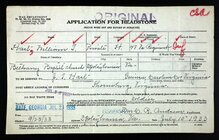
I've seen a few applications for headstone from my own ancestors. They were all filled out by an "applicant". Most of the time, a descendent. From the looks of the ones I've personally seen, it appears that, info given by applicant is verified, than issued. I come to these conclusions by the red check marks I've seen, as if they were checking off the information as verified.

So if a person served in multiple units, I would imagine the info on the application is what is engraved on the stone
 
Here is one for reference....
 

Attachments

  • headstone app.jpg
    headstone app.jpg
    323.5 KB · Views: 116
It was not uncommon that a given soldier may have served in more than one unit. Those that were mid-later war enlistee's into an already existing unit... Once that units enlistment time expired for the majority, they were discharged. Those still with service obligation time remaining, and/or reenlisted would typically be transferred into another unit.

The early VA gravestones were for those buried in the National Cemeteries. These usually only had the subjects, name, rank, and what state they served from. Later versions would include a unit ID, as well as the stones were made available for those buried in other cemeteries. They were commonly ordered after they were buried by family members, Cemetery staff, or GAR. Whatever information was put on the request card was verified, and if approved, then the order for the stone placed with one of the stone contractors at the time. They usually would go by whatever unit was put on the card. If that person was confirmed to have served in that unit at any point, that's what usually went through. Of course mistakes were not uncommon, from what was ordered to what the stone actually had on it sometimes wasn't the same.. Incorrect initials, misspellings, or wrong state or unit ID was not totally rare to encounter, especially with the earlier stones. Verification cross checking quality control appeared to be non-existent in those earlier days. Have found lots with incorrect information on them.

Gravestones that were private purchased and not via the VA govt ordered-provided ones... you could basically put whatever you wanted on it. Many already did so before the govt stones were extended to be provided to private/local cemeteries.
 
Here's what the early applications looked like (pretty simple):

Scan0001.jpg


This is one for my cemetery. Note that the cemetery name is Laurel Hill. There was no such cemetery (it was Jacksonville Cemetery) but laurel hill is what the locals called the hill on which the cemetery is located (due to the large number of pacific madrone trees - colloquially referred to as laurel). So, it was a bit loose in the early days.
 
You did have to have proof of unit service to put that on a stone. The last unit served in is always easiest to document
 

Learn About Us
About CivilWarTalk
Contact the Webmaster
Meet the Staff
Link to CivilWarTalk
Join Our Community
Register
Browse Forums
View Today's Discussions
Search the Forum
Get Help
FAQ
Student Guide
Forum Rules & Etiquette
Copyright / DMCA

     Contact Us CivilwarTalk on Facebook CivilWarTalk on YouTube CivilWarTalk on Twitter RSS Feed

Bringing the American Civil War and More to Life.
© 1999 - , CIVILWARTALK, LLC - Site Version 10.0

SlaveryTalk.com - SecessionTalk.com - CivilWarTalk.com - ReconstructionTalk.com
Back
Top