★ ★  Pope, John

John Pope

Born: March 16, 1822
Pope 1.jpg


Birthplace: Louisville, Kentucky

Father: Judge Nathaniel Pope 1784 – 1850
(Buried: Bellefontaine Cemetery, Saint Louis, Missouri)​

Mother: Lucretia Backus 1787 – 1867
(Buried: Bellefontaine Cemetery, Saint Louis, Missouri)​

Wife: Clara Pomeroy Horton 1834 – 1888
(Buried: Bellefontaine Cemetery, Saint Louis, Missouri)​

Married: September 15, 1859 in Meigs, Ohio

Children:
Horton Pope 1864 – 1953​
(Buried: Fairmount Cemetery, Denver, Colorado)​
Brig. General Francis Horton Pope 1876 – 1971​
(Buried: Arlington National Cemetery, Arlington, Virginia)​

Education:
1842: Graduated from West Point Military Academy – (17th in class)​

Occupation before War:

1842 – 1846: Brevet, 2nd Lt. United States Army, Topographic Engineers
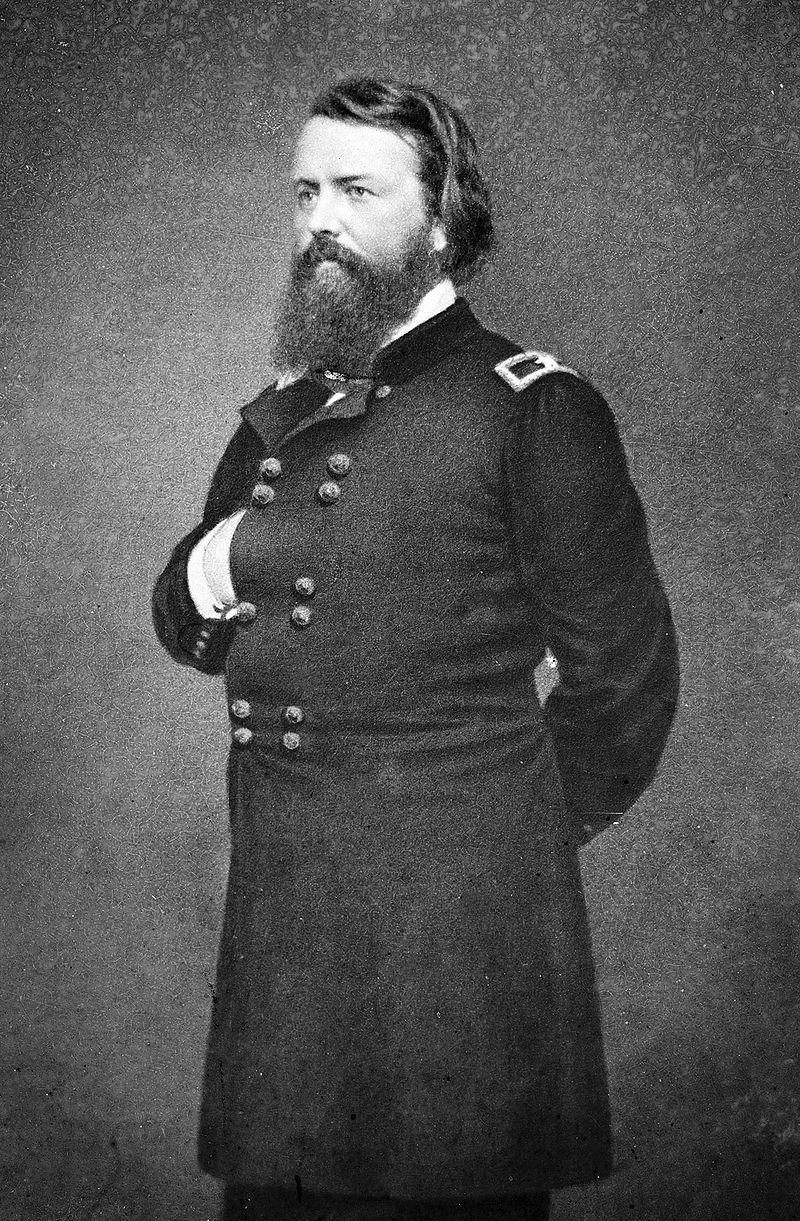
Pope.jpeg
1846 – 1853: 2nd Lt. United States Army, Topographic Engineers​
1846: Brevetted, 1st Lt. for Gallantry at Battle of Monterrey, Mexico​
1847: Brevetted, Captain for Gallantry at Battle of Buena Vista, Mexico​
1851 – 1853: Chief Topographic Engineer, Department of New Mexico​
1853 – 1856: 1st Lt. United States Army, Topographic Engineers​
1856 – 1862: Captain, United States Army, Topographic Engineers​

Civil War Service:

1856 – 1862: Captain, United States Army, Topographic Engineers​
1861: Mustering Officer for Union Army in Chicago, Illinois​
1861 – 1862: Brigadier General Union Army Volunteers, Infantry​
1861: Commander of Union Army, District of North Missouri​
1861 – 1862: Commander of Union Army, District of South Missouri​
1861: Capturer Provisions and Prisoners at Blackwater, Missouri​
1862: Union Army Commander of Army of the Mississippi​
1862: Union Army Commander, Battle of New Madrid, Missouri​
1862 – 1866: Major General of Union Army Volunteers, Infantry
Pope 2.jpg
1862: Commander of left Wing of Halleck's Army at Corinth, Mississippi​
1862 – 1882: Brigadier General in United States Army​
1862: Commander of Union Army of Virginia​
1862: Unsuccessful Union Army Commander, 2nd Battle of Bull Run​
1862: Relieved himself of Command of Army of Virginia on Sept. 12th
1862 – 1865: Union Army Commander, Department of the Northwest​
1865: Union Army Commander, Military Division of the Missouri​
1865: Brevetted Major General for his role at Battle of Island No. 10​
1865 – 1866: Union Army Commander, Department of the Missouri​
1866: Mustered out of Volunteer Service on September 1st

Occupation after War:

1862 – 1882: Brigadier General in United States Army​
1867: Commander of Third Military District​
1868 – 1870: Commander United States, Army Department of Lakes​
1870 – 1883: Commander United States, Army Department of Missouri​
1882 – 1886: Major General in United States Army​
1883 – 1886: Commander United States, Army Dept. of California​
1886: Retired from United States Army on March 16th
1886 – 1892: Resident of Saint Louis, Missouri​

Died: September 23, 1892

Place of Death: Sandusky, Ohio

Age at time of Death: 70 years old

Burial Place: Bellefontaine Cemetery, Saint Louis, Missouri
 
Last edited by a moderator:
Following his relief from the command of the Army of Virginia, Pope was assigned to command the newly formed Department of the Northwest where he oversaw the end of the Dakota War in Minnesota and the Dakota Territory. He oversaw the harsh measures taken against the Indians after the fighting ended which included 303 death sentences handed down by a military tribunal (Lincoln commuted most of them). His attitude is shown in the following extract of a letter he sent to BG Henry H. Sibley:

"The horrible massacres of women and children and the outrageous abuse of female prisoners, still alive, call for punishment beyond human power to inflict. There will be no peace in this region by virtue of treaties and Indian faith. It is my purpose utterly to exterminate the Sioux if I have the power to do so and even if it requires a campaign lasting the whole of next year. Destroy everything belonging to them and force them out to the plains, unless, as I suggest, you can capture them. They are to be treated as maniacs or wild beasts, and by no means as people with whom treaties or compromises can be made."
 
Address to the new Army of Virginia in July, 1862. Has a "Patton" flavor, apparently did not go over well.


Let us understand each other. I have come to you from the West, where we have always seen the backs of our enemies; from an army whose business it has been to seek the adversary and to beat him when he was found; whose policy has been attack and not defense. In but one instance has the enemy been able to place our Western armies in defensive attitude. I presume that I have been called here to pursue the same system and to lead you against the enemy. It is my purpose to do so, and that speedily. I am sure you long for an opportunity to win the distinction you are capable of achieving. That opportunity I shall endeavor to give you. Meantime I desire you to dismiss from your minds certain phrases, which I am sorry to find so much in vogue amongst you. I hear constantly of "taking strong positions and holding them," of "lines of retreat," and of "bases of supplies." Let us discard such ideas. The strongest position a soldier should desire to occupy is one from which he can most easily advance against the enemy. Let us study the probable lines of retreat of our opponents, and leave our own to take care of themselves. Let us look before us, and not behind. Success and glory are in the advance, disaster and shame lurk in the rear. Let us act on this understanding, and it is safe to predict that your banners shall be inscribed with many a glorious deed and that your names will be dear to your countrymen forever

— John Pope, message to the Army of Virginia
 
After the battle of Buena Vista in 1847, Lieutenant John Pope and a friend, "kidnapped two Mexican women, one only 14 years old… for carnal purposes. [These girls]… live with them now, and ride [throughout] the city with them in defiance of decency in an open carriage."

Letter from Braxton Bragg to Samuel French, 13 October 1847.
 
Pope did a good job out west and was well thought of by Sherman and Grant. Cozzen's biography of Pope is interesting and while exposing Pope's warts it also shows him as a man who learned from his mistakes and served his country well. He also was more sympathetic to the Indians than his reactions to the Great Sioux Rebellion indicate. And the Sioux did get rather out of hand.
 
In case you missed it the first time around in 1998 (So many books; so little time!), here is the book Irishtom29 referenced above:

The Military Memoirs of General John Pope edited by Peter Cozzens and Robert I. Girardi

 
He's the one who said his headquarters would be in the saddle.This led to the quip that he didn't know his headquarters from his hindquarters.I'm sure most readers can figure out the meaning of that cleaned up version.
 
Last edited:
In case you missed it the first time around in 1998 (So many books; so little time!), here is the book Irishtom29 referenced above:

The Military Memoirs of General John Pope edited by Peter Cozzens and Robert I. Girardi


Thank you, LL, though I was referring to this book...


Learn About Us
About CivilWarTalk
Contact the Webmaster
Meet the Staff
Link to CivilWarTalk
Join Our Community
Register
Browse Forums
View Today's Discussions
Search the Forum
Get Help
FAQ
Student Guide
Forum Rules & Etiquette
Copyright / DMCA

     Contact Us CivilwarTalk on Facebook CivilWarTalk on YouTube CivilWarTalk on Twitter RSS Feed

Bringing the American Civil War and More to Life.
© 1999 - , CIVILWARTALK, LLC - Site Version 10.0

SlaveryTalk.com - SecessionTalk.com - CivilWarTalk.com - ReconstructionTalk.com
Back
Top